
The bottom-line holding in the U.S. Court of Appeals’ recent opinion in Appalachian Voices v. Fed. Energy Reg. Comm’n, No. 24-1094 (June 6, 2025), that FERC was ok when it allowed a pipeline company an extension of time to complete the project isn’t all that surprising. And indeed, it isn’t all that interesting except
CA8: Local Ordinances Regulating Pipelines Are Preempted By State And Federal Pipeline Law
A short one from the U.S. Court of Appeals for the Eighth Circuit.
In Couser v. Shelby County, No. 23-3758 (June 5, 2025), the court held that local ordinances which were adopted after a pipeline company announced plans to build a project to move carbon dioxide across several states (and presumably designed to make
CA8: Private Delegee Of Federal Eminent Domain Power Does Not Owe Attorneys Fees Even If State Law Requires
A short one from the U.S. Court of Appeals for the Eighth Circuit.
The caption of WBI Energy Transmission, Inc. v. 189.9 rods, No. 24-1693 (Mar. 24, 2025), should tell you that this is a private-delegation federal taking, and indeed it is. Another Natural Gas Act taking by a private pipeline company.
After WBI
CA4: Owner With Personal Knowledge Can Testify About Value Of Her Land
As the title should inform you, Mountain Valley Pipeline, LLC v. 0.32 Acres of Land, No. 23-1935 (Jan. 27, 2025) is a federal taking. Here, a taking where a private pipeline condemnor is exercising the delegated federal power of eminent domain under the Natural Gas Act.
The issue we’re focusing on in this
Breaking News: Come Join Us For The 42d ALI-CLE Eminent Domain & Land Valuation Litigation Conference, San Diego, Jan 30-Feb 1
With our tongues firmly planted in cheeks, the Planning Chairs for the upcoming 42d edition of this popular and venerable Conference bring you this “breaking news” report from San Diego!
As you know, in addition to being the best nationally-focused conference on the subjects that we love and a venue that is nearly certain to have some of the warmest winter weather in the continental United States, and we went on-location from some of the local highlights: the beaches, Torrey Pines, the Zoo, Balboa Park, the Gaslamp Quarter, and Coronado to name but a few.
More about the Conference here, including registration information.
Here are some of the highlights:
- Property Rights at the Supreme Court: DeVillier and Sheetz and What’s Next
- Slow Take: Possession, Rent, Relocation, and Offset
- The Jury’s View: How Jurors See Your Case
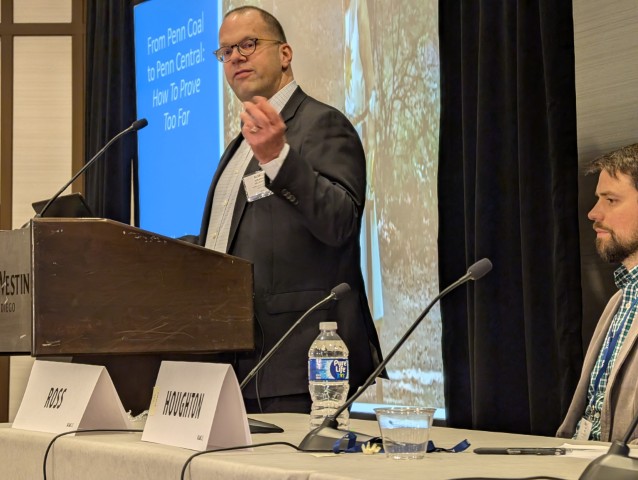
- From Penn Coal to Penn Central: How to Prove “Too Far”
- Leveraging Expertise in Eminent Domain Litigation: Working with Land Planners, Engineers, and Other Predicate Experts
- Kelo at Twenty: What Changed, What Didn’t, and What’s on the Horizon
- Viva Las Vegas: How the Nevada Judiciary Upheld Property Rights in 180 Land’s Inverse Condemnation Taking
- Ethics: Guiding the Trolley: Perspectives on Professional Ethics in Eminent Domain for Lawyers, Appraisers, and Right of Way Agents
- “I Think I Shall Never See” Just Compensation For a Tree: Strategies to Securing Recovery for Trees, Crops, and Fixtures
And more. Check out the complete agenda here. Registration information here.
We especially welcome first-time participants, or those returning after an absence. Connect (or reconnect) with your colleagues from across the nation.
The 41st Conference was in New Orleans. Here’s a report of that event, and here are our reports from prior conferences in Austin and Scottsdale.
Don’t miss out on San Diego: we have had record attendance in recent years, so hold your space now. #EminentDomain2025
Continue Reading Breaking News: Come Join Us For The 42d ALI-CLE Eminent Domain & Land Valuation Litigation Conference, San Diego, Jan 30-Feb 1Iowa: Statute Permitting Precondemnation Surveyor Entry Is “pre-existing limitation on … title”
The latest state supreme court decision involving a takings challenge to a statute permitting precondemnation entries, this time from Iowa.
In Summit Carbon Solutions, LLC v. Kasischke, No. 23-1186 (Nov. 22, 2024), the Iowa Supreme Court concluded that, at least on its face, Iowa’s entry statute for hazardous liquid pipelines, which permits
Registration For The 42d ALI-CLE Eminent Domain & Land Valuation Litigation Conference Is Underway (Don’t Miss Out!)

Get ready to join your colleagues and friends in San Diego for the 42d ALI-CLE Eminent Domain & Land Valuation Litigation Conference.
The 41st Conference was in New Orleans. Here’s a report of that event, and here are our reports from prior conferences in Austin and Scottsdale.
Here are some of the
Nevada: Private-to-Private Takings By Privately-Owned Utilities Are OK, Even Though State Constitution Prohibits “transfer … from one private party to another”
Those of you who are students of eminent domain and the public use requirement know that in Berman v. Parker, 348 U.S. 26 (1954), the Court (in)famously held, “when the legislature has spoken, the public interest has been declared in terms well nigh conclusive.”
Not only was the Court in Berman signalling that it
CA4: Jury Is Free To Cut-And-Paste Various Just Compensation Evidence To Reach A Verdict “Within the range of credited testimony”
Check out the U.S. Court of Appeals for the Fourth Circuit’s opinion in Mountain Valley Pipeline, LLC v. 8.37 Acres of Land, No. 23-1532 (May 14, 2024).
The caption tells you it is a federal eminent domain case, specifically the Mountain Valley Pipeline, a very controversial and much-objected-to natural gas pipeline in the Virginias.
Pass A Good Time: Our Report From The 41st ALI-CLE Eminent Domain & Land Valuation Litigation Conference, Feb 1-3, 2024, New Orleans
When it comes to the longstanding ALI-CLE American Law Institute-CLE Eminent Domain and Land Valuation Litigation Conferences, we’re always ready to go. You know that. But this year’s version — the 41st — was buzzing like no other in recent memory.
Maybe it was the New Orleans venue with its atmo, food, and music for