A quick one from the South Dakota Supreme Court. But it is well worth your time.

In City of Sioux Falls v. Johnson Properties, LLC, No. 30945 (Nov. 19, 2025), the court upheld a trial court’s award of attorney’s fees to a property owner in an eminent domain action. The final amount of compensation exceeded the 20% threshold under South Dakota law that triggers fee shifting, and the Supreme Court concluded that even though the amount of fees awarded exceeding the “lodestar” calculation, the owner was entitled to an enhancement.
Here’s the court’s description of the critical action and numbers in the trial court:

[¶6.] Shortly before trial, the City increased its offer of compensation to
$250,000. Johnson Properties rejected the offer and the case proceeded to a three-day jury trial on the issue of just compensation. At trial, Johnson Properties’
appraiser testified that, in his opinion, the

Continue Reading South Dakota: Eminent Domain “is a highly specialized area of law that requires skill and experience…” Meriting Attorney’s Fee Lodestar Enhancement

A short one from the U.S. Court of Appeals for the Eighth Circuit. 

The caption of WBI Energy Transmission, Inc. v. 189.9 rods, No. 24-1693 (Mar. 24, 2025), should tell you that this is a private-delegation federal taking, and indeed it is. Another Natural Gas Act taking by a private pipeline company. 

After WBI and a property owner couldn’t agree on selling a strip of land for a natural gas pipeline, WBI filed a federal condemnation action under the NGA. Eventually the parties settled on the amount of just compensation owing for the land. 

Under North Dakota law, a property owner is entitled to attorneys fees. So the owner here asserted it was entitled to such fees as part of the property. After all, full indemnity is part of its property rights, no? The District Court agreed, concluding that WBI was on the hook. 

If this all sounds

Continue Reading CA8: Private Delegee Of Federal Eminent Domain Power Does Not Owe Attorneys Fees Even If State Law Requires

Hyatt

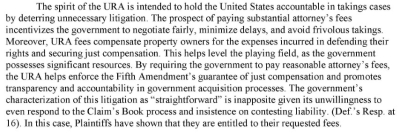
One from the U.S. Court of Federal Claims that is worth your time at least to skim. And the opinion is worth reading if only for the court’s conclusion which we’ve reproduced above.

Hyatt v. United States, No. 23-399 (Jan. 16, 2025) is, as the court described it, “a typical rails-to-trails action[.]” The issue resolved here was how much the property owners were entitled to recover in attorneys fees and expenses, now that they prevailed on the merits.

Under the Uniform Relocation Act, a property owner who obtains compensation for a regulatory taking may recover reasonable attorneys fees and costs. The opinion noted:

Specifically, in actions brought under the Tucker Act or the Little Tucker Act in which a plaintiff is compensated for the taking of property, the URA provides for the recovery of “such sum as will in the opinion of the court or the Attorney General reimburse

Continue Reading CFC: Attorneys Fee Shifting “incentivizes the government to negotiate fairly, minimize delays, and avoid frivolous takings”

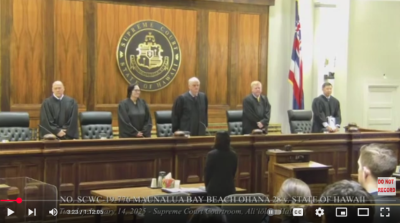
Screenshot 2025-01-18 at 14-58-03 No. SCWC-19-0000776 January 14 2025 10 30 a.m. Maunalua Bay v. State of Hawaiʻi - YouTube

Here’s the latest in a case we’ve been following for a long time.

As we previously noted, the Hawaii court of appeals affirmed a trial verdict that the just compensation owed to littoral property owners for the State’s regulatory taking of small portions of accreted beach is zero.

Last week, the Hawaii Supreme Court heard oral arguments. Here’s the video (sorry, can’t embed it here). Worth watching, if only because questions of just compensation and how it is calculated rarely are presented to this court (which is a frequent flyer in regulatory takings cases).

Here’s a description of the case and issues from the Hawaii Judiciary:

Petitioners Maunalua Bay Beach Ohana 28, Maunalua Bay Beach Ohana 29, and Maunalua Bay Beach Ohana 38 brought an inverse condemnation action against the State of Hawai‘i in 2005. At that time, they argued that the State effected a taking of accreted lands via Act 73 of 2005. In 2009, the Intermediate Court of Appeals (ICA) held that Act 73 “effectuated a permanent taking of littoral owners’ ownership rights to existing accretions to the owners’ oceanfront properties that had not been registered or recorded or made the subject of a then-pending quiet-title lawsuit or petition to register the accretions.” Maunalua Bay Beach Ohana 28 v. State, 122 Hawai‘i 34, 57, 222 P.3d 441, 464 (Ct. App. 2009).

On remand from the ICA, Petitioners sought just compensation for the alleged temporary taking of their accreted lands between 2005 and 2012. At trial, the circuit court concluded that $0 was just compensation for the alleged temporary taking of the accreted land and no nominal damages should be awarded to the petitioners. It also determined that the petitioners were not entitled to attorney’s fees.

The ICA affirmed the circuit court’s decision. With regard to attorney’s fees, the ICA held that the petitioners’ “claim for attorneys fees against the State for obtaining declaratory relief is barred by sovereign immunity.” The ICA further held that the Ohanas were not entitled to attorney’s fees under the private attorney general doctrine.

In their application for certiorari, the petitioners argue that the ICA erred in affirming the circuit court’s award of $0 in just compensation with no nominal or severance damages. Petitioners also contend that the ICA erred by concluding that sovereign immunity bars an award of attorney’s fees, and that they would not be entitled to fees under private attorney general doctrine. The State contends that the ICA did not err in affirming the circuit court’s award of $0 in just compensation or declining to award nominal damages to petitioners. It also argues that the ICA correctly held that sovereign immunity bars petitioners’ claim for attorney’s fees, and that even if it did not, petitioners would not be entitled to attorney’s fees under the private attorney general doctrine.

We watched live, and have a couple of thoughts:

  • Justice McKenna’s questions indicate she recalls that in an earlier regulatory takings case, the court concluded that even “speculation value” was enough to place a regulatory takings claim outside a Lucas wipeout analysis, an indicator that in this court’s view, property always has value, even if it has no use. Is that enough to say the owners here were entitled to, at the very least, nominal just compensation?
  • Does obtaining a decision holding the State to its constitutional obligation (after which the State repeals the unconstitutional statute) qualify the plaintiff for fee recovery from the State under the private attorney general doctrine, even where the adjudicated compensation is zero? We think so, because suing to keep the State in line when it has acted beyond its authority is exactly the kind of thing that the Attorney General should do (but didn’t here, because it has been too busy defending the State’s action). What about the advocate for the State who argued that there was no constitutional wrong here, because of the zero compensation verdict (the notion that the Takings Clause does not prohibit takings, only uncompensated takings)? The fact that the State withdrew the offending statute after the plaintiffs won the takings claim seems to contradict that argument because at the heart of it, the court ruled that the State should have used its eminent domain power to take future accreted land, and not the police power.

Stay tuned. We’ll continue to follow along and will post the court’s opinion when issued.Continue Reading Hawaii Supreme Court Arguments: Is Just Compensation For Even A Small Slice Of A Primo Hawaii Beach Zero?

PXL_20241004_152452877.MP
Lawprof Ilya Somin (GMU Law), Mercatus Center’s Charles Gardner,
and lawyer Emily Cruikshank Bayonne (Tubman Realty, LLC)
speaking on “
How Policy Changes Can Address Incursions on
Property Rights Where Courts Have Failed to do So.”
Jim Burling (PLF) moderating.

Recently, we attended a wonderful symposium co-sponsored by George Mason Law School’s Journal of Law, Economics & Policy (congratulations to the student editors who ran the show that day), and our outfit Pacific Legal Foundation. Of course, with the subject being “Imagining the Future of Regulatory Takings,” how could we resist attending?

If you missed it, it was not recorded unfortunately. But stay tuned for the full published symposium issue which shall include all of the articles and other pieces the speakers presented that day.

PXL_20241004_130701595.MP
PLF’s Ethan Blevins kicked off the day by
urging the speakers and the audience to
“make property rights cool again.”

PXL_20241004_182439511.MP
Brian Hodges

Continue Reading Imagining The Future Of Regulatory Takings: “Making Property Rights Cool Again”

On the surface, the Virginia Court of Appeals’ opinion in Town of Iron Gate v. Simpson, No. 1588-23-3 (Sep. 17, 2024) deals with a straightforward issue in a straightforward way: the property owner’s inverse complaint adequately alleged that the Town’s flooding of her property was for a public use, and thus properly survived the Town’s demurrer.

As the Virginia Supreme Court has held, one of the elements of pleading a legally-adequate inverse condemnation complaint for flooding is an allegation that the flooding was for some public use. The court of appeals rejected the Town’s argument that Simpson failed to allege public use, holding that the complaint’s allegation that the Town “used her ‘property as a ‘makeshift storage site for excess stormwater,’ which was accomoplished for the public use of maintaining and operating the Town’s stormwater system[,]'” was certainly good enough:

She alleged that the Town “purposefully uses, operates

Continue Reading Va App: It Doesn’t Take Much To Allege Public Use In Inverse Condemnation

You all have likely seen ’em, those “We Buy Houses Any Condition” billboards letting the world know that no matter what condition it might be in, there’s an outfit that says it is willing to buy your house.

Well, that outfit ran into the one other outfit that is willing to buy your house, except here, that outfit can force you to sell it. That’s right, the government. In this case, the City of Ontario, California, exercising its power of eminent domain. (As someone once famously described the power of eminent domain: “whether you know it or not, your house is for sale.”)

The city went through the usual motions to forcibly take “multiple vacant lots” next to the Ontario International(!) Airport which it claimed were blighted:

In 2021, the City held a public hearing, after which the city council adopted a resolution of necessity authorizing the City to

Continue Reading Blight Slight: No Taking Of Property For “The Proposed Project” When No Project Has Been Proposed

This is a short one, and the title of this post pretty much sums up the Minnesota Supreme Court’s opinion in State of Minnesota v. Schaffer, No. A23-0036 (June 20, 2024).

The case addressed a frequently-occurring issue in jurisdictions which permit some kind of fee recovery in eminent domain cases. Where a statute permits a property owner to recover “reasonable” attorney fees, how is the recovery calculated? By the usual “lodestar” formula (reasonable time x reasonable fee), or is it limited by the actual contractual arrangement between the property owner and her lawyer (in this case a contingency fee that resulted in a fee less than a lodestar-determined fee). 

The court held rejected MDOT’s argument fee recovery under the statute “cannot exceed the amount owed to the landowner’s attorney in a contingency fee agreement[.]” Slip op. at 2. The court held:

We reiterate what we held in Cameron: the

Continue Reading Statutory Fee Recovery In Minnesota Condemnations Not Limited By Contingency Fee Agreement

Here’s one we’ve been meaning to post for a while, the Ontario (Canada) Land Tribunal’s opinion in 13538 Ontario Inc. v. City of Stratford, No. OLF-22-002455 (Jan. 11, 2024), where the court resolved a dispute between the parties in an expropriation (eminent domain) case over which owed the other costs. 

Now that isn’t our area of expertise at all, but we were intrigued after our Toronto colleagues Shane Rayman and Conner Harris sent it our way.

The matter before the Tribunal was the penultimate chapter in an interminable legal battle, of nearly Dickensian proportions, relating to the expropriation by the City of Stratford (“City”) of the lands of the historic Grand Trunk Railroad Repair Shops. This tale features a hard fought legal battle over many years, a monstrous narrative with many subplots, the tragic death of the central protagonist whose vision for the Cooper site never came to fruition

Continue Reading Canadian Court Resolves A Very Un-Canadian Expropriation Beef