In Grand v. City of University Heights, No. 24-3876 (Nov. 13, 2026), the U.S. Court of Appeals for the Sixth Circuit held that a complaint alleging a RLUIPA claim and others was not ripe because they are “land use” claims subject to Williamson County‘s final decision requirement.

A neighbor was “displeased” that Grand was using his home to hold a “shul,” which “in Hebrew refers to a synagogue or a house where prayers are held.” Slip op. at 2. The city told him to stop because his use as “a place of religious assembly” violated the zoning code (his home is zoned U-1, which doesn’t allow such uses).

Grand applied for a Special Use Permit, which would allow him to make the use as a “house of worship.” The Planning Commission had a hearing, but didn’t make a decision. It “tabled the discussion, requesting more details

Continue Reading CA6: RLUIPA Claim Subject To Williamson County Final Decision Ripeness Because It’s A “Land Use” Issue

In State ex rel. Boggs v. City of Cleveland, No. 2025-Ohio-5094 (Nov. 13, 2025), the Ohio Supreme Court held that the City of Cleveland could be liable for inversely condemning land, even though that land is not in the City of Cleveland.

The city claimed that in order to be liable for inverse condemnation, it must have the authority to take the property by eminent domain. And under Ohio law, the state has only delegated to the city the power to take by eminent domain property that is within the city’s geographic boundaries. Therefore, the city argued, if we can’t affirmatively take the plaintiff’s land, we can’t be liable for inversely condemning it.

The case involves the Cleveland airport. As part of its runway expansion, airplanes would fly over adjacent properties (obviously), including properties outside the city’s jurisdiction. The city was authorized to purchase avigation easements on some

Continue Reading Ohio: City Can Be Liable For Inverse Condemnation Of Land Outside Its Geographic Jurisdiction

Yes, the mysterious ducks remain — and seem to have multiplied.

It’s that time of the year again. Fall’s-a-coming, and that means that starting today, we’re back at the William and Mary Law School in Williamsburg, Virginia to teach two courses:

  • Eminent Domain and Property Rights (W&M is one of the few law schools in the country that offer a course in eminent domain, just compensation, and takings)
  • Land Use Controls (an especially hot topic at the moment)

The registration numbers for both courses are good (really good), and two full classrooms of Dirt Law goodness tells us something about this area of law — it’s really interesting, and a good place to make your way in the practice, and law students recognize that.

PXL_20240819_121031630.MP
We don’t use $400 casebooks in either class.

Time to jack back into the (takings and land use) Matrix.

6a00d83451707369e20240a476d216200c-800wi
Continue Reading Back To School For Dirt Law @ William & Mary, Season 8

PXL_20250624_180653444.MP

The room where it happened.

We’re not going to say much about the California Court of Appeal’s recent decision in Sheetz v. County of El Dorado, No. C093682 (July 29, 2025), which is back in the California court system after remand from the U.S. Supreme Court, because it is one of ours.  

Here’s the bottom line:

Upon further analysis as directed by the Supreme Court, we now conclude that the challenged permit condition (TIM fee) does not constitute an unlawful monetary exaction under the Nollan/Dolan test. The legislatively formulated generally applicable impact fee is not an unconstitutional condition imposed on land use in violation of the Fifth Amendment’s takings clause. Accordingly, we again affirm the judgment.

Slip op. at 5.

We don’t necessarily agree 100% with our colleague Ben Rubin’s assessment, but do urge you to read his piece, “California Court of Appeal Confirms Legislatively Enacted

Continue Reading Sheetz On Remand: “The legislatively formulated generally applicable impact fee is not an unconstitutional condition imposed on land use in violation of the Fifth Amendment’s takings clause.”

Kelo site Ft Trumbull
Over there is where the “little pink house” was.
July 26, 2025.

Regular readers know that from time to time, we make what we call property or takings pilgrimages to the sites of famous cases. Inter alia: Kaiser Aetna, Nollan, Dolan, Loretto, Penn Central, Hadacheck, the High Line, Boomer.

Included in that are eminent domain cases of course, including Chicago Burlington, and Berman. 

With the recent 20th anniversary of Kelo v. City of New London just past, we thought it appropriate to revisit the site when we were in the neighborhood to see what’s up and what “progress,” if any, New London has made in effecting those plans it claimed to have, which necessitated the taking of Susette Kelo’s “little pink house.” For Professor Gideon Kanner’s thoughts on “Eminent Domain Projects That Didn’t Work Out

Continue Reading Property Rights Pilgrimage: The Kelo Property And House, Twenty Years On

Charlottesvillezoning

This interesting — and kind of funny — story has been circulating: “Judge’s ruling means Charlottesville has no zoning laws whatsoever right now.” 

What happened? Is the counter-Euclid revolution underway? Did the judge rediscover Nectow? Did Charlottesville voters decide to go Full Houston

No, nothing quite as dramatic. The story notes that the city’s attempt to adopt a new zoning code was held invalid. But, the story notes, the former zoning ordinance was repealed so that the new one could be adopted. With the former code ineffective and the new code invalidated … just like that, no zoning!

We haven’t checked, but we would not be surprised if the most popular search on WEXIS right now in the Blue Ridge is “Virginia /s vested /s rights or ‘estoppel.'”

In the meantime, the city has stopped processing new development applications, while claiming this is all

Continue Reading Houston Says ‘Welcome!’ – What Happens When Another City Has No Zoning?

Here’s the latest in an issue we’ve been following for a long time.

In Jackson v. Southfield Neighborhood Revitalization Initiative, No. 166320 (July 16, 2025), the Michigan Supreme Court re-confirmed its ruling in Rafaeli v. Oakland County, that the government “keeping the change” after liquidating property to satisfy a delinquent tax debt is a taking, rejecting the claim that transferring the property to a non-governmental organization does not relieve the government of its obligation to provide compensation. 

There’s a lot going on here, and we’re not wading into too much detail both because it is one of ours, but also because this one is Michigan-specific. But we will say that this case is a good example of a court viewing things pragmatically, and calling out government action that seeks to work around a constitutional ruling. 

Here’s the heart of the court’s holding:

In this case, the operative

Continue Reading Michigan: Gov’t Can’t Avoid A Rafaeli Taking Just By Having A Proxy Do It

In City of Dallas v. Dallas Short-Term Rental Alliance, No. 05-23-01309-CV (July 18, 2025), the Texas Court of Appeals affirmed a preliminary injunction, suspending operation of two ordinances which (1) restrict, and (2) require registration of short-term rentals in Dallas.

It’s a short opinion and up on appeal from interlocutory emergency relief, so there isn’t a ton there. But it is still worth reading because the court concludes the challengers have a likelihood of eventually showing that the ordinance restricting short-term renting violates “due-course-of-law” (aka substantive due process). Texas recognizes a property right in leasing property, and the owners here asserted they have a vested right to do so:

Under the circumstances, we conclude appellees Dallas Short Term-Rental Alliance, Sammy Aflalo, Vera Elkins, and Denise Lowry proved their probable right to relief against the City’s zoning ordinance under their due-course-of-law argument because they alleged they possessed well-established rights to

Continue Reading Tex App: Challengers Likely To Succeed On Due Course Of Law Claim For Short-Term Rental Ban

Euclidsymposium

With the 100th anniversary of Village of Euclid v. Ambler Realty Co. nearly upon us in 2026, we’ve put together a series of events designed to reexamine the case that set the stage for a century’s-worth of intense land use regulations and restrictions.

Are Euclid‘s assumptions and conclusions still valid? If the original separation-of-uses and nuisance-prevention rationale of zoning made sense, does that rationale apply when “zoning” has become the shorthand for extremely granular regulation of property’s uses? What of the role of judicial review and a return to Nectowian review? 

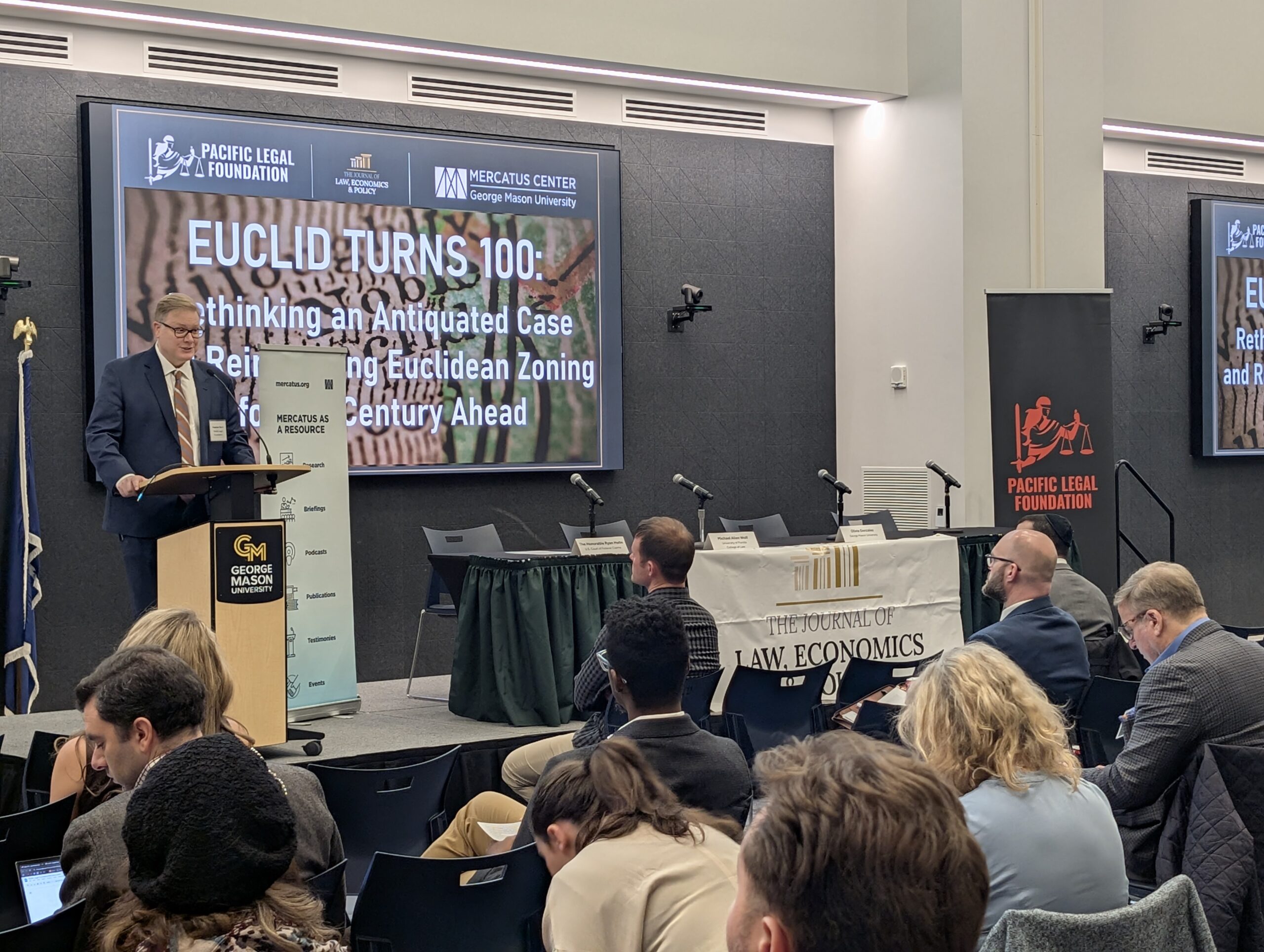
Our Euclid series begins with a call for papers, and a follow-up conference at which these articles will be presented and discussed. For more, see the call for papers: “Euclid Turns 100: Rethinking an Antiquated Case and Reimagining Euclidean Zoning for the Century Ahead.” The link also has a few suggestions about

Continue Reading Call For Papers: “Euclid Turns 100: Rethinking an Antiquated Case and Reimagining Zoning for the Century Ahead”

Sacto_votes

The above is the image Skynet returned when we
asked for a graphic for this post

The California Court of Appeal’s recent opinion in Dessins LLC v. City of Sacramento, No. C100644 (July 9, 2025) doesn’t deal with eminent domain or takings, but is about municipal fees and the way California requires these things get adopted. But we’re going to cover it, if only briefly. 

Why? Because it turns out that this decision tells us a lot about how California courts seem to look for any way to uphold exercises of government power. And when that power comes directly into conflict with the voters as it does here, one guess who wins.  

A bit of background for you non-Californians.

If you were to not have an understanding of the history of local fee collection and property taxation in California, you might be under the impression that it is pretty tough

Continue Reading One City, Many Votes: Cal App OK’s Municipal Sleight-of-Law To Permit City To Impose Fees… On Itself (And Others)