Property rights

Here’s the latest in an issue we’ve been on for a long time: whether government actions taken under the police power are categorically exempt from providing just compensation when those activities take or damage private property. In Blue 42 Organics, LLC v. Georgia Dep’t of Public Safety, No. S25G1493 (Sep. 9, 2026), the Georgia Supreme Court held no, and that the State was not categorically immune from an inverse condemnation claim just because the government damaged the property in the course of an apparently valid exercise of the police power.
Continue Reading Georgia: Invoking “Police Power” Doesn’t Automatically Evade Just Compensation When Govt Damages Private Property

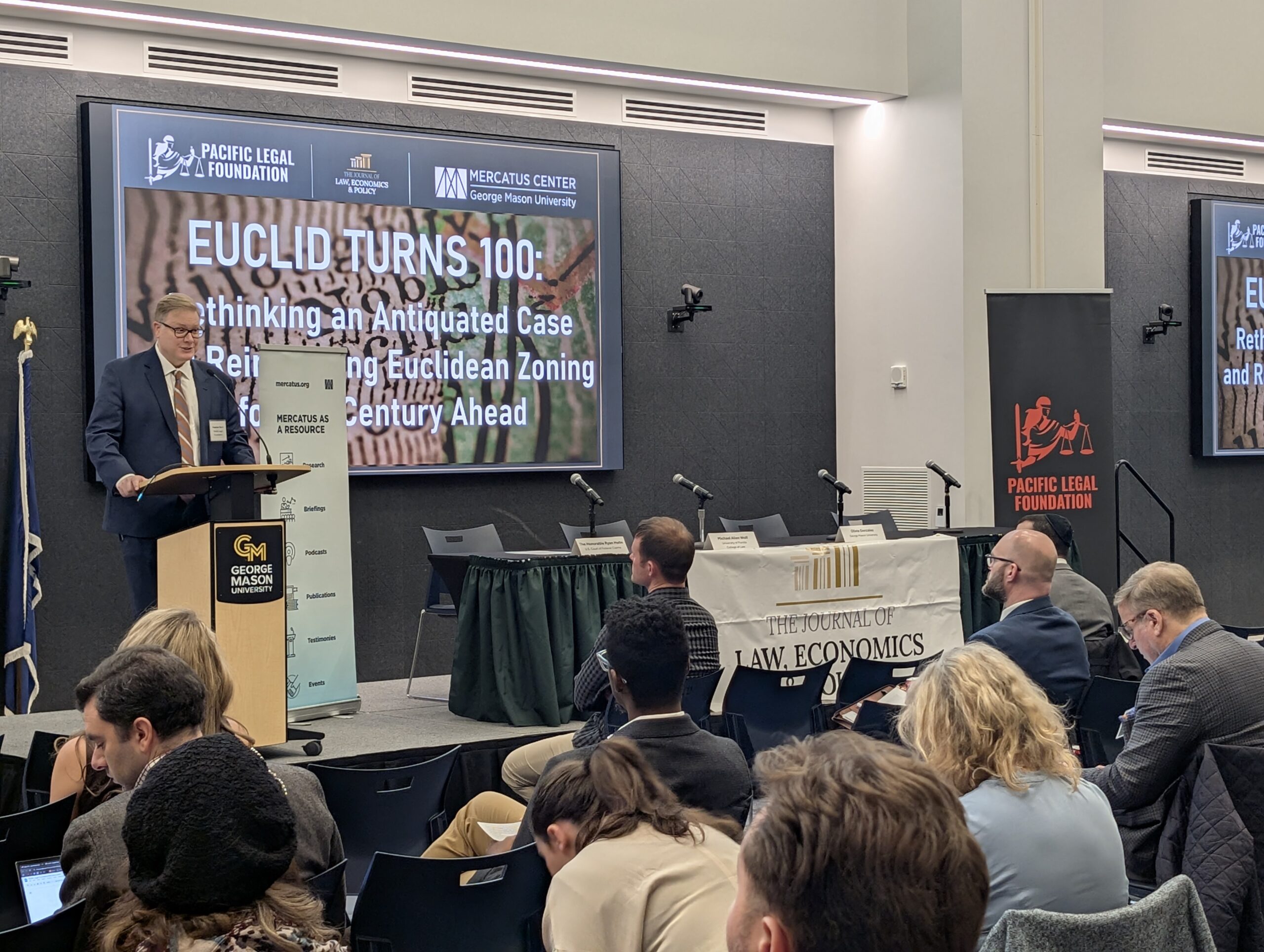
A couple of weeks ago, we (along with nationally renown zoning law expert lawprof Michael Wolf), offered our thoughts on “Euclid at 100,” the most most (in?)famous zoning case, now coming up on its 100th anniversary. The session was recorded and the Federalist Society has now posted it, so if you couldn’t make it live, here’s your chance.
Continue Reading Euclid at 100: The Past, Present, and Future of Zoning (Recording)

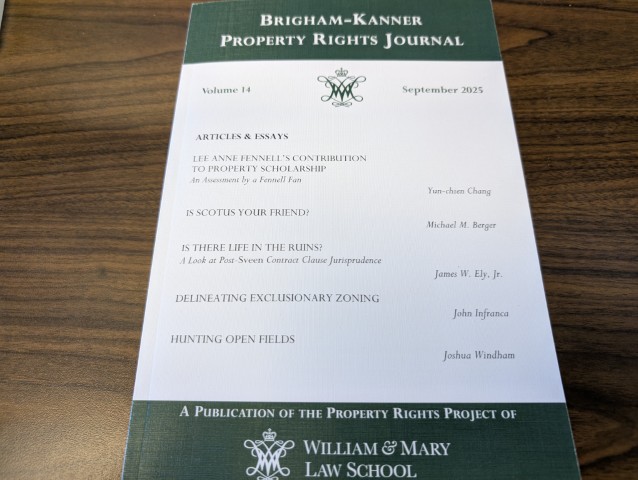
Spots are filling up, so if you are even thinking about it, here’s the complete agenda for the 2026 Brigham-Kanner Property Rights Conference, October 14-16, 2026, in London.
Continue Reading Still Time to Join Us For The 2026 Brigham-Kanner Property Rights Conference (Oct. 14-16, 2026, London)

But can a private for-profit energy company that admittedly does not possess the power of eminent domain force its way onto private property on the theory that it needs entry so the government can evaluate whether to delegate it the power of eminent domain? In PSEG Renewable Transmission LLC v. Arentz Family, LP, No. 25-1730 (Aug. 6, 2026), the U.S. Court of Appeals thought so.
Continue Reading CA4 Puts The Cart Before The Horse: Private Entity Doesn’t Have The Power Of Eminent Domain, But It Is Likely To Get It If Only Those Pesky Owners Were Stopped From Exercising Their Right To Exclude

Time to sign up for the upcoming “Unpacking Private Property’s Bundle of Sticks” Symposium, sponsored by our shop and George Mason Law Review. September 15, 2026, 12:15 – 5:45 p.m., Arlington, Virginia.
Continue Reading Register Now For “Unpacking Private Property’s Bundle of Sticks” Symposium (PLF & GMU Law Review) (Sep. 15, 2026)

Here’s the latest in a case we’ve been closely following (because we represent the property owners!). In this Memorandum and Order, the U.S. District Court for the District of Rhode Island invalidated the Town of Johnston’s ham-fisted attempt to take the property of a local family in order to move the current Town Hall from its present location in the center of town to the very outer border of the municipality, and build a new government complex. What is really going on is that this scheme only came about after the Town learned of the family’s plans to build affordable housing on their own land.
Continue Reading Town Has Not Been Delegated Eminent Domain Power And Can’t Just Make Up Its Own Procedures

Here’s the complete agenda for the 2026 Brigham-Kanner Property Rights Conference, October 14-16, 2026, in London. The Conference has gone international twice before (Beijing (2011) and The Hague (2016)). At the Conference, the Brigham-Kanner Property Rights prize will be presented to Professor James Penner, “whose scholarship has reshaped contemporary understandings of the nature and structure of property.” We’ll be speaking on “Property, Human Rights, and International Law” which will “consider how property rights are recognized, limited, and contested in international contexts.”
Continue Reading 2026 Brigham-Kanner Property Rights Conference Agenda (Oct. 14-16, 2026, London)

Not a lot that’s earthshaking from the Supreme Court of the Commonwealth of the Northern Mariana Islands in Sablan v. Commonwealth Utilities Corp., No. 2024-SCC-0023 (June 20, 2026), but we’re posting it because its holding — an entity lacking the power of eminent domain may nonetheless be liable for inverse condemnation — is important because it rightly concludes that the focus of the calculus in these cases is on the infringement of the property owner’s rights, not the technicalities of the government’s power.
Continue Reading “The constitutional duty to provide just compensation arises from the act of taking private property for public use, not the formal possession of eminent domain authority.” Entity Lacking Eminent Domain Power Can Be Liable For Taking Property

Here’s the cert petition (filed yesterday) which asks whether a takings challenge to rent control which is justiciable under Article III (plaintiff has suffered a concrete injury that is fairly traceable to the challenged restrictions, and a ruling will redress that injury) may nonetheless be dismissed because the court believes that if the owner would only continue to chase the government via its own administrative procedures, she might get relief (thus relieving the courts of the burden of making a ruling). That’s right, the “prudential ripeness” question that has divided the lower courts.
Continue Reading New Cert Petition (Ours): Can Courts Choose To Avoid Constitutional Challenges To Rent Control By Making Owners Chase Pointless Denials?