
Check out the transcript of the recent Supreme Court oral arguments in Wolford v. Lopez.
That’s the case challenging the Hawaii statute barring individuals from carrying concealed firearms unless the owner of the premises affirmative consents as a violation of the Second Amendment.
Recall that the Supreme Court has already held that you have a 2A self-defense right to strap up in public. The Ninth Circuit upheld the statute and split with the Second Circuit, prompting Supreme Court review.
While this case is catching the attention of the Second Amendment mavens, a review of the transcript shows that there’s a lot here for property types as well.
Let’s start with the Question Presented:
Whether the Ninth Circuit erred in holding, in direct conflict with the Second Circuit,
that Hawaii may presumptively prohibit the carry of handguns by licensed concealed carry
permit holders on private property open to the public unless the property owner affirmatively
gives express permission to the handgun carrier?
It doesn’t take much to see that the owner’s right to exclude (or include) is also in the mix, not just the rights of firearm possessor to go where he pleases. And a review of the transcript indeed shows that our favorite property right is at the core of the arguments. Even with the blue Justices. Do we like it when they argue that property rights rule the day? What do you think about this:
JUSTICE JACKSON: Right. But you’re –but — but I’m just suggesting that the historical presumption is about the consent, not about your rights. We agreed at the beginning, I thought — I thought there was a general consensus that your right to carry is limited to the permission of the owner when you’re talking about private property.
Like, you’ve –you’ve already agreed that the Second Amendment right is –is, I would say, subordinate, but, you know, in –in the panoply of rights, the right to exclude is superior because the owner can say no, you can’t bring this gun in here.
And so, once you’ve done that, these laws that are about licensing or, you know, implying that the owner has consented are all in the realm of property law, I think, and not in the realm of the Second Amendment anymore.
Tr. at 15-16.
Of course we like just about anything that upholds the right of the owner to choose whom to exclude or include. And to us, that seems to be the core of the property argument here. Should the State be in the business of adopting a presumption that, unless the owner expressly says “come on in, gun owners, I welcome you,” these persons are breaking the law if they enter private property (especially private property that has been opened to the public)? In our book, the state shouldn’t be making this choice for property owners.
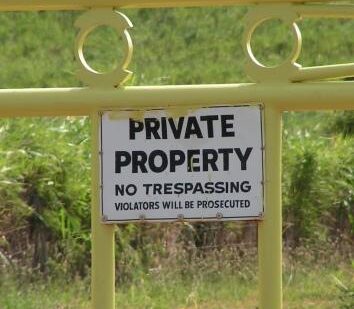
Is private property, private property, even if there’s not a sign that says “private property?” Of course. That should be the presumption.
And in the “dog that didn’t bark” department, you know what doesn’t make an appearance in the arguments (but probably should have)? That’s right, PruneYard.
It will be interesting to see if the right to exclude becomes a big part of the opinions in the case. Stay tuned.
Transcript, Wolford v. Lopez, No.24-1046 (U.S. Jan. 20, 2026)