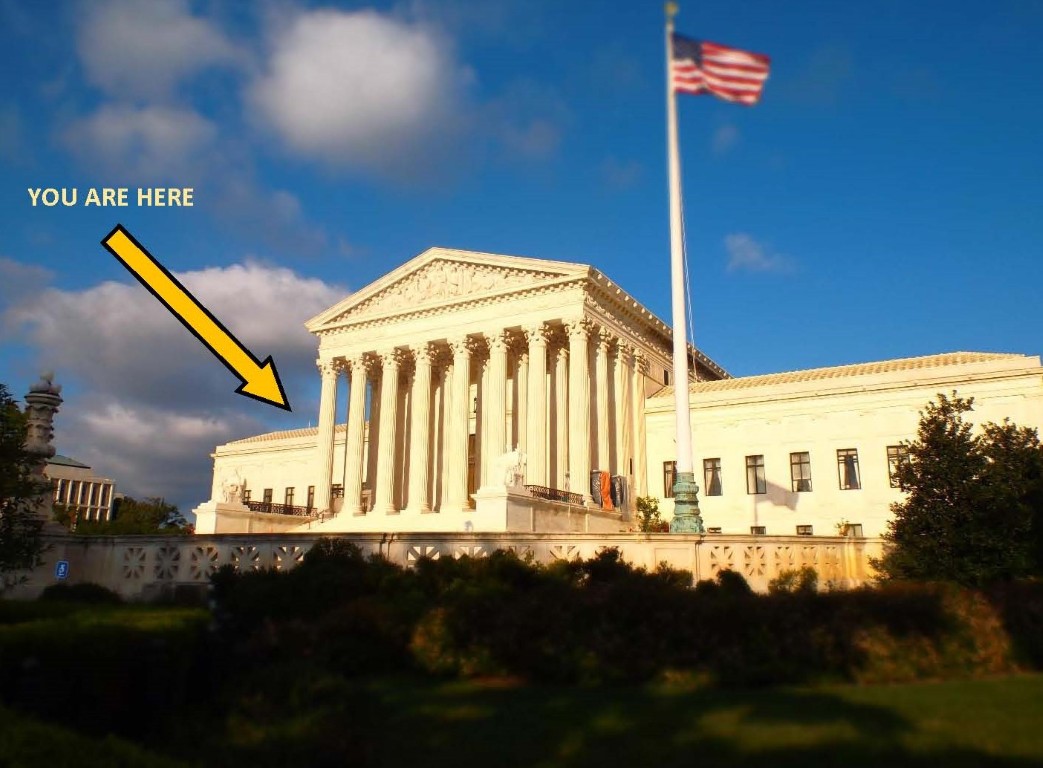
This just in: in this Order, the U.S. Supreme Court has granted certiorari and agreed to review two cases which involve property and property rights.

First, in Pung v. Isabella County, No. 25-95, the Court will be considering these Questions Presented:

1. Whether taking and selling a home to satisfy a debt to the government, and keeping the surplus value as a windfall, violates the Takings Clause of the Fifth Amendment when the compensation is based on the artificially depressed auction sale price rather than the property’s fair market value?

2. Whether the forfeiture of real property worth far more than needed to satisfy a tax debt but sold for fraction of its real value constitutes an excessive fine under the Eighth Amendment, particularly when the debt was never actually owed?

Here’s the cert petition in Pung. Note that the Court agreed to review the Excessive Fine

Continue Reading SCOTUS Grants Two Property Rights Petitions

This image has an empty alt attribute; its file name is Property-rights-will-never.png

Just a few weeks ago, we were celebrating our 19th birthday, and our 5,000th post.

Then came the news that our long-time hosting service, Typepad, was shutting down on September 30, 2025, and that if we did not migrate the blog to a new host, it was going dark…permanently.

We have now found a new home: an old friend to legal blogs, LexBlog.

This is a behind-the-scenes fix, so from your side, you shouldn’t see any big changes. You can still find us on the web right here at inversecondemnation.com. For readers who follow along by email, you should continue to see posts showing up in your inbox via Feedblitz or now, LexBlog. Anyone still use RSS? If so, same.

Our content will also remain the same: takings, eminent domain, and property rights goodness.

Continue Reading Never Gonna Give You Up, Never Gonna Let You Down
Muchmagnacarta

Here’s the latest in a case we’ve been following which presents an important issue. So much so that we filed an amicus brief in support of the property owner.

In Town of Apex v. Rubin, No. 206PAA21 (Aug. 22, 2025), the North Carolina Supreme Court held that if a taking is determined to be for private benefit and not a public use or purpose, title and right of possession “revest” with the original owner.

The court also held that if, as here, the condemnor had already seized the land and completed construction, a court is not powerless to address it and may order the condemnor to “restore the land to its pre-construction condition. Whoa.

In short, this is an important one that is well worth your review. 

Before we get underway, a note: recall that the North Carolina Constitution does not have a “takings” or “just compensation” clause. Does

Continue Reading NC: If A Taking Is Determined To Lack A Public Use, Title Revests In Private Owner. If Construction Already Taken Place, Restoration Is An Available Remedy

BK2025

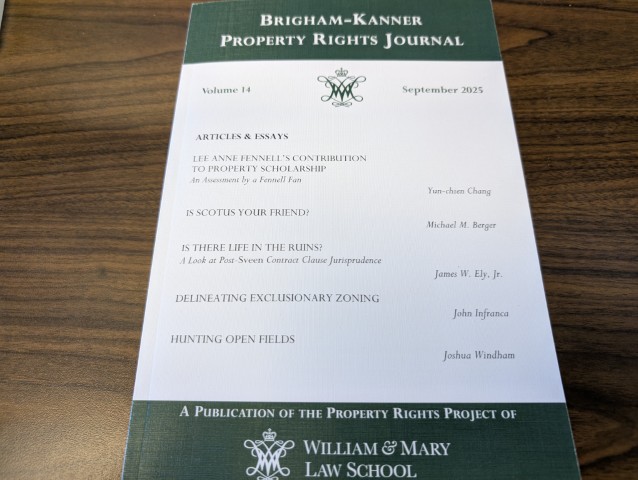
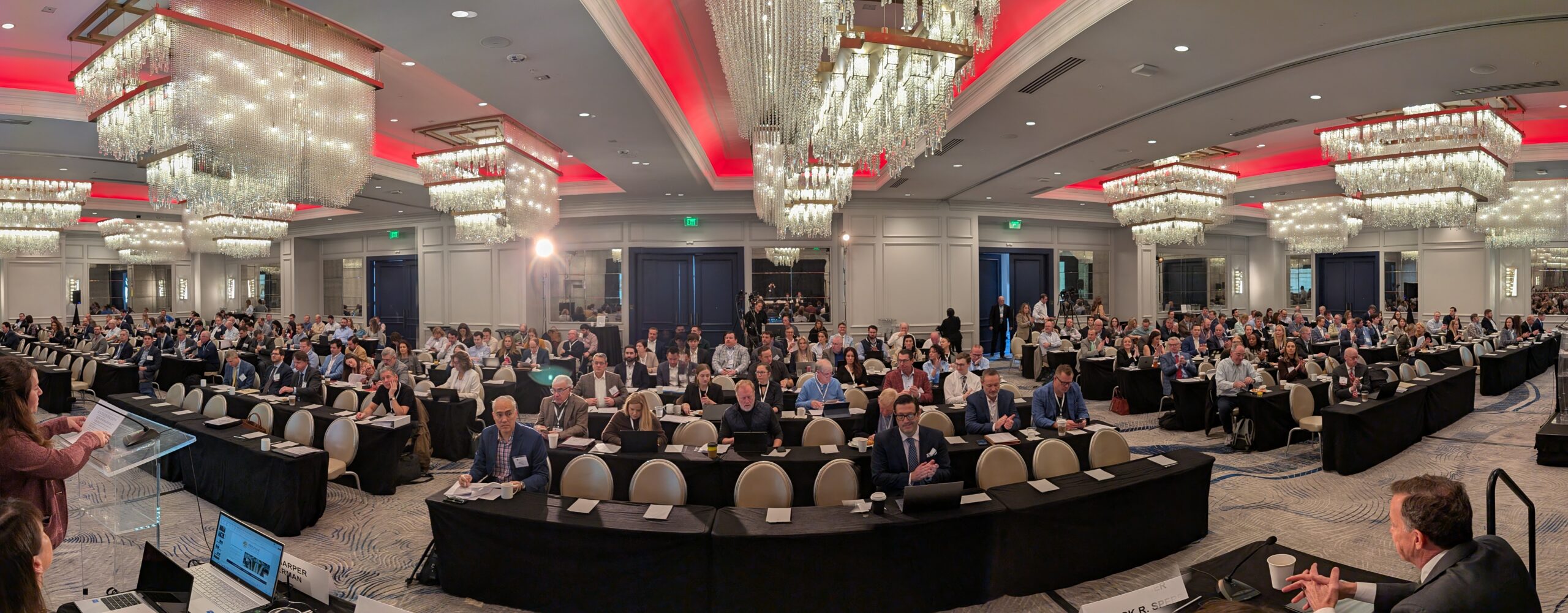
That’s right, it’s time to plan on joining us at the 22d edition of the best one-day property law conference, William and Mary Law School‘s Brigham-Kanner Property Rights Conference.

As we noted, Professor William Fischel will be awarded the 2025 Brigham-Kanner Property Rights Prize at the annual Wren Building candlelight ceremony in Williamsburg on October 23, with the following day being devoted to a celebration of his work and career, and discussions of the hot topics in property rights law.

The Conference is expressly designed to get legal academics and the nation’s best dirt law practitioners in the same room, discussion how legal scholarship and law practice work hand-in-hand to shape the law. 

More details:  

The Brigham-Kanner Property Rights Prize is presented annually to a scholar, practitioner, or jurist whose work affirms the fundamental importance of property rights. It is named in honor of the late Toby Prince

Continue Reading Registration Open: 22d Brigham-Kanner Property Rights Conference, Oct. 23-24, 2025, Williamsburg

Rethinking
Available now. 

Just published: Rethinking the Law of Private Property, edited by lawprof Jan Laitos, with chapters by some of Dirt Law’s most notable luminaries. Here’s the abstract:

In Rethinking the Law of Private Property, eminent legal scholars consider how private property rights might be transformed and realigned to better cope with modern challenges. They rethink current paradigms around private property and natural resource ownership in light of police power regulations, health rules and expanded land-use regulations.

Vicki Been, Daniel Cole, Robin Craig, Richard Epstein, Jan Laitos, Roger Pilon, J.B. Ruhl, James Salzman and Ilya Somin are among America’s leading scholars on private property rights. Their chapters consider three critical issues facing private property owners in the 21st century. (1) To what extent may constitutional protections of private property resist police power limits restricting property uses? (2) Do developers of property for housing have the ability to provide affordable

Continue Reading New Book: Rethinking the Law of Private Property (J. Laitos, ed. 2025)

Bundle of Sticks

What is private property? James Madison called it “that dominion which one man claims and exercises over the external things of the world, in exclusion of every other individual.” The Constitution’s Takings Clause doesn’t define it; it simply prohibits the taking of private property for public use without just compensation.

In this academic workshop – to be held in November 2025 – Pacific Legal Foundation seeks scholarly papers exploring the other sources of private property and how they should be used to define private property rights protected by the Takings Clause.

The U.S. Supreme Court has recently re-explored what property rights are protected under the Constitution in Tyler v. Hennepin County, where the Court unanimously held that home equity was a property right protected by the Takings Clause. Since the Constitution does not define private property, the Court explained, in Tyler, that private property can be defined by

Continue Reading “Unpacking Private Property’s Bundle Of Sticks” – Call For Proposals

Kelo site Ft Trumbull
Over there is where the “little pink house” was.
July 26, 2025.

Regular readers know that from time to time, we make what we call property or takings pilgrimages to the sites of famous cases. Inter alia: Kaiser Aetna, Nollan, Dolan, Loretto, Penn Central, Hadacheck, the High Line, Boomer.

Included in that are eminent domain cases of course, including Chicago Burlington, and Berman. 

With the recent 20th anniversary of Kelo v. City of New London just past, we thought it appropriate to revisit the site when we were in the neighborhood to see what’s up and what “progress,” if any, New London has made in effecting those plans it claimed to have, which necessitated the taking of Susette Kelo’s “little pink house.” For Professor Gideon Kanner’s thoughts on “Eminent Domain Projects That Didn’t Work Out

Continue Reading Property Rights Pilgrimage: The Kelo Property And House, Twenty Years On

Readers of this blog are surely familiar with the soft spot we have in our heart for the Australian film, “The Castle.”

We described it as “Kelo Down Under,” noting that despite its comic spin, the film accurately portrays why owners of property object to eminent domain (in Australia, “compulsory acquisition“).  Eminently quotable, it captures “the vibe of the thing.” 

Which is why we’re posting this piece that declares the movie, “the best Aussie movie of all time.” Why? The piece lists the reasons why. A bit click-baity, but still a good read. 

Vibe

Post-class whiteboard graffiti,
left behind by a student a few years ago who got it.
Continue Reading “There’s no doubt about it – The Castle is the best Aussie movie of all time”

In City of Dallas v. Dallas Short-Term Rental Alliance, No. 05-23-01309-CV (July 18, 2025), the Texas Court of Appeals affirmed a preliminary injunction, suspending operation of two ordinances which (1) restrict, and (2) require registration of short-term rentals in Dallas.

It’s a short opinion and up on appeal from interlocutory emergency relief, so there isn’t a ton there. But it is still worth reading because the court concludes the challengers have a likelihood of eventually showing that the ordinance restricting short-term renting violates “due-course-of-law” (aka substantive due process). Texas recognizes a property right in leasing property, and the owners here asserted they have a vested right to do so:

Under the circumstances, we conclude appellees Dallas Short Term-Rental Alliance, Sammy Aflalo, Vera Elkins, and Denise Lowry proved their probable right to relief against the City’s zoning ordinance under their due-course-of-law argument because they alleged they possessed well-established rights to

Continue Reading Tex App: Challengers Likely To Succeed On Due Course Of Law Claim For Short-Term Rental Ban