
It hardly seems like two decades have passed. After all, it was a mere 10 years ago we were lamenting “Kelo At 10: Still Stinks, And A Decade Has Not Lessened The Odor.”
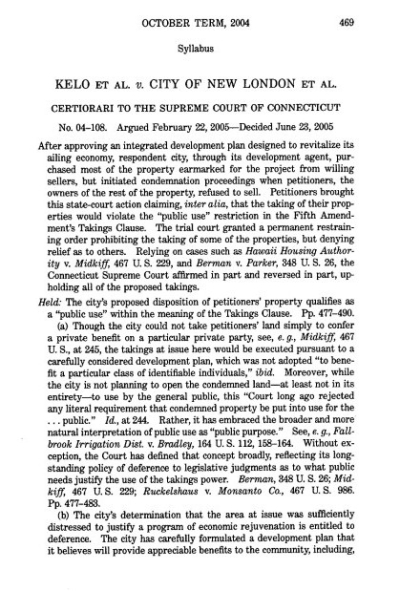
But yes, it was twenty years ago today … the U.S. Supreme Court, by the thinnest of margins, held in Kelo v. City of New London, 545 U.S. 469 (June 23, 2005) that there’s nothing inherently suspect about “economic development” takings to justify a higher level of judicial scrutiny than the judges-as-poodles standard of review applied in Public Use challenges to takings for every other reason.
Susette Kelo’s home was taken on the claim that it was needed as part of the package of incentives to lure a pharmaceutical company to set up shop in New London, which would in turn, raise the overall economic climate in the city. That butterfly-effect theory was good enough for the Court’s majority, which applied rational basis review to her challenge under the Public Use Clause.
What a thin reed on which to hang a taking: someone else may make a more intense use of your property, so you can be disseized. Anyone here whose property is already at its maximal potential use? Now you see the problem.
Rather than confront this criticism, the Kelo majority adopted a process-based rationale, concluding that the New London Development Corporation reached the decision to take her home via a public process that was part of an overall economic development and revitalization plan, so the outcome was as trustworthy as every other exercise of eminent domain. That’s right: property owners should rely on the political process to protect their rights, not courts. If Ms. Kelo lost in New London’s process, that’s democracy at work and of no constitutional consequence.
Justice Stevens rested the majority’s conclusion on Berman v. Parker, 348 U.S. 26 (1954), which came to the remarkable conclusion that the legislature’s declaration of public purpose is “well-nigh conclusive.” He also relied on Hawaii Housing Authority v. Midkiff, 467 U.S. 229 (1984), which held that exercises of eminent domain to seize private property are considered under the same rational basis standard of review as police power regulation of private property.
With those cases setting the stage, observers understood that Ms. Kelo had no chance unless the Court was willing to revisit them and either carve out an exception for economic development takings, or overrule one or both. As we know, that didn’t happen. Students of the decision understand that despite the loss, it wasn’t like it altered all that much, because it simply affirmed the longstanding judicial approach to Public Use.
In addition to reliance on Berman and Midkiff, most revealing was the majority’s stealth-citation to the Supreme Court decision which forms the basis of land use planning and zoning and the high degree of deference which the courts pay to zoning decisions, Village of Euclid v. Ambler Realty Co., 72 U.S. 365 (1926), thus making express what was strongly hinted at in Midkiff. You land users will find the majority’s language very familiar:
Those who govern the City were not confronted with the need to remove blight in the Fort Trumbull area, but their determination that the area was sufficiently distressed to justify a program of economic rejuvenation is entitled to our deference. The City has carefully formulated an economic development plan that it believes will provide appreciable benefits to the community, including–but by no means limited to–new jobs and increased tax revenue. As with other exercises in urban planning and development,12 the City is endeavoring to coordinate a variety of commercial, residential, and recreational uses of land, with the hope that they will form a whole greater than the sum of its parts. To effectuate this plan, the City has invoked a state statute that specifically authorizes the use of eminent domain to promote economic development. Given the comprehensive character of the plan, the thorough deliberation that preceded its adoption, and the limited scope of our review, it is appropriate for us, as it was in Berman, to resolve the challenges of the individual owners, not on a piecemeal basis, but rather in light of the entire plan. Because that plan unquestionably serves a public purpose, the takings challenged here satisfy the public use requirement of the Fifth Amendment.
———————————
12. Cf. Village of Euclid v. Ambler Realty Co., 272 U.S. 365 (1926).
That “plan” requirement is about as loose in eminent domain as it is in land use law. In the time since Kelo, there have been commentary on the necessity of a plan, as well as cases from other courts which focus on the “plan” which a taking is supposedly part of. Necessary? Some say yes, some say no, as do others. Some courts have held that an imaginary plan is ok.
Should the fact that many of these plans are just pie-in-the-sky have any impact on Justices who believe that the process by which these plans are adopted is more important than the question of whether the plans will actually work? The usual majoritarian processes by which plans are adopted and someone’s property is targeted are not very good at protecting vulnerable owners from a government officials’ starry-eyed thinking and economic pipe dreaming. We think that is where the majority’s assumptions were horribly wrong. Check out what the great teacher and practitioner of eminent domain law, Professor Gideon Kanner, wrote about this in his final law review article, “Eminent Domain Projects that Didn’t Work Out,” 12 Brigham-Kanner Property Rts. J. 171 (2023).
In the land use arena, we haven’t seen any indication that judges care all that much about the chances of success of government plans, whether those plans be zoning, planning, economic legislation, or eminent domain. Indeed, courts studiously eschew any role in what is called the “means-end-fit,” or whether legislation will “work.”
But we wish courts would care in eminent domain, even if they don’t care generally. There’s something different about eminent domain and takings someone’s property away than when the government is merely exercising its police or other power to regulate property, isn’t there?
True, eminent domain comes with just compensation. But as Kelo case starkly illustrated, sometimes the dignity of keeping your property cannot be replaced with money, and courts should recognize and protect that. The Supreme Court’s recent decision in Sheetz was a good sign the Court is starting that recognition. There, the Court was in “radical agreement” that just because it is the legislature which imposes an exaction as the price of exercising your constitutional property rights, does not insulate the legislation from the dual requirements of logical nexus and rough proportionality.
Here’s the amicus brief we filed in Kelo, where we set out our thinking on what the Public Use Clause requires:
In undertaking the review of public use issues reserved to the judiciary in Midkiff, 467 U.S. at 240, this Court should adopt the same heightened scrutiny for exercises of the eminent domain power justified by promises of a better economy as it has established for suspect regulatory takings: a taking justified only by economic development is invalid if it fails to substantially advance a legitimate state interest. See Tahoe-Sierra Preservation Council v. Tahoe Regional Planning Agency, 535 U.S. 302, 333-34 (2002) (regulation is an illegal taking if it “fails to substantially advance a legitimate state interest”).
Under the Fifth Amendment’s Takings Clause, the affirmative exercise of eminent domain to take private property is valid only if it is for “public use” and just compensation is provided. U.S. Const. amend. V. In regulatory takings jurisprudence, a regulation has the same effect as an exercise of eminent domain when it either fails to substantially advance a legitimate state interest, or deprives an owner of beneficial use of property. Agins v. City of Tiburon, 447 U.S. 255, 260 (1980). A regulation substantially advances a legitimate state interest when there is a nexus between the regulation and a legitimate aim of government, and the regulation is tailored to achieve its end. Nollan v. California Coastal Comm’n, 482 U.S. 825, 834 (1987) (nexus required); Dolan v. City of Tigard, 512 U.S. 374, 385 (1994) (“rough proportionality” between goal and means used to achieve it).
Br. at 4.
Let’s wrap this retrospective with this: two decades of searching for some stable mooring should clue us in that Kelo was never really the source of the problem. Despite capturing the public’s imagination, the real problem isn’t that decision standing alone. After all, the majority’s ruling is expressly based on Midkiff and Berman (despite Justice O’Connor’s vain attempt to distinguish those cases, especially her own opinion in Midkiff).
To make any progress, the Court is going to have to be convinced that there’s something different about the way government regulates private property and the way government seizes private property. Midkiff — and perhaps Berman — need to be revisited and overruled.
It just so happens that we have a case where the property owners are asking just that.
Let’s hope there’s not another twenty years of inaction.
Kelo v. City of New London, 545 U.S. 469 (2005)