Eminent Domain | Condemnation

Here’s one we’ve been meaning to post for a while. In Borough of Seaside Park v. Shree Jyoti, LLC, No. 089599 (N.J. Aug. 10, 2026), the New Jersey Supreme Court held that a municipality is not required to identify the specific public use in an ordinance authorizing the taking of private property. It’s enough that there is a public use. It’s up to you, property owner and the public, to figure it out.
Continue Reading NJ: Just Because A Taking Must Have A Public Use And The Govt Should Have Let The Public Know, Doesn’t Mean The Condemnor Must Actually State The Public Use
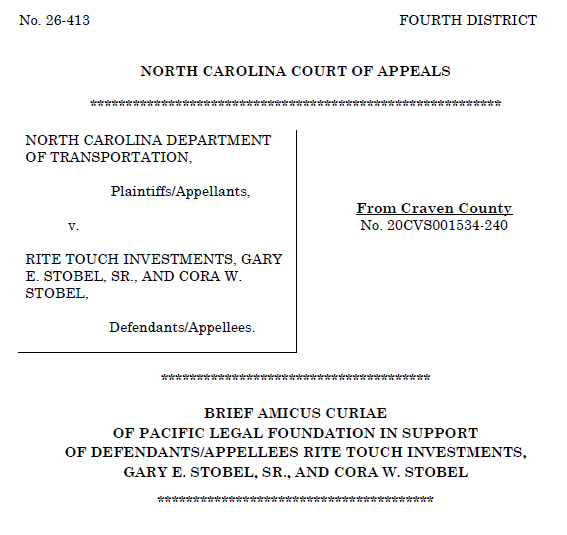
The question before the North Carolina Court of Appeals in Dep’t of Transportation v. Rite Touch Investments is whether the state constitution’s Law of the Land Clause, N.C. Const. art. I, § 19, permits a property owner who proves the condemnor’s offer of just compensation was constitutionally inadequate to recover attorneys’ fees and costs. Here, the trial court held yes, and NCDOT appealed.
Continue Reading Brief (Ours): N.C. Constitution Requires Owners Be Made Economically Whole, Which Includes Attorneys’ Fees

Spots are filling up, so if you are even thinking about it, here’s the complete agenda for the 2026 Brigham-Kanner Property Rights Conference, October 14-16, 2026, in London. …
Continue Reading Still Time to Join Us For The 2026 Brigham-Kanner Property Rights Conference (Oct. 14-16, 2026, London)

In Town of Apple Valley v. Apple Valley Ranchos Water, No. S289391 (Aug. 24, 2026), the California Supreme Court held that the usual uber-deferential standard of review in eminent domain cases to the condemnor’s claim that the taking is necessary does not apply where a government is taking a private utility company to operate itself. …
Continue Reading California Supreme Court: Guess What? Eminent Domain Statutes Mean What They Say

But can a private for-profit energy company that admittedly does not possess the power of eminent domain force its way onto private property on the theory that it needs entry so the government can evaluate whether to delegate it the power of eminent domain? In PSEG Renewable Transmission LLC v. Arentz Family, LP, No. 25-1730 (Aug. 6, 2026), the U.S. Court of Appeals thought so.
Continue Reading CA4 Puts The Cart Before The Horse: Private Entity Doesn’t Have The Power Of Eminent Domain, But It Is Likely To Get It If Only Those Pesky Owners Were Stopped From Exercising Their Right To Exclude

It’s that time of the year again. Fall’s-a-coming, and that means that in a few days, we’re back at the William and Mary Law School in Williamsburg, Virginia to teach two courses: Eminent Domain and Property Rights (W&M is one of the few law schools in the country that offer a course in eminent domain, just compensation, and takings) -and Land Use Controls (an especially hot topic at the moment).
Continue Reading Back To School For Dirt Law @ William & Mary, Season 9

Here’s the latest in a case we’ve been closely following (because we represent the property owners!). In this Memorandum and Order, the U.S. District Court for the District of Rhode Island invalidated the Town of Johnston’s ham-fisted attempt to take the property of a local family in order to move the current Town Hall from its present location in the center of town to the very outer border of the municipality, and build a new government complex. What is really going on is that this scheme only came about after the Town learned of the family’s plans to build affordable housing on their own land.
Continue Reading Town Has Not Been Delegated Eminent Domain Power And Can’t Just Make Up Its Own Procedures

Here’s the latest in a case we’ve been following. (And an issue we’ve been following for a while.) [Disclosure: our shop filed an amicus brief in that case in favor of the property owner.] In Township of Jackson v. Getzel Bee, LLC, No. 090404 (N.J. July 20, 2026), the New Jersey Supreme Court invalidated a taking where the stated public use was to acquire property for open space, but the condemned properties were not going be be so used, but instead would be used to swap with another private owner, so its property could be used for open space. …
Continue Reading New Jersey: No Taking To Swap Land With Someone Else

It hardly seems like two decades-plus have passed. After all, it was a mere 10 years ago we were lamenting “Kelo At 10: Still Stinks, And A Decade Has Not Lessened The Odor.” But yes, it was 21 years ago today … the U.S. Supreme Court, by the thinnest of margins, held in Kelo v. City of New London, 545 U.S. 469 (June 23, 2005) that there’s nothing inherently suspect about “economic development” takings to justify a higher level of judicial scrutiny than the judges-as-poodles standard of review applied in Public Use challenges to takings for every other reason…
Continue Reading Kelo Hits 21 (And Gets Worse With Age)

The majority opinion of the Texas Supreme Court in State of Texas v. JRJ Pusok Holdings, LLC, No. 24-0447 (June 12, 2026), starts off pretty good: “The right to own property is ‘fundamental, natural, inherent, inalienable, not derived from the legislature and . . . preexist[s] even constitutions.'” And it gets better from there. At issue was one of those “buyback” statutes — property taken for a public use that isn’t used for that public use within a defined time frame can be repurchased by its former owner. In this case, Texas’s (as the caption indicates).
Continue Reading Texas: Agreeing To Settle A Just Compensation Claim Can Trigger Repurchase Right If Govt Doesn’t Use Property For Stated Purpose