Need an excuse to be in Honolulu mid-winter?

If you are still looking for an excuse to head to the 808, here it is. The 2026 Future of Property Law Conference, February 13, 2026 at the University of Hawaii School of Law.

Chaired by Professor David Callies, the agenda features dirt law luminaries (and others, us included) speaking about topics like housing, the ALI Restatement, Coastal Protection/Public Trust, and IP/AI Property. (We are speaking on “Physical and Regulatory Takings” at 9:15am.)

Speakers include Thomas Mitchell, Jim Burling, John Infranca, Henry Smith, and Thomas Merrill.

See the complete agenda and speaker list (and registration) here.

Here’s the official program description:

This 1-day conference is a must attend for any attorney or professional whose practice involves land use and development. Distinguished land-use practitioners, scholars, planners, and regulators from Hawaii and the Mainland will discuss timely and relevant issues, including: Housing

Continue Reading 2026 Future of Property Law Conference, University of Hawaii Law School, Feb 13, 2026 (Live & Webcast)

The view from the podium

That’s right. More than 300 of the nation’s best eminent domain lawyers, judges, appraisers, right-of-way agents, scholars, and other industry professionals are in Savannah for the next two and a half days for what is now known as the American Law Institute (“ALI” alone, no longer with the “-CLE” addition) Eminent Domain & Land Valuation Litigation Conference.

We’re now in our 43d edition and have a record attendance as the above photo, taken from the podium as we got underway, shows.

The view from the audience

If you are not here, you really should consider joining us. We’ll announce the location for the 2027 Conference tomorrow (hint: it will be in the west).

We’ll have more as the Conference progresses.

Continue Reading We’re Underway At The 43d American Law Institute Eminent Domain & Land Valuation Conference, Savannah

Here’s the latest in a case we’ve been following closely. (We won’t be commenting much, because it is one of ours.)

In The Coalition for Fairness in Soho and Noho, Inc. v. City of New York, No. 112 (Jan. 13, 2026), the New York Court of Appeals (dun-dun) held that

New York City wants to save space so artists can live there. If an owner wants to covert a SoHo or NoHo artist live/work space into plain old residential (because artists ain’t living in SoHo or NoHo), she better get ready to pay to the City’s Arts Fund a non-refundable fee of $100 per square foot as a precondition of even filing a building permit. When owners challenged this fee as unconstitutional under Nollan/Dolan/Koontz/Sheetz, the trial division said no.

But the Appellate Division held otherwise, concluding that the imposition of the

Continue Reading NY Court Of Appeals Tees Up A Certworthy Exactions Case

Here’s the latest in a case we’ve been following (because it is a product of our shop: we represent the property owners/plaintiffs).

In this Order, the Florida Supreme Court declined to exercise jurisdiction to review the Third District Court of Appeals en banc opinion in Shands v. City of Marathon. So that decision stands.

This is the case in which the Shands Family, the owners of Shands Key — a small island in the City of Marathon (about 1/2 way down the Overseas Highway in the Florida Keys) — asserted that the City’s downzoning their property from a density that allowed residential development to a density that doesn’t (Shands Key is below the minimum lot size under the downzoning), is a Lucas taking.

The court of appeal rejected the City’s claim that beekeeping and overnight camping were possible uses of the property under the downzoning, thus exempting it

Continue Reading Fla SCT Declines Review: En Banc Court Of Appeal Decision That Downzoning Was A Lucas Taking (And Sale Of Property For Third-Party TDRs Is Not A “Use”), Stands

In Grand v. City of University Heights, No. 24-3876 (Nov. 13, 2026), the U.S. Court of Appeals for the Sixth Circuit held that a complaint alleging a RLUIPA claim and others was not ripe because they are “land use” claims subject to Williamson County‘s final decision requirement.

A neighbor was “displeased” that Grand was using his home to hold a “shul,” which “in Hebrew refers to a synagogue or a house where prayers are held.” Slip op. at 2. The city told him to stop because his use as “a place of religious assembly” violated the zoning code (his home is zoned U-1, which doesn’t allow such uses).

Grand applied for a Special Use Permit, which would allow him to make the use as a “house of worship.” The Planning Commission had a hearing, but didn’t make a decision. It “tabled the discussion, requesting more details

Continue Reading CA6: RLUIPA Claim Subject To Williamson County Final Decision Ripeness Because It’s A “Land Use” Issue

Euclid_front

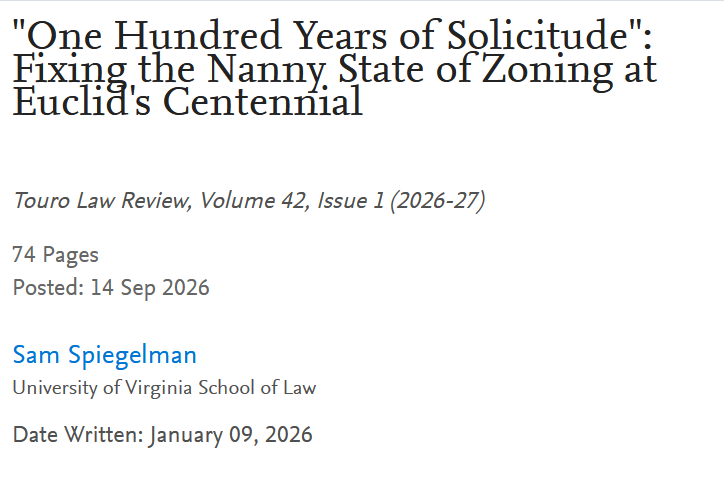
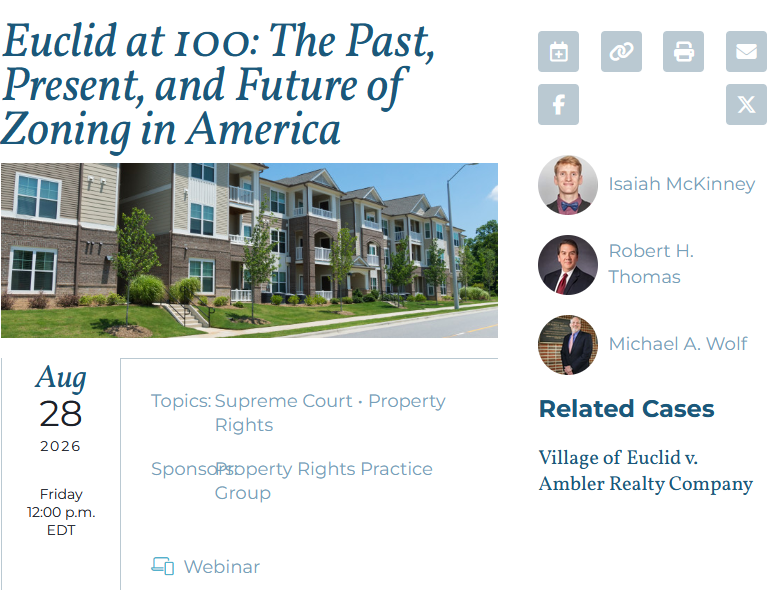
Tomorrow, November 22, 2025 is the 99th anniversary of the day in 1926 when the United States Supreme Court issued its landmark opinion in Village of Euclid v. Ambler Realty Co., 272 U.S. 365 (Nov. 22, 1926).

You know this one (and can you call yourself a dirt lawyer if you don’t?). It’s the one in which the Supreme Court first upheld — against a facial due process challenge — the validity of this thing we now call “Euclidean zoning.”

In the intervening century, zoning has become a catch-all term for all sorts of regulatory restrictions on the uses of real property, land users know that “zoning” — ackshually — refers only to the regulation and separation of uses, restrictions on density, and height regulation. At least that’s how it began. The Euclid court concluded this was mostly nuisance prevention, so no worries. But we’d

Continue Reading You Don’t Look A Day Over 98, Euclid

As we wrap up another year, it’s time to look ahead to the one event that always gets our eminent domain blood pumping: the annual ALI-CLE Eminent Domain and Land Valuation Litigation Conference. Details, including faculty list, a complete agenda, and registration information is posted here.

Now in its 43rd year, this flagship gathering remains the undisputed national hub for practitioners, academics, appraisers, and anyone else who lives and breathes property rights law. Mark your calendars for January 22-24, 2026, when we’ll convene at the JW Marriott Plant Riverside District in Savannah, Georgia. Think historic charm meets Southern hospitality, with moss-draped oaks, riverfront vibes, and enough ghost tours to inspire a dozen inverse condemnation hypotheticals. (For those of you who prefer pixels to palm trees, a live webcast option is available.)

What makes this conference indispensable? For starters, it’s the place to reconnect and talk shop with the

Continue Reading Savannah Bound: Don’t Miss The 43rd ALI-CLE Eminent Domain & Land Valuation Litigation Conference (Jan. 22-24, 2026)

This is going to be a short post, mostly because the U.S. Court of Appeals for the Ninth Circuit’s opinion in KOGAP Ent., Inc. v. City of Medford, No 24-5268 (Nov. 13, 2025) is itself short.

Before we go further, this disclosure: this is one of ours, and our Pacific Legal Foundation colleague Brian Hodges argued the case.

It’s a three-page memorandum opinion so there’s not a lot there to sink our teeth into, and it would be faster for you to just read it yourself, rather than us explaining what it said. Short story is that the city imposed an exaction requiring KOGAP to extend a city street. The court affirmed the exaction has an “essential nexus” to KOGAP’s proposed development project, holding that the street extension was justified because the development would likely result in “more auto-oriented uses.”

But the court held that there’s no evidence that

Continue Reading CA9: No Evidence That Exaction Was Proportional

This image has an empty alt attribute; its file name is 2010-06-08-13.11.25-553x740.jpg

Here’s a case that isn’t about takings and our usual fare, but is nonetheless an example of how dirt law can be fascinating.

In Hilo Bay Marina, LLC v. State of Hawaii, No. SCAP-23-0000310 (Sep. 12, 2025), the Hawaii Supreme Court held that a restriction in a land patent issued by the State of Hawaii’s predecessor-in-interest (the Territory of Hawaii) in 1922, that limited the uses of the land to “Church purposes only” cannot be enforced under the state constitution’s establishment clause.

Continue Reading Restriction In Gov’t-Granted Deed Limiting Uses To “Church purposes” Can’t Be Enforced