Euclid_front

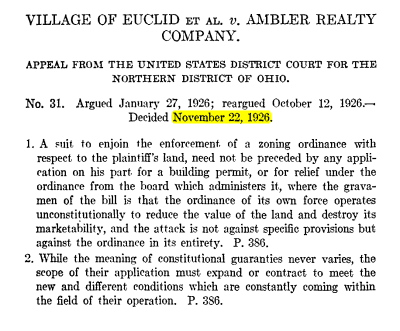
Tomorrow, November 22, 2025 is the 99th anniversary of the day in 1926 when the United States Supreme Court issued its landmark opinion in Village of Euclid v. Ambler Realty Co., 272 U.S. 365 (Nov. 22, 1926).

You know this one (and can you call yourself a dirt lawyer if you don’t?). It’s the one in which the Supreme Court first upheld — against a facial due process challenge — the validity of this thing we now call “Euclidean zoning.”

In the intervening century, zoning has become a catch-all term for all sorts of regulatory restrictions on the uses of real property, land users know that “zoning” — ackshually — refers only to the regulation and separation of uses, restrictions on density, and height regulation. At least that’s how it began. The Euclid court concluded this was mostly nuisance prevention, so no worries. But we’d

Continue Reading You Don’t Look A Day Over 98, Euclid

Charlottesvillezoning

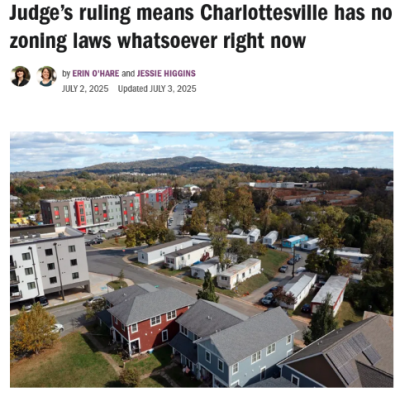
This interesting — and kind of funny — story has been circulating: “Judge’s ruling means Charlottesville has no zoning laws whatsoever right now.” 

What happened? Is the counter-Euclid revolution underway? Did the judge rediscover Nectow? Did Charlottesville voters decide to go Full Houston

No, nothing quite as dramatic. The story notes that the city’s attempt to adopt a new zoning code was held invalid. But, the story notes, the former zoning ordinance was repealed so that the new one could be adopted. With the former code ineffective and the new code invalidated … just like that, no zoning!

We haven’t checked, but we would not be surprised if the most popular search on WEXIS right now in the Blue Ridge is “Virginia /s vested /s rights or ‘estoppel.'”

In the meantime, the city has stopped processing new development applications, while claiming this is all

Continue Reading Houston Says ‘Welcome!’ – What Happens When Another City Has No Zoning?

Euclidsymposium

With the 100th anniversary of Village of Euclid v. Ambler Realty Co. nearly upon us in 2026, we’ve put together a series of events designed to reexamine the case that set the stage for a century’s-worth of intense land use regulations and restrictions.

Are Euclid‘s assumptions and conclusions still valid? If the original separation-of-uses and nuisance-prevention rationale of zoning made sense, does that rationale apply when “zoning” has become the shorthand for extremely granular regulation of property’s uses? What of the role of judicial review and a return to Nectowian review? 

Our Euclid series begins with a call for papers, and a follow-up conference at which these articles will be presented and discussed. For more, see the call for papers: “Euclid Turns 100: Rethinking an Antiquated Case and Reimagining Euclidean Zoning for the Century Ahead.” The link also has a few suggestions about

Continue Reading Call For Papers: “Euclid Turns 100: Rethinking an Antiquated Case and Reimagining Zoning for the Century Ahead”

Here’s the latest in a case we’ve been following.

In Hudson Valley Property Owners Ass’n v. City of Kingston, No. 59 (June 18, 2025), the New York Court of Appeals held that after a municipality declares a housing emergency allowing it to regulate the amount of rent, it has the power to order lessors to refund to tenants rent which exceeded the maximum allowed amount, even if those rents had been collected prior to the declaration of the emergency. 

At least that is how we read the opinion. Due to its somewhat unusual procedural posture, the court did not actually allow the city to nail property owners for retroactive “overcharges,” it merely rejected the owners’ claims that because the statute may allow it in particular cases, it isn’t facially unconstitutional.

This was a facial challenge by property owners to Kingston, New York’s declaration of a housing emergency during

Continue Reading NY: In A Housing “Emergency,” City Can Retroactively Lower The Rent, Even Rent Collected Before The Emergency

Here’s what we’re reading this day:

Good weekend reading as well. Continue Reading Friday Dirt Law Round-Up

20180720_150853_HDR
The only courthouse we know where the Supreme Court
is
below the Court of Appeals (SJC on the second floor,
appellate court on the third)

A brief one from the Supreme Judicial Court of Massachusetts.

In Attorney General v. Town of Milton, No. SJC-13580 (Jan. 8, 2025), the court rejected a challenge to a state statue which allowed the Massachusetts Bay Transportation Authority, the public transit authority in the Boston area, to require municipalities which access the T loosen their zoning regimes to “provide for at least one district of multifamily housing ‘as of right’ near their local MTBA facilities.” Slip op. at 3. One town declined to do so, and the state AG sued to enforce the statute.

The town responded by challenging the statute’s validity and the AG’s authority to sue to enforce it. Yes on both counts held the SJC. But (and there’s a

Continue Reading Mass SJC: State Requiring Municipalities To Adopt Multi-Family Zoning Is Enforceable By AG…But

With our tongues firmly planted in cheeks, the Planning Chairs for the upcoming 42d edition of this popular and venerable Conference bring you this “breaking news” report from San Diego!

As you know, in addition to being the best nationally-focused conference on the subjects that we love and a venue that is nearly certain to have some of the warmest winter weather in the continental United States, and we went on-location from some of the local highlights: the beaches, Torrey Pines, the Zoo, Balboa Park, the Gaslamp Quarter, and Coronado to name but a few.

More about the Conference here, including registration information.

Here are some of the highlights:

  • Property Rights at the Supreme Court: DeVillier and Sheetz and What’s Next
  • Slow Take: Possession, Rent, Relocation, and Offset
  • The Jury’s View: How Jurors See Your Case
  • From Penn Coal to Penn Central: How to


Continue Reading Breaking News: Come Join Us For The 42d ALI-CLE Eminent Domain & Land Valuation Litigation Conference, San Diego, Jan 30-Feb 1

Euclid_front98 years old, and still going (for better or worse)

On this day in 1926, the United States Supreme Court issued its landmark opinion in Village of Euclid v. Ambler Realty Co., 272 U.S. 365 (Nov. 22, 1926).

You know this one (and can you call yourself a dirt lawyer if you don’t?). It’s the one in which the Supreme Court first upheld — against a facial due process challenge — the validity of this thing we call “zoning.” While in the intervening century, zoning has become a catch-all term for all sorts of regulatory restrictions on the uses of real property, land users know that “zoning” — ackshually — refers only to the regulation and separation of uses, and restrictions on density, and height regulation. At least that’s how it began.

While “Euclid” and “Euclidean zoning” have become part of the land use

Continue Reading (Un?)Happy Euclid Day!

Here are the cases and other materials we discussed in today’s Section of State & Local Government Law Land Use group meeting on takings:


Continue Reading Links From Today’s ABA Land Use Session