Sometimes when you read a court opinion you imagine there’s a big gap between the objective, sterile words on the page and the reality of the situation.

The U.S. Court of Appeals for the Seventh Circuit’s opinion in O’Donnell v. City of Chicago, No. 24-2946 (Dec. 22, 2025) is one of those.

The words on the page reveal the court held that a Chicago ordinance which authorizes the city to seize vehicles for traffic violations — even other cars the violator owns — is not a taking because its “an exercise of the City’s police power to enforce its traffic code, and thus isn’t a taking.” Slip op. at 5. (We have problems with that conclusion, but more on that below.)

But reading the opinion gives a hint of the off-page reality on the ground.

Dig this. Get a traffic ticket in Chicago, and you can either challenge it

Continue Reading CA7: No Taking When City Forfeited Cars For Traffic Violations – Even Cars Not Involved In The Violation

Here’s one you don’t want to miss. Lawprof Shelley Ross Saxer has published “Forfeiture Takings, Police Power, and Necessity Destruction,” 80 U. Miami L. Rev. 147 (2025).

Here’s the Abstract:

Civil forfeiture laws allow law enforcement to seize property when there is probable cause it has been used or possessed in violation of legal rules, often before an owner has a chance to contest the government’s seizure in court. In the criminal context, forfeiture is typically an in personam action that requires a criminal conviction and is part of a defendant’s sentence. In the civil context, however, forfeiture is an in rem proceeding brought against the property derived from or used to commit an offense––not against the person who committed the offense. As such, a civil forfeiture may not require a criminal conviction or predeprivation hearing, and, under the “guilty property” theory, developed in England before eventually being

Continue Reading New Article: Shelley Ross Saxer, “Forfeiture Takings, Police Power, and Necessity Destruction,” 80 U. Miami L. Rev. 147 (2025)

Euclid_front

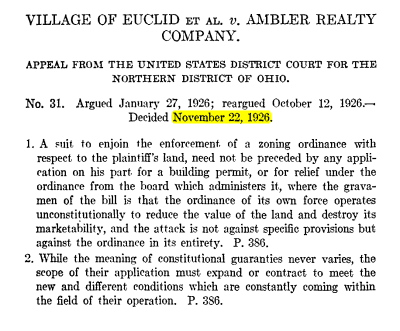
Tomorrow, November 22, 2025 is the 99th anniversary of the day in 1926 when the United States Supreme Court issued its landmark opinion in Village of Euclid v. Ambler Realty Co., 272 U.S. 365 (Nov. 22, 1926).

You know this one (and can you call yourself a dirt lawyer if you don’t?). It’s the one in which the Supreme Court first upheld — against a facial due process challenge — the validity of this thing we now call “Euclidean zoning.”

In the intervening century, zoning has become a catch-all term for all sorts of regulatory restrictions on the uses of real property, land users know that “zoning” — ackshually — refers only to the regulation and separation of uses, restrictions on density, and height regulation. At least that’s how it began. The Euclid court concluded this was mostly nuisance prevention, so no worries. But we’d

Continue Reading You Don’t Look A Day Over 98, Euclid

Check this out: a significant and important decision from the U.S. Court of Appeals for the Eleventh Circuit in an issue we’ve been following.

In Alford v. Walton County, No. 2021-13999 (Nov. 17, 2025), the unanimous panel concluded that the county’s Co-19 restrictions, which closed all beaches (public and private) in the county, worked a physical taking of Alford’s private property rights.

In response to the outbreak of Co-19, which the opinion notes was “a novel virus from Wuhan, China,” slip op. at 3, Florida declared a state of emergency, and followed up with an executive order that limited beach access statewide to “no more than 10 persons,” imposed a six-foot separation, among other things. Two days later, the county adopted an ordinance closing all public beaches in the county.

The following month, after the governor issued further executive orders, the county temporarily closed “[a]ll beaches” in the

Continue Reading CA11: “[T]here is no COVID exception to the Takings Clause”

As we wrap up another year, it’s time to look ahead to the one event that always gets our eminent domain blood pumping: the annual ALI-CLE Eminent Domain and Land Valuation Litigation Conference. Details, including faculty list, a complete agenda, and registration information is posted here.

Now in its 43rd year, this flagship gathering remains the undisputed national hub for practitioners, academics, appraisers, and anyone else who lives and breathes property rights law. Mark your calendars for January 22-24, 2026, when we’ll convene at the JW Marriott Plant Riverside District in Savannah, Georgia. Think historic charm meets Southern hospitality, with moss-draped oaks, riverfront vibes, and enough ghost tours to inspire a dozen inverse condemnation hypotheticals. (For those of you who prefer pixels to palm trees, a live webcast option is available.)

What makes this conference indispensable? For starters, it’s the place to reconnect and talk shop with the

Continue Reading Savannah Bound: Don’t Miss The 43rd ALI-CLE Eminent Domain & Land Valuation Litigation Conference (Jan. 22-24, 2026)

Is “personal” property (as contrasted with real estate), or property that is used in commercial dealings, not “private property” is protected from uncompensated takings by the Fifth Amendment?

That’s what the U.S. Court of Appeals for the Tenth Circuit appeared to conclude in Green Room LLC v. State of Wyoming, No. 24-853 (Oct. 27, 2025).

There, the court was faced with (inter alia) a takings claim which asserted that when the Wyoming legislature amended a statute, the effect of which was to make what had been a legal market in hemp products illegal. “In addition to the claims brought in their complaint, Plaintiffs’ brief in support of their motion argued that SEA 24 constituted an unconstitutional regulatory taking of their personal property.” Slip op. at 9.

We won’t go into detail about how the Tenth Circuit analyzed the federal preemption and dormant commerce clause claims, except to

Continue Reading No Taking When Legislature Revised Statute And Made Hemp That Was Legal … Illegal: No Property Right In Personal, Commercial Property

The U.S. Court of Appeals for the Seventh Circuit is the latest court to wade in (or more accurately, re-wade in) to what we call the SWAT Takings issue.

The logic is sound: under a governmental power (police power), the government (SWAT) has physically invaded (deprived the owner of an essential stick of private property, the right to exclude) a home (private property), for public use (police apprehending suspects is a good thing), triggering the obligation to spread the burden of this public good to the entire public (Armstrong).

 
Continue Reading CA7: No Taking For SWAT Destroying Property While Executing Valid Warrant

BK2025

That’s right, it’s time to plan on joining us at the 22d edition of the best one-day property law conference, William and Mary Law School‘s Brigham-Kanner Property Rights Conference.

As we noted, Professor William Fischel will be awarded the 2025 Brigham-Kanner Property Rights Prize at the annual Wren Building candlelight ceremony in Williamsburg on October 23, with the following day being devoted to a celebration of his work and career, and discussions of the hot topics in property rights law.

The Conference is expressly designed to get legal academics and the nation’s best dirt law practitioners in the same room, discussion how legal scholarship and law practice work hand-in-hand to shape the law. 

More details:  

The Brigham-Kanner Property Rights Prize is presented annually to a scholar, practitioner, or jurist whose work affirms the fundamental importance of property rights. It is named in honor of the late Toby Prince

Continue Reading Registration Open: 22d Brigham-Kanner Property Rights Conference, Oct. 23-24, 2025, Williamsburg

Euclidsymposium

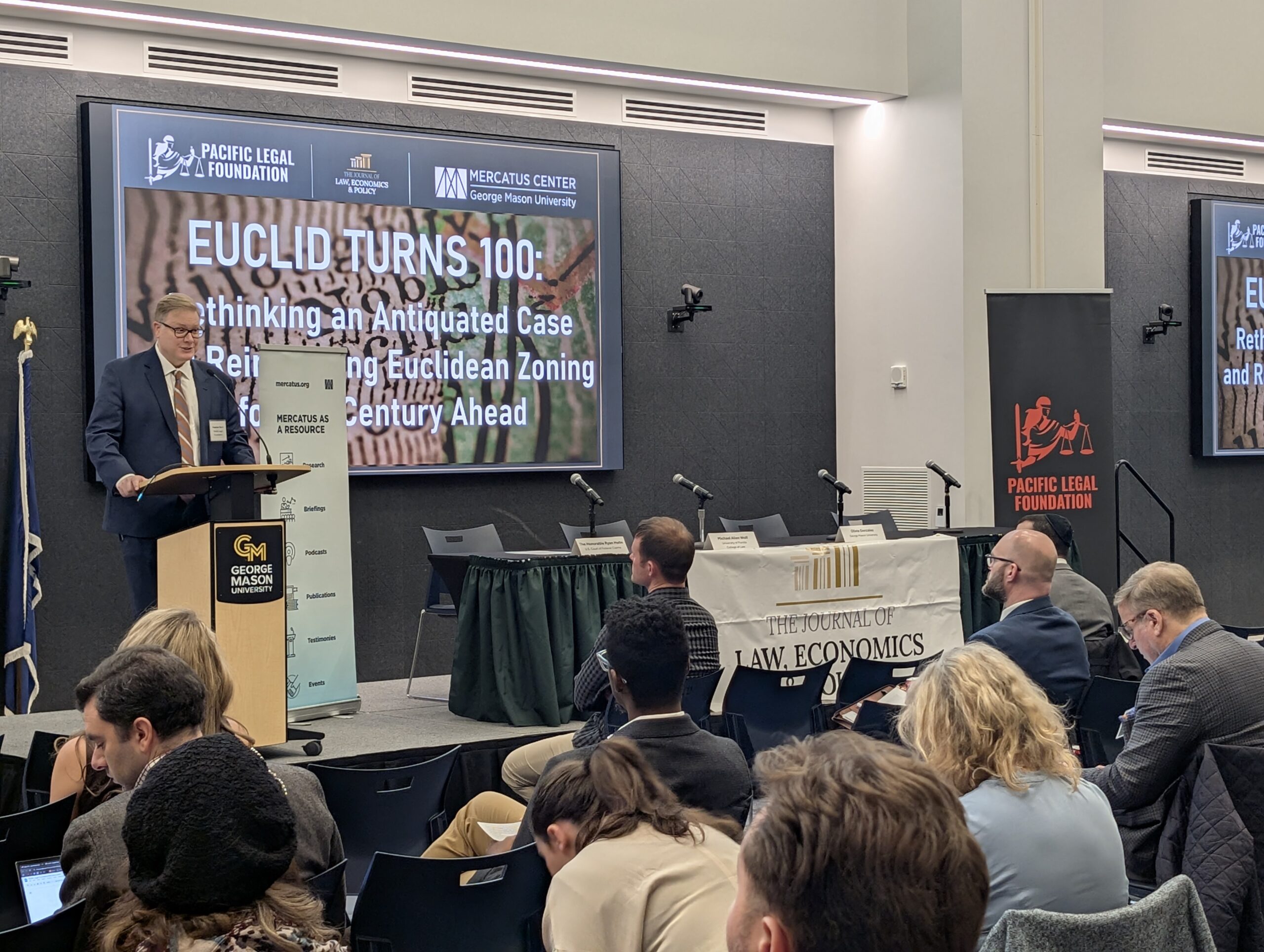
With the 100th anniversary of Village of Euclid v. Ambler Realty Co. nearly upon us in 2026, we’ve put together a series of events designed to reexamine the case that set the stage for a century’s-worth of intense land use regulations and restrictions.

Are Euclid‘s assumptions and conclusions still valid? If the original separation-of-uses and nuisance-prevention rationale of zoning made sense, does that rationale apply when “zoning” has become the shorthand for extremely granular regulation of property’s uses? What of the role of judicial review and a return to Nectowian review? 

Our Euclid series begins with a call for papers, and a follow-up conference at which these articles will be presented and discussed. For more, see the call for papers: “Euclid Turns 100: Rethinking an Antiquated Case and Reimagining Euclidean Zoning for the Century Ahead.” The link also has a few suggestions about

Continue Reading Call For Papers: “Euclid Turns 100: Rethinking an Antiquated Case and Reimagining Zoning for the Century Ahead”