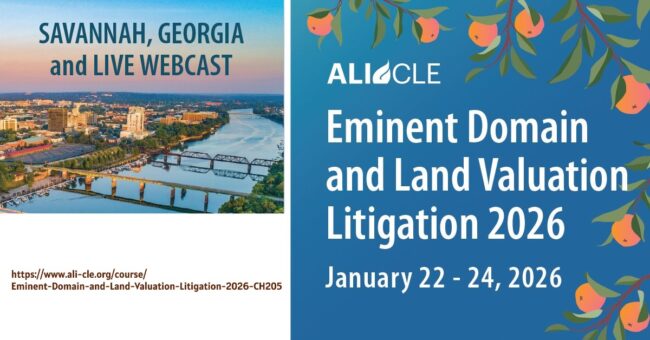
As we wrap up another year, it’s time to look ahead to the one event that always gets our eminent domain blood pumping: the annual ALI-CLE Eminent Domain and Land Valuation Litigation Conference. Details, including faculty list, a complete agenda, and registration information is posted here.

Now in its 43rd year, this flagship gathering remains the undisputed national hub for practitioners, academics, appraisers, and anyone else who lives and breathes property rights law. Mark your calendars for January 22-24, 2026, when we’ll convene at the JW Marriott Plant Riverside District in Savannah, Georgia. Think historic charm meets Southern hospitality, with moss-draped oaks, riverfront vibes, and enough ghost tours to inspire a dozen inverse condemnation hypotheticals. (For those of you who prefer pixels to palm trees, a live webcast option is available.)

What makes this conference indispensable? For starters, it’s the place to reconnect and talk shop with the

Continue Reading Savannah Bound: Don’t Miss The 43rd ALI-CLE Eminent Domain & Land Valuation Litigation Conference (Jan. 22-24, 2026)

In Brady v. City of Myrtle Beach, No. 23-1847 (May 16, 2025), the U.S. Court of Appeals for the Fourth Circuit made short work of the takings claims brought by several business owners who claimed the city directly or indirectly shut them down because their businesses contributed to a rise in crime in the area.

Myrtle Beach’s “Superblock,” was one of those problem areas. As the Fourth Circuit put it:

In 2015 and 2016 alone, eleven people were shot in the Superblock. Dozens more were sexually assaulted, battered, or robbed. Because most of these crimes occurred in or around a small cluster of bars, the City increased its police presence in the area and began closely investigating the establishments for compliance with state and local safety regulations. Despite these measures, crime continued unabated.

Slip op. at 2.

Some of the details of those incidents:

The crime in

Continue Reading CA4: No Property Right To Conduct A Business, So No Taking For Police Response To Area Crime Surge

The facts in D.A. Realestate Inv., LLC v. City of Norfolk, No. 23-1863 (Jan. 16, 2025), a recent decision from the U.S. Court of Appeals for the Fourth Circuit, are fairly sympathetic. And the opinion starts off with a tantalizing quote:

In 1761, Massachusetts lawyer James Otis exclaimed “one of the most essential branches of English liberty is the freedom of one’s house. A man’s house is his castle.” John Adams’s Reconstruction of Otis’s Speech in the Writs of Assistance Case, in Collected Political Writings of James Otis 12–13 (Richard Samuelson, ed. 2015). American law has embraced that principle since our nation’s founding. U.S. Const. amend. V. But we have also long recognized that “all property in this country is held under the implied obligation that the owner’s use of it shall not be injurious to the community.” Mugler v. Kansas, 123 U.S. 623, 665 (1887).

Slip op.

Continue Reading CA4: Challenge Public Use/Pretext Under Due Process And § 1983, Not Inverse

With our tongues firmly planted in cheeks, the Planning Chairs for the upcoming 42d edition of this popular and venerable Conference bring you this “breaking news” report from San Diego!

As you know, in addition to being the best nationally-focused conference on the subjects that we love and a venue that is nearly certain to have some of the warmest winter weather in the continental United States, and we went on-location from some of the local highlights: the beaches, Torrey Pines, the Zoo, Balboa Park, the Gaslamp Quarter, and Coronado to name but a few.

More about the Conference here, including registration information.

Here are some of the highlights:

  • Property Rights at the Supreme Court: DeVillier and Sheetz and What’s Next
  • Slow Take: Possession, Rent, Relocation, and Offset
  • The Jury’s View: How Jurors See Your Case
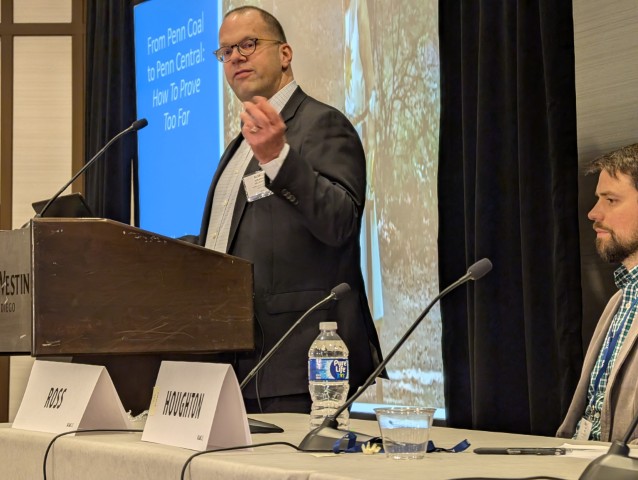
  • From Penn Coal to Penn Central: How to


Continue Reading Breaking News: Come Join Us For The 42d ALI-CLE Eminent Domain & Land Valuation Litigation Conference, San Diego, Jan 30-Feb 1

We’re not going to pretend to fully understand the Supreme Court of India’s recent decision in Property Owners Ass’n v. State of Maharashtra, No. 2012-2022 (Nov. 4, 2024) for obvious reasons (plus, the judgement and various opinions and dissents total 193 pages).

But we post it here because we think it gives some insight how other jurisdictions and cultures view expropriation, and the role of property rights in free societies.

Some background. The Constitution of India (article 39(b)) has been held by the Supreme Court to embody a concept known as “constitutional socialism.” It provides:

The State shall, in particular, direct its policy towards securing–

(b) that the ownership and control of the material resources of the community are so distributed as best to sub serve the common good.

Not quite the Fifth Amendment, is it?

Indeed, Justices of the Supreme Court have opined that constitutional

Continue Reading Blight Redevelopment & Eminent Domain, India Style: Private Property As A Basis For “Economic Democracy”

You all have likely seen ’em, those “We Buy Houses Any Condition” billboards letting the world know that no matter what condition it might be in, there’s an outfit that says it is willing to buy your house.

Well, that outfit ran into the one other outfit that is willing to buy your house, except here, that outfit can force you to sell it. That’s right, the government. In this case, the City of Ontario, California, exercising its power of eminent domain. (As someone once famously described the power of eminent domain: “whether you know it or not, your house is for sale.”)

The city went through the usual motions to forcibly take “multiple vacant lots” next to the Ontario International(!) Airport which it claimed were blighted:

In 2021, the City held a public hearing, after which the city council adopted a resolution of necessity authorizing the City to

Continue Reading Blight Slight: No Taking Of Property For “The Proposed Project” When No Project Has Been Proposed

PXL_20231202_194330453.PORTRAIT

Here it is — Professor Gideon Kanner’s final law journal article, published shortly before his passing:

Gideon Kanner, Eminent Domain Projects That Didn’t Work Out, 12 Brigham-Kanner Prop. Rts. J. 171 (2023).

Appropriately, we think, published in William and Mary Law School’s Brigham-Kanner Property Rights Journal, named in part in Gideon’s honor.

This isn’t a typical law journal article, but an essay collecting Professor Kanner’s thoughts, comments, and (best of all) opinions on, well, eminent domain (and redevelopment) projects that didn’t work out.

In Gideon’s own words, from the Introduction:

But whether you favor widespread use of eminent domain or not, and whether the projects created by its use are sound or not, it is deplorable that the power of eminent domain has been often deployed to the detriment of racial and politically powerless minorities. Typically, redevelopment projects tend to displace middle class and poor people from

Continue Reading Professor Kanner’s Final Article: “Eminent Domain Projects That Didn’t Work Out,” 12 Brigham-Kanner Prop. Rts. J. 171 (2023)

The New York Appellate Division’s opinion in Huntley Power, LLC v. Town of Tonawanda, No. 22-011460 (June 9, 2023), is typically short (6 pages, including a dissent).

The town instituted eminent domain proceedings to take Huntley’s riverfront property, including an electric plant decommissioned in 2016, and water intake structures. The asserted public use is “revitalizing and redeveloping the former industrial property, which was a blight on the Town, and maintaining the critical raw water supply to significant industrial employers in the Town[.]” Slip op. at 2.

That was enough for the court to “reject reject petitioner’s contention that the condemnation will not serve a public use, benefit, or purpose[.]” Id. Rational basis, and so forth.

Nor was the condemnation “excessive,” because it allegedly took more than it needed.” There’s no obvious abuse — or at least any abuse that would qualify as an abuse of discretion. Slip op. at

Continue Reading NY App Div: OK To Condemn Blighted Property To Sell To Private Developer

Remember that case from a couple of years back, where the Supreme Court, by a tantalizingly close vote, declined to grant a cert petition seeking review of an Illinois decision that preventing future blight was a sufficiently public use to support a redevelopment taking? 

A law student at Catholic U. law school recently made a presentation on the case and the issues as part of the Student Scholars Series, and the law school has kindly made the video available. More here.

We think it is fantastic both that law students are examining these issues, and that the law school encourages and promotes their work. It gives us comfort for the future of the profession, and the Dirt Law Bar.

Well done, Mr. Tocchio!Continue Reading Catholic U Law School Student Scholar: “Eychaner v. City of Chicago: Repercussions after The Supreme Court refuses to take up a Takings Clause Reconsideration”

LUI

Here are the opinions that we spoke about this afternoon at the Land Use Institute on “The Use of Eminent Domain for Redevelopment & Economic Development Projects.”

Thanks for joining in.Continue Reading Cases And Links From Today’s Land Use Institute Session: “The Use of Eminent Domain for Redevelopment & Economic Development Projects”