In an earlier post (“CAFED: Like We Said Before, “Inevitably Recurring” Flooding Is A Taking“), we covered the U.S. Court of Appeals for the Federal Circuit’s recent opinion in Alban v. United States, No. 23-1363 (Dec. 22, 2025), which held that the failure of the Corps of Engineers to properly operate two dams which resulted in upstream flooding when Hurricane Harvey struck was a “permanent” taking.

In this post, we’ll cover the latter part of the opinion, which dealt with the just compensation aspects of the case (each party appealed a portion of the Court of Federal Claims’s damage award).

The first claim was that the CFC’s award of compensation for damage to structures and personal property was not compensable. The Federal Circuit clarified that had the government merely taken a flowage easement, its claim to not be liable for such damage might have had some merit.

Continue Reading CAFED: Where The Government Chooses To Not Condemn But Allows It To Happen, It “Bears The Risk” That The Property Taken Is More Than The Government Wants To Pay For

Here’s the latest in an issue we’ve been following.

In Alban v. United States, No. 23-1363 (Dec. 22, 2025), the U.S. Court of Appeals for the Federal Circuit affirmed the Court of Federal Claims’s judgment concluding that the failure of the Corps of Engineers to properly operate two dams, which resulted in upstream flooding when Hurricane Harvey struck was a “permanent” taking.

The dams were built nearly 100 years ago to reduce downstream flood risks. The reservoirs are usually dry, and fill up when it rains a certain amount. At the time of construction, the Corps considered acquiring property which would be inundated when the reservoirs filled up to a certain level, but ultimately decided to not do so. The Corps made the decision to acquire only the properties predicted to be flooded in smaller storms. The Corps understood that flooding of additional property was predicted in more

Continue Reading CAFED: Like We Said Before, “Inevitably Recurring” Flooding Is A Taking

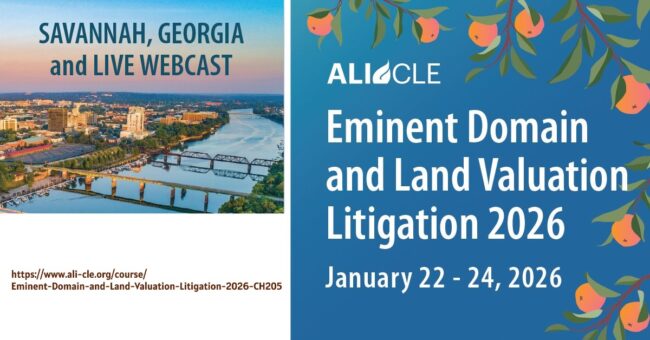
As we wrap up another year, it’s time to look ahead to the one event that always gets our eminent domain blood pumping: the annual ALI-CLE Eminent Domain and Land Valuation Litigation Conference. Details, including faculty list, a complete agenda, and registration information is posted here.

Now in its 43rd year, this flagship gathering remains the undisputed national hub for practitioners, academics, appraisers, and anyone else who lives and breathes property rights law. Mark your calendars for January 22-24, 2026, when we’ll convene at the JW Marriott Plant Riverside District in Savannah, Georgia. Think historic charm meets Southern hospitality, with moss-draped oaks, riverfront vibes, and enough ghost tours to inspire a dozen inverse condemnation hypotheticals. (For those of you who prefer pixels to palm trees, a live webcast option is available.)

What makes this conference indispensable? For starters, it’s the place to reconnect and talk shop with the

Continue Reading Savannah Bound: Don’t Miss The 43rd ALI-CLE Eminent Domain & Land Valuation Litigation Conference (Jan. 22-24, 2026)

“A brighter tomorrow is only a day away.”

So held the U.S. Court of Appeals for the Fifth Circuit in an important case, DM Arbor Court, Ltd. v. City of Houston, No. 23-20385 (Aug. 12, 2025). 

The issue was whether the City of Houston’s denial of a rebuilding permit after a flood was a Lucas taking. De facto taking, regulatory taking, involuntary regulatory servitude. Call it what you will, the theory is the same. You mavens understand what that means: a regulation or other government action has deprived the property of all economically-beneficial uses. So even though the owner retains title and ownership, the lack of such uses means that from the owner’s perspective, the government might as well have taken the property by eminent domain.

The appraisers for the parties agreed that the denial of the permit “ended Arbor Court’s economic life.” Slip op. at 7.

Continue Reading CA5: Land Value From “Holding For Investment” (aka Speculation) Is Not An Economically-Beneficial Use

Please add this one to your podcast listening queue: the latest episode of Bound by Oath, produced by John Ross at the Institute for Justice. BBO isn’t a typical podcast, but more of an audio documentary as we have noted before. If you aren’t a subscriber, you really should be. 

This episode focuses on regulatory takings, and the sleight-of-law that governments frequently employ to avoid the merits of takings claims, or perhaps worse yet to avoid paying compensation even after ordered to. Cases detailed include DeVillier, Agins, First English, Violet Dock Port, Ariyan. This episode is a great companion piece to BBO‘s episodes on Euclid (zoning), Pennsylvania Coal (reg takings), and Berman (Public Use). 

Put on your “self-executing” hat and take a listen! 

Here’s the description of the episode:

The Fifth Amendment says that the government must pay just compensation when it takes

Continue Reading Must-Listen Podcast: “Neat Takings Tricks” (Bound by Oath, S3, E3)

PXL_20230509_183011703

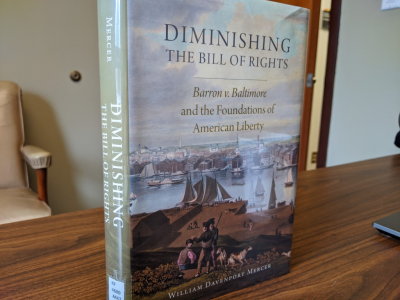
This Sunday, February 16, 2025, will be the day, 192 years ago, when — a mere 5 days after oral arguments — the U.S. Supreme Court issued its (in)famous opinion in Barron ex rel. Tiernan v. Mayor and City Council of Baltimore, 32 U.S. 243 (1833).

Generations of law students study this decision in their Con Law classes, and it is mostly known as the case in which the Court held that the Bill of Rights limits only the federal government and does not limit the power of states. For the latter, one must look to state constitutions. Barron, of course, was overruled or otherwise neutralized by the Fourteenth Amendment (privileges or immunities clause or the due process clause, take your pick). And it was formally abrogated in Chicago, Burlington and Quincy Railroad Co. v. City of Chicago, 166 U.S. 226 (1897) (states and their instrumentalities are bound

Continue Reading Feb. 16, 1833: Unhappy 192d Birthday To The First SCOTUS Takings Case, Barron v. Baltimore

2025 San Diego

Get ready to join your colleagues and friends in San Diego for the 42d ALI-CLE Eminent Domain & Land Valuation Litigation Conference.

The 41st Conference was in New Orleans. Here’s a report of that event, and here are our reports from prior conferences in Austin and Scottsdale.

Here are some of the highlights of the upcoming Conference:

  • Property Rights at the Supreme Court: DeVillier and Sheetz and What’s Next
  • Slow Take: Possession, Rent, Relocation, and Offset
  • The Jury’s View: How Jurors See Your Case
  • From Penn Coal to Penn Central: How to Prove “Too Far”
  • Leveraging Expertise in Eminent Domain Litigation: Working with Land Planners, Engineers, and Other Predicate Experts
  • Kelo at Twenty: What Changed, What Didn’t, and What’s on the Horizon
  • Viva Las Vegas: How the Nevada Judiciary Upheld Property Rights in 180 Land’s Inverse Condemnation Taking
  • Ethics: Guiding the Trolley: Perspectives on Professional Ethics in


Continue Reading Registration For The 42d ALI-CLE Eminent Domain & Land Valuation Litigation Conference Is Underway (Don’t Miss Out!)

Here are the cases and other materials we discussed in today’s Section of State & Local Government Law Land Use group meeting on takings:


Continue Reading Links From Today’s ABA Land Use Session

Screenshot 2024-11-04 at 12-34-18 Texas Supreme Court
Charles McFarland, arguing.

Here’s the latest in a case we’ve been following closely (and disclosure: our firm filed an amicus brief in the Texas Supreme Court).

In The Commons of Lake Houston, Ltd. v. City of Houston, the Texas Court of Appeals held that the city could not be liable for a taking for an ordinance that limited development and use within the city’s 100-and-500-year floodplains because the ordinance was a valid exercise of police power and otherwise survived the rational basis test.

As we wrote here, that seems like utter nonsense to say that a valid police power reason categorically insulates a government action from a takings challenge. After all, the entire regulatory takings doctrine is built on the notion that an otherwise-valid exercise of government power (here, the police power, delegated from the State to the city) can so impact an owner’s property rights that

Continue Reading Oral Arguments In Texas Takings Case: If The Govt Limits Use For Healthsafetywelfaremorals, Is It Exempt From Takings?

On the surface, the Virginia Court of Appeals’ opinion in Town of Iron Gate v. Simpson, No. 1588-23-3 (Sep. 17, 2024) deals with a straightforward issue in a straightforward way: the property owner’s inverse complaint adequately alleged that the Town’s flooding of her property was for a public use, and thus properly survived the Town’s demurrer.

As the Virginia Supreme Court has held, one of the elements of pleading a legally-adequate inverse condemnation complaint for flooding is an allegation that the flooding was for some public use. The court of appeals rejected the Town’s argument that Simpson failed to allege public use, holding that the complaint’s allegation that the Town “used her ‘property as a ‘makeshift storage site for excess stormwater,’ which was accomoplished for the public use of maintaining and operating the Town’s stormwater system[,]'” was certainly good enough:

She alleged that the Town “purposefully uses, operates

Continue Reading Va App: It Doesn’t Take Much To Allege Public Use In Inverse Condemnation