
If you are a plaintiff, you may rightly predict that if an opinion begins with the words, “[r]oughly two decades ago…” there’s a good chance you aren’t going to like the outcome. Courts tend to not like cases that are based on facts that occured 20+ years ago, after all. But that’s how the U.S. Court of Appeal for the Fourth Circuit’s opinion in Poppleton Now Community Ass’n LLC v. La Cite Development, LLC, No. 25-1770 (May 4, 2026) begins. Yet perhaps surprisingly, the court’s ruling against the plaintiffs is not based on the statute of limitations or some other defense keyed to the passage of time. Or any other procedural defense. Indeed, the court reversed district court’s judgment which had dismissed the complaint because the plaintiffs lacked standing.
Continue Reading CA4: Neighbors Can’t Challenge Failed Redevelopment That Resulted Only in “Vacant And Neglected” Property Next Door
CA6 Affirms Detroit Land Bank Taking: New Facts Defeat Res Judicata
This one is worth your time to review.
In HRT Enterprises v. City of Detroit, No. 23-1847 (Dec. 22, 2025), the U.S. Court of Appeals for the Sixth Circuit affirmed the district court’s entry of summary judgment in favor of the plaintiff/owner and a jury verdict on just compensation.
The case is notable not
Here’s The Agenda For The 2025 Brigham-Kanner Property Rights Conference (Oct. 23-24, 2025)

As you already know, registration is also underway for the 22d Brigham-Kanner Property Rights Conference, October 23-24, 2025, at the William and Mary Law School in Williamsburg, Virginia.
The Conference is expressly designed to get legal academics and the nation’s best dirt law practitioners in the same room, discussing how legal scholarship and law
“There’s no doubt about it – The Castle is the best Aussie movie of all time”
Readers of this blog are surely familiar with the soft spot we have in our heart for the Australian film, “The Castle.”
We described it as “Kelo Down Under,” noting that despite its comic spin, the film accurately portrays why owners of property object to eminent domain (in Australia, “compulsory
Ind App: Eminent Domain Abuse Is [Also] Abuse Of Process
What does a property owner do if she believes that the government’s eminent domain lawsuit is abusive? Is the remedy limited to the four corners of the eminent action (i.e., a counterclaim, third-party claim, etc.), or may a landowner institute a separate action which includes a tort claim for abuse of process?
In Indiana Land
Maine: Seller Of Land Has No Duty To Disclose Govt Plans To Condemn
A and B entered into a purchase and sale agreement for A to sell a commercial property (let’s call it “Blackacre”) to B, a commercial real estate developer.
A knew that the city planned to redevelop the area for a roundabout, “that would require the City to take over a portion of the property by
Join Us: “Property Rights and The Roberts Court: 2005-2025” (Feb. 27, 2025, UC Berkeley Law School)

Register now and plan on joining us on Thursday, February 27, 2025 at the U.C. Berkeley Law School for a one-day conference: “Property Rights and the Roberts Court: 2005-2025.”
Here’s the agenda. Here’s a description of the program:
For much of the past century, property rights were relegated to second-class status compared
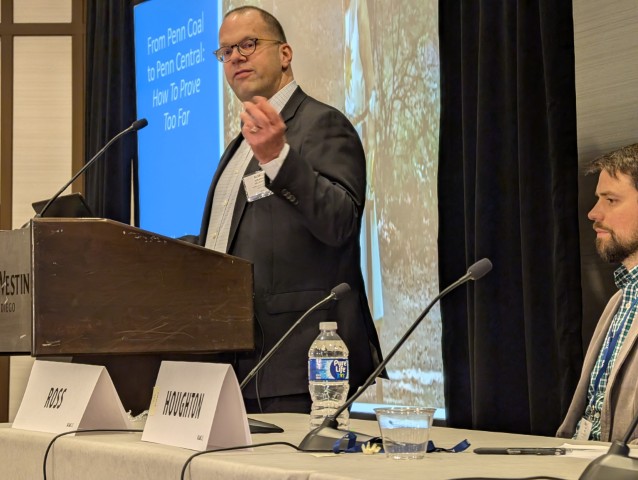
Breaking News: Come Join Us For The 42d ALI-CLE Eminent Domain & Land Valuation Litigation Conference, San Diego, Jan 30-Feb 1
With our tongues firmly planted in cheeks, the Planning Chairs for the upcoming 42d edition of this popular and venerable Conference bring you this “breaking news” report from San Diego!
As you know, in addition to being the best nationally-focused conference on the subjects that we love and a venue that is nearly certain to have some of the warmest winter weather in the continental United States, and we went on-location from some of the local highlights: the beaches, Torrey Pines, the Zoo, Balboa Park, the Gaslamp Quarter, and Coronado to name but a few.
More about the Conference here, including registration information.
Here are some of the highlights:
- Property Rights at the Supreme Court: DeVillier and Sheetz and What’s Next
- Slow Take: Possession, Rent, Relocation, and Offset
- The Jury’s View: How Jurors See Your Case
- From Penn Coal to Penn Central: How to Prove “Too Far”
- Leveraging Expertise in Eminent Domain Litigation: Working with Land Planners, Engineers, and Other Predicate Experts
- Kelo at Twenty: What Changed, What Didn’t, and What’s on the Horizon
- Viva Las Vegas: How the Nevada Judiciary Upheld Property Rights in 180 Land’s Inverse Condemnation Taking
- Ethics: Guiding the Trolley: Perspectives on Professional Ethics in Eminent Domain for Lawyers, Appraisers, and Right of Way Agents
- “I Think I Shall Never See” Just Compensation For a Tree: Strategies to Securing Recovery for Trees, Crops, and Fixtures
And more. Check out the complete agenda here. Registration information here.
We especially welcome first-time participants, or those returning after an absence. Connect (or reconnect) with your colleagues from across the nation.
The 41st Conference was in New Orleans. Here’s a report of that event, and here are our reports from prior conferences in Austin and Scottsdale.
Don’t miss out on San Diego: we have had record attendance in recent years, so hold your space now. #EminentDomain2025
Continue Reading Breaking News: Come Join Us For The 42d ALI-CLE Eminent Domain & Land Valuation Litigation Conference, San Diego, Jan 30-Feb 1Holiday Dirt Law Movie: “Christmas at the Drive In” (aka Rudolph The Red-Nosed Redeveloper)
‘Tis the season for TV holiday movies. Here’s one to add to your list, as it is on-brand for us dirt lawyers. “Christmas at the Drive In” is described thusly:
“A property lawyer works to prove that her town’s Drive In Theater, a local institution, is not closed down at the holidays, finding
Registration For The 42d ALI-CLE Eminent Domain & Land Valuation Litigation Conference Is Underway (Don’t Miss Out!)

Get ready to join your colleagues and friends in San Diego for the 42d ALI-CLE Eminent Domain & Land Valuation Litigation Conference.
The 41st Conference was in New Orleans. Here’s a report of that event, and here are our reports from prior conferences in Austin and Scottsdale.
Here are some of the