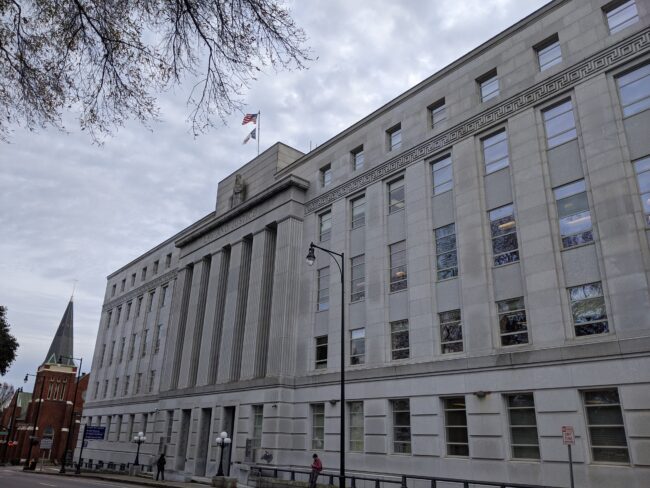
In State ex rel. Boggs v. City of Cleveland, No. 2025-Ohio-5094 (Nov. 13, 2025), the Ohio Supreme Court held that the City of Cleveland could be liable for inversely condemning land, even though that land is not in the City of Cleveland.

The city claimed that in order to be liable for inverse condemnation, it must have the authority to take the property by eminent domain. And under Ohio law, the state has only delegated to the city the power to take by eminent domain property that is within the city’s geographic boundaries. Therefore, the city argued, if we can’t affirmatively take the plaintiff’s land, we can’t be liable for inversely condemning it.

The case involves the Cleveland airport. As part of its runway expansion, airplanes would fly over adjacent properties (obviously), including properties outside the city’s jurisdiction. The city was authorized to purchase avigation easements on some

Continue Reading Ohio: City Can Be Liable For Inverse Condemnation Of Land Outside Its Geographic Jurisdiction

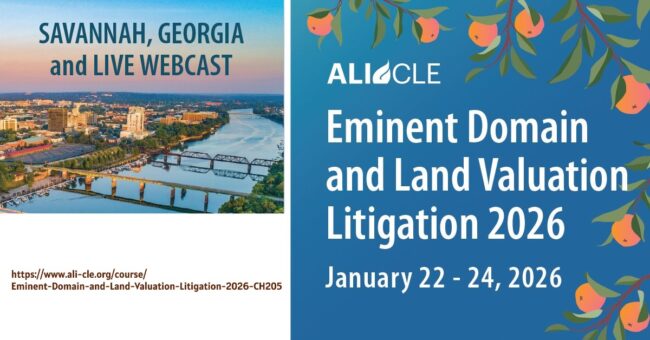
As we wrap up another year, it’s time to look ahead to the one event that always gets our eminent domain blood pumping: the annual ALI-CLE Eminent Domain and Land Valuation Litigation Conference. Details, including faculty list, a complete agenda, and registration information is posted here.

Now in its 43rd year, this flagship gathering remains the undisputed national hub for practitioners, academics, appraisers, and anyone else who lives and breathes property rights law. Mark your calendars for January 22-24, 2026, when we’ll convene at the JW Marriott Plant Riverside District in Savannah, Georgia. Think historic charm meets Southern hospitality, with moss-draped oaks, riverfront vibes, and enough ghost tours to inspire a dozen inverse condemnation hypotheticals. (For those of you who prefer pixels to palm trees, a live webcast option is available.)

What makes this conference indispensable? For starters, it’s the place to reconnect and talk shop with the

Continue Reading Savannah Bound: Don’t Miss The 43rd ALI-CLE Eminent Domain & Land Valuation Litigation Conference (Jan. 22-24, 2026)
Muchmagnacarta

Here’s the latest in a case we’ve been following which presents an important issue. So much so that we filed an amicus brief in support of the property owner.

In Town of Apex v. Rubin, No. 206PAA21 (Aug. 22, 2025), the North Carolina Supreme Court held that if a taking is determined to be for private benefit and not a public use or purpose, title and right of possession “revest” with the original owner.

The court also held that if, as here, the condemnor had already seized the land and completed construction, a court is not powerless to address it and may order the condemnor to “restore the land to its pre-construction condition. Whoa.

In short, this is an important one that is well worth your review. 

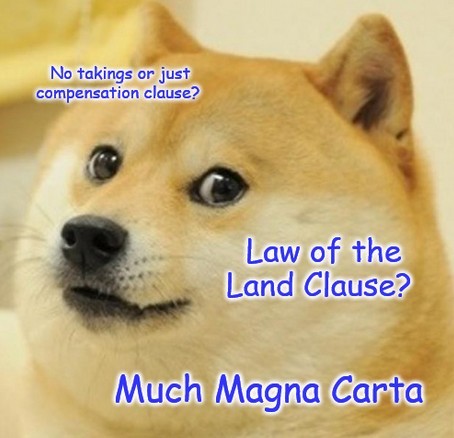
Before we get underway, a note: recall that the North Carolina Constitution does not have a “takings” or “just compensation” clause. Does

Continue Reading NC: If A Taking Is Determined To Lack A Public Use, Title Revests In Private Owner. If Construction Already Taken Place, Restoration Is An Available Remedy

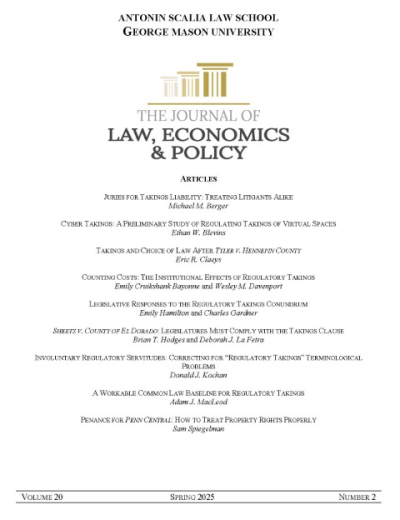
JLEPcover

Last year, we attended a conference devoted to the future of regulatory takings, hosted by the Antonin Scalia School of Law (George Mason U), and Pacific Legal Foundation.

The publisher, the Journal of Law, Economics, and Policy has released the articles and essays from that conference, and made them available here

Here’s the list of articles:

  • Michael M. Berger, Juries for Takings Liability: Treating Litigants Alike
  • Ethan W. Blevins, Cyber Takings: A Preliminary Study of Regulating Takings of Virtual Spaces
  • Eric R. Claeys, Takings and Choice of Law After Tyler v. Hennepin County
  • Emily Cruikshank Bayonne and Wesley M. Davenport, Counting Costs: the Institutional Effects of Regulatory Takings
  • Emily Hamilton and Charles Gardner, Legislative Responses to the Regulatory Takings Conundrum
  • Brian T. Hodges and Deborah J. La Fetra, Sheetz v. County of El Dorado: Legislatures Must Comply With the Takings Clause
  • Donald J. Kochan, Involuntary Regulatory Servitudes:


Continue Reading New Property Rights Symposium Published – “Too Far: Imagining the Future of Regulatory Takings”

“The Irrigation District will disavow any knowledge of your actions…”

In Hamann v. Heart Mountain Irrigation District, No. S-24-0234 (July 11, 2025), the Wyoming Supreme Court unanimously held that a state agency cannot avoid its obligation to provide just compensation when its employee causes a taking or damaging of private property, merely because the employee was not acting under an express instruction to take or damage property. 

In short, an agency can’t simply disavow actions of its employees that take take or damage property (or in this case, physically injure the owner). 

This is one of ours, so we are not going into great detail, but here is the short story.

A county road runs along the northern boundary of Hamann’s ranch. The Irrigation District operates and maintains a canal adjacent to the road and has used the northern road for access for decades. But the District also

Continue Reading Wyoming: Inverse Condemnation Claim Is How Owners Protect Property Rights Even Where Government Hasn’t Instituted Formal Action

Here’s the latest in a case we’ve been following closely (and disclosure: our firm filed an amicus brief in the Texas Supreme Court).

First, the bottom line: in The Commons at Lake Houston, Ltd. v. City of Houston, No. 23-0474 (Mar. 21, 2025), the Texas Supreme Court held that merely because a regulation is a justified exercise of police power does not insulate it from a claim that it goes too far and is also a taking requiring compensation. 

The Texas Court of Appeals held that the city could not be liable for a taking for an ordinance that limited development and use within the city’s 100-and-500-year floodplains because the ordinance was a valid exercise of police power and otherwise survived the rational basis test.

As we wrote here, that seems like utter nonsense to say that a valid police power reason categorically insulates a government action

Continue Reading Breaking: Texas Takings Law Enters The 20th Century!

TX Em Domain 2025 Austin

Texans: now is a good time to register for the 24th Annual Texas Eminent Domain Superconference, March 27-28, 2025, at the Austin Country Club in Austin.

We spoke at the Conference a couple of years agolast year and in other editions, and can report that it is excellent. Check out the faculty and agenda, and then register and reserve your spot.Continue Reading Texas Eminent Domain Conference – Austin, March 27-28, 2025

A short one from the California Court of Appeal, Shehyn v. County of Ventura Public Works Agency, No. B337452 (Feb. 20, 2025).

Bottom line: the court reversed the trial court’s demurrer, which had dismissed a flood inverse claim. Good news, the owner gets to press its claim. 

The plaintiff here is the owner of a commercial avocado orchard. The complaint alleged that sediment from the County’s water district damaged irrigation pipes on the owner’s land, and inversely condemned the plaintiff’s property. The trial court sustained the demurrer on the grounds that … get this …  the owner “‘invited’ District water onto his property.” Slip op. at 5.

And how did the avocado farmer “invite” the district’s water on the property? Apparently by being a water customer of the district. Well, the court of appeal wasn’t having any of that, instead viewing the issue as whether the plaintiff alleged it

Continue Reading Don’t Get Between California And Its Avocados – Court OK’s Inverse Flooding Claim

With our tongues firmly planted in cheeks, the Planning Chairs for the upcoming 42d edition of this popular and venerable Conference bring you this “breaking news” report from San Diego!

As you know, in addition to being the best nationally-focused conference on the subjects that we love and a venue that is nearly certain to have some of the warmest winter weather in the continental United States, and we went on-location from some of the local highlights: the beaches, Torrey Pines, the Zoo, Balboa Park, the Gaslamp Quarter, and Coronado to name but a few.

More about the Conference here, including registration information.

Here are some of the highlights:

  • Property Rights at the Supreme Court: DeVillier and Sheetz and What’s Next
  • Slow Take: Possession, Rent, Relocation, and Offset
  • The Jury’s View: How Jurors See Your Case
  • From Penn Coal to Penn Central: How to


Continue Reading Breaking News: Come Join Us For The 42d ALI-CLE Eminent Domain & Land Valuation Litigation Conference, San Diego, Jan 30-Feb 1