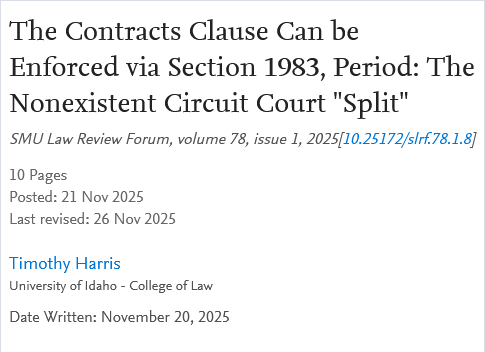
Check out a newly-published law review article by lawprof Timothy Harris, “The Contracts Clause Can be Enforced via Section 1983, Period: The Nonexistent Circuit Court ‘Split’,” 78 SMU L. Rev. Forum 106 (2025).

The article delves into the issue of whether 42 U.S.C. § 1983 is the cause of action to bring a Contracts Clause challenge. The Contracts Clause prohibits states from passing any law impairing the obligation of contracts, and the fundamental question to be answered is whether your Contracts Clause rights are “rights, privileges, or immunities secured by the Constitution and laws” as described in section 1983.

Here’s the Abstract:

The Federal Circuit Courts are apparently split on whether 42 U.S.C. § 1983—which provides a civil cause of action for constitutional deprivation of rights— applies to actions brought under the Contracts Clause in article 1 of the U.S. Constitution. The “split” has existed since

Continue Reading New Article: Timothy Harris, “The Contracts Clause Can be Enforced via Section 1983, Period: The Nonexistent Circuit Court ‘Split’,” 78 SMU L. Rev. Forum 106 (2025)

There’s not a lot of new territory forged in the U.S. Court of Appeals for the Ninth Circuit’s opinion in Pena v. City of Los Angeles, No. 24-2422 (Nov. 4, 2025), holding that the city could not be liable for a taking after SWAT officers severely damaged a home in the course of apprehending a suspect who had taken refuge there.

After all, the other federal courts which have addressed the issue of whether a local government’s damaging or destroying a home in the course of apprehending a criminal suspect is a taking have all concluded no, although for a variety of reasons. Some say there’s no absolute right to exclude, with the issue turning on whether the police are acting pursuant to a valid warrant, incorporating by reference Fourth Amendment property law. Some say the owner has no expectations of exclusion of the government as a

Continue Reading CA9: No Claim For A SWAT Taking Because There’s A Public Safety Exception To The Fifth Amendment

In Witherspoon v. Ince, No. 24-6194 (Oct. 9, 2025), the U.S. Court of Appeals for the Tenth Circuit held that a property owner who alleged that Oklahoma’s system of private takings — where the state authorizes private parties to use eminent domain to take what looks like an easement by necessity over a neighbor’s land for access — is unconstitutional, cannot sue the State under 42 U.S.C. § 1983 to raise that claim.

The private taking is not “under color of state law,” according to the court.

If that seems counterintuitive (after all, the neighbors are literally using a State-authorized process to seize property for their own private uses), the court found a way noodle through it:

Section 1983 creates civil liability for “[e]very person who, under color of any statute, ordinance, regulation, custom, or usage, of any State . . ., subjects, or causes to be subjected, any

Continue Reading CA10: Color Of What? Private Takings Are Not Government Action

A short one (unpublished) from the U.S. Court of Appeals for the Sixth Circuit in a Tyler taking case (an issue that seems like it is on a lot of courts’ minds right now).

In Wayside Church v. Van Buren County, No. 24-1598 (Oct. 6, 2025), the court affirmed the district court’s certification of class certification and the subsequent class settlement. This issue is only of mild interest to us, and it isn’t reason we’re posting this case.

What really grabs our attention is Judge Kethledge’s concurring opinion (scroll down to page 23 of the pdf). It is not only a good overview of the home equity theft takings issue, but also points out how the just compensation rules actually work to keep property owners from receiving full compensation for what they have lost, especially in a class action settlement situation compared to a non-class section 1983 claim:

To

Continue Reading “Local governments should serve their people, not prey upon them” – CA6 Approves Takings Class Action Settlement (But Not Enthusiastically)

Here’s the cert petition which we filed recently. We won’t be saying much about this one because it is one of ours. 

But here’s the Question Presented, which pretty much says it all:

The City of Lathrup Village, Michigan, prohibits leasing commercial property without a license. But the City will not issue a license unless the property owner first discloses the names of prospective tenants and a description of the tenants’ principal business activity.

Petitioners omitted this information in a license application to comply with a nondisclosure provision in its lease agreements, were denied a license, and are therefore prohibited from renting their property. They sued under 42 U.S.C. § 1983, challenging the disclosure requirement as an unconstitutional “Law impairing the Obligation of Contracts.” U.S. Const. art. I, § 10.

The Sixth Circuit, joining the Fourth, held that “an alleged Contracts Clause violation cannot give rise to a cause of

Continue Reading New Cert Petition – Time To Resolve Contract Clause Circuit Split: Can You Raise A Claim Via Section 1983?

Here’s a recent cert petition which asks the Supreme Court to take up the case of a small property owner in West Hollywood, California, whose case was dismissed when he asked “[h]ow far can a city expand rent control to advance general socioeconomic policies before crossing constitutional property protections?” Pet. at 3. 

Here are the Questions Presented:

1.  Whether a municipality may transform temporary emergency rent restrictions and occupancy mandates adopted at the start of the COVID-19 pandemic into permanent rent control measures that expand benefits to tenants and the public at large at the expense of private property owners, without triggering scrutiny under the Takings and Due Process Clauses of the Fifth and Fourteenth Amendments of the U.S. Constitution.

2.  Whether the denial of leave to amend, despite the viability of property claims for takings and due process violations, constituted an abuse of discretion under this Court’s liberal standard

Continue Reading New Cert Petition: Is Expanding Temporary Emergency Measures Into Permanent Rent Control A Problem?

It appears that the U.S. Court of Appeals for the Eleventh Circuit has addressed the issue the U.S. Supreme Court sidestepped recently in DeVillier v. Texas, 601 U.S. 285 (2024): do you need Congress’s ok to sue for just compensation for a taking?  

In Fulton v. Fulton County Bd of Commissioners, No. 22012041 (July 31, 2025), a 2-1 panel of the court held that the Just Compensation Clause is indeed “self-executing,” meaning that even in the absence of a legislative recognition of a cause of action, an owner whose private property has (allegedly) been taken by government action may sue for compensation. 

The opinion starts off dramatically, with this:

In Greek mythology, the Greek gods condemned Tantalus to eternal hunger and thirst, all while forcing him to forever stand in a shallow pool of water under a tree with low-hanging fruit. Though the remedy for Tantalus’s hunger and

Continue Reading CA11: Congress Doesn’t Need To Legislate A Cause Of Action For Just Compensation

“The Irrigation District will disavow any knowledge of your actions…”

In Hamann v. Heart Mountain Irrigation District, No. S-24-0234 (July 11, 2025), the Wyoming Supreme Court unanimously held that a state agency cannot avoid its obligation to provide just compensation when its employee causes a taking or damaging of private property, merely because the employee was not acting under an express instruction to take or damage property. 

In short, an agency can’t simply disavow actions of its employees that take take or damage property (or in this case, physically injure the owner). 

This is one of ours, so we are not going into great detail, but here is the short story.

A county road runs along the northern boundary of Hamann’s ranch. The Irrigation District operates and maintains a canal adjacent to the road and has used the northern road for access for decades. But the District also

Continue Reading Wyoming: Inverse Condemnation Claim Is How Owners Protect Property Rights Even Where Government Hasn’t Instituted Formal Action

A short one from the U.S. Court of Appeals for the Sixth Circuit.

In Wenzel v. Federspiel, No. 24-1278 (June 20, 2025), the Sheriff was accused of keeping “fourteen firearms seized in a criminal investigation that ended years ago.” Slip op. at 1. Eventually, the claimed owners of those guns sued, inter alia, for a taking. You got no proof that these guns belong to you, replied the Sheriff. 

The plaintiffs “do not have any documents proving their ownership,” slip op. at 2, so in support of their motion for summary judgment, they submitted declarations that they owned the guns. We’re not sure whether the Sheriff responded with any evidence of his own. But in the end, the district court granted the Sheriff summary judgment because the plaintiffs “had not established constitutional violations.” Slip op. at 3. 

After first concluding that the Sheriff in his personal capacity was

Continue Reading CA6: A Wrongful Keeping Is A Taking, If Plaintiff Proves He Owns The Kept Property

Magna_Carta_(British_Library_Cotton_MS_Augustus_II.106)

810 years ago today* on a grassy plain down by the river, the barons convinced bad King John to affix his seal to Magna Carta. Or the Magna Carta. Or Magna Charta. However you want to grammarize it. (And no, he didn’t “sign” it, they didn’t do things like that back then.)

And boy was that guy bad even by the standards of medieval royals: when you type “bad king…” in your search engine, the first suggested search is “bad king … John.”

Badkingjohn

There’s a lot of good stuff in Magna Carta — and a lot of stuff that has been rendered irrelevant or quaint by the passage of time, and even some stuff that we’d consider cringe-worthy today (see art. 10, for example).

But we takings geeks all know and continue to appreciate article 28:

Nullus enarius aries, vel alius ballivus noster, capiat enar vel

Continue Reading Happy 810th (The) Magna Carta (Charta) Day!