If you were creating a moot court problem, what topic would you pick? You’d want a question that is a hot topic. Unresolved by the Supreme Court. Controversial, interesting, and complex.

Well, we have just the issue for you: our favorite topic, takings.

That appears to be what the powers-that-be behind Harvard Law School’s moot court competition believed, because according to this report (Rachel Reed, “Harvard Law students battle for honors at the 2025 Ames Moot Court Competition,” Harvard Law Today (Nov. 19, 2025)), the student teams were confronted with a case where there was a clear taking (the commandeering and take-over of a hand sanitizer plant during Co-19), but the plant owner was denied a remedy because the defendant is the (fictional) State of Ames.
Ah yes, the question the Court dodged recently in DeVillier v. Texas, 601 U.S. 285 (2024): may an owner whose property

Continue Reading Harvard Law School’s Moot Court Problem This Year? Takings.

Check this out: a significant and important decision from the U.S. Court of Appeals for the Eleventh Circuit in an issue we’ve been following.

In Alford v. Walton County, No. 2021-13999 (Nov. 17, 2025), the unanimous panel concluded that the county’s Co-19 restrictions, which closed all beaches (public and private) in the county, worked a physical taking of Alford’s private property rights.

In response to the outbreak of Co-19, which the opinion notes was “a novel virus from Wuhan, China,” slip op. at 3, Florida declared a state of emergency, and followed up with an executive order that limited beach access statewide to “no more than 10 persons,” imposed a six-foot separation, among other things. Two days later, the county adopted an ordinance closing all public beaches in the county.

The following month, after the governor issued further executive orders, the county temporarily closed “[a]ll beaches” in the

Continue Reading CA11: “[T]here is no COVID exception to the Takings Clause”
Darby

Here’s the latest in a case we’ve been following.

The federal government has asked (and been granted), an extension of time in which to file a cert petition in the Darby case.

That’s the one in which the U.S. Court of Appeals for the Federal Circuit allowed a claim that the federal government is liable for a physical taking for the Center for Disease Control’s residential eviction moratorium. The U.S. Supreme Court eventually invalidated the moratorium, and several property owners who were prevented from removing tenants are seeking just compensation. 

There’s nothing particularly earth-shattering about the government seeking more time. Indeed, it is rather routine. But the request included a somewhat unusual peek behind the Solicitor General curtain. We suppose the SG could have just asked for more time, and it would have been granted. But the request included an indication that there’s a bit of contention within

Continue Reading Is A Gov’t Cert Petition In Darby (Eviction Moratorium Physical Takings) Forthcoming?

Here’s a recent cert petition which asks the Supreme Court to take up the case of a small property owner in West Hollywood, California, whose case was dismissed when he asked “[h]ow far can a city expand rent control to advance general socioeconomic policies before crossing constitutional property protections?” Pet. at 3. 

Here are the Questions Presented:

1.  Whether a municipality may transform temporary emergency rent restrictions and occupancy mandates adopted at the start of the COVID-19 pandemic into permanent rent control measures that expand benefits to tenants and the public at large at the expense of private property owners, without triggering scrutiny under the Takings and Due Process Clauses of the Fifth and Fourteenth Amendments of the U.S. Constitution.

2.  Whether the denial of leave to amend, despite the viability of property claims for takings and due process violations, constituted an abuse of discretion under this Court’s liberal standard

Continue Reading New Cert Petition: Is Expanding Temporary Emergency Measures Into Permanent Rent Control A Problem?

Here’s the latest in a case we’ve been following.

In Hudson Valley Property Owners Ass’n v. City of Kingston, No. 59 (June 18, 2025), the New York Court of Appeals held that after a municipality declares a housing emergency allowing it to regulate the amount of rent, it has the power to order lessors to refund to tenants rent which exceeded the maximum allowed amount, even if those rents had been collected prior to the declaration of the emergency. 

At least that is how we read the opinion. Due to its somewhat unusual procedural posture, the court did not actually allow the city to nail property owners for retroactive “overcharges,” it merely rejected the owners’ claims that because the statute may allow it in particular cases, it isn’t facially unconstitutional.

This was a facial challenge by property owners to Kingston, New York’s declaration of a housing emergency during

Continue Reading NY: In A Housing “Emergency,” City Can Retroactively Lower The Rent, Even Rent Collected Before The Emergency

Screenshot 2025-06-30 201407

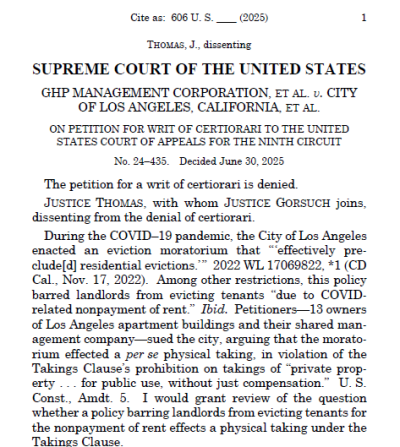
Yesterday, in this Order in a case we’ve been following, the U.S. Supreme Court declined to consider whether a municipal ordinance which allowed non-paying tenants to remain in the lessor’s property after the agreed-upon termination of a lease (nonpayment of rent) is a physical taking, or merely the regulation of the lessor/lessee relationship under the Yee theory.

You remember that theory? It goes like this: once an owner voluntarily rents property to a tenant, the government then allowing that tenant to remain rent-free when, under the rental agreement, the right to occupancy would otherwise be terminated (for failure to timely pay rent, for example) isn’t the government facilitating an unauthorized physical occupation (see, e.g., Kaiser Aetna), but rather is merely a regulation of the existing lessor/lessee relationship. The Ninth Circuit in this case, and other courts around the country have viewed Yee as compelling

Continue Reading The Other Shoe Drops: SCOTUS Declines Review Despite Acknowledged Split – Is Barring Owners From Evicting Nonpaying Tenants A Physical Taking?

SCOTUSdoor
Knocking on the Supreme Court’s door

Earlier this week in this Order, the U.S. Supreme Court declined to review four property rights cert petitions (three of which were ours):

Is this a sign, something we should place any significance in?

Of course, reading Supreme Court tea leaves is a fool’s errand except for nine people, none of whom are talking. Sometimes there are hints, such as dissents from cert denials, or statements. Not this time. Just what might be considered “routine” denials.

We don’t think that these denials should tell us much of anything about some

Continue Reading Should We Make Anything Of The Supreme Court’s Denial Of Four Property Rights Petitions?

Here’s the latest in a case we’ve been following

In this Order, the U.S. Court of Appeals for the Federal Circuit denied en banc review of a 2-1 panel opinion which concluded that a complaint challenging the CDC’s Co-10 residential eviction moratorium properly pleaded a physical takings claim even though the Supreme Court eventually invalidated the moratorium as beyond the CDC’s authority.

In that opinion, the Court also noted that preventing a property owner from “evicting tenants who breach their leases intrudes on one of the most fundamental elements of property ownership–the right to exclude.” The Darby panel concluded similarly, holding that prohibiting evictions is not merely regulating the lessor-lessee relationship, but could result in a physical occupation taking. This issue is the same one we’ve been on hold waiting to see if the Supreme Court is willing to take up in GHP Management Corp. v.

Continue Reading Fed Cir Denies En Banc, Tees Up SCOTUS: Can There Still Be A Taking If Government Acts Illegally? Is Prohibiting Eviction A Physical Taking?

Here’s a recently-filed cert petition raising questions in a challenge to Los Angeles’ County’s imposition of ban on commercial evictions during Co-19. A lot of other jurisdictions around the country imposed eviction restrictions or prohibitions on residential properties, but LA County stood alone in restricting commercial evictions.

This one asks whether a party is categorically barred from asserting a claim that a local government impaired a contract solely because other jurisdictions had adopted or were adopting similar restrictions (although here, those restrictions affected only residential leases), and thus had no expectation of having his contract unimpaired.  

This is out of our shop, so we’re not going to say much more about it except to post the Question Presented:

In response to the COVID-19 pandemic, the County of Los Angeles enacted a moratorium that prohibited commercial landlords from, among other things, evicting defaulting tenants and demanding immediate payment of overdue rent.

Continue Reading New Cert Petition: To Assert A Contracts Clause Claim, Must You Predict Futurelaw?

Two — count ’em two! — cert petitions from our shop, filed today. Both call for “clarifying or overruling” Penn Central.

Oh, have I got your attention now?

Both arise out of the Michigan governor’s orders shuttering some, but not all, businesses during Co-19. These had devastating consequences, and owners sued for, inter alia, a taking, asserting a Penn Central theory. As we noted here, the Gym 24/7 case went up through the Michigan court system, with the Supreme Court eventually denying discretionary review over an extensive dissent. The Mount Clemens Recreational Bowl case took pretty much the same path. 

We’re not going to say much more because

Continue Reading Two New Cert Petitions (Ours) – 50 Years Of Fruitless Trying Is Enough: Overrule Or Clarify Penn Central!