
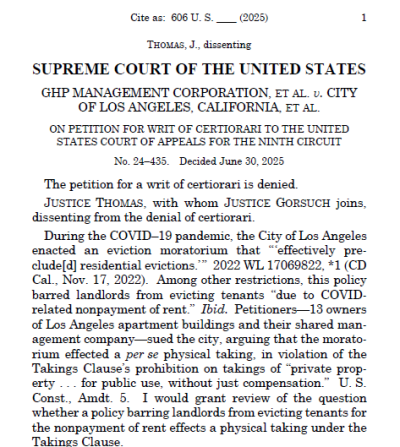
Yesterday, in this Order in a case we’ve been following, the U.S. Supreme Court declined to consider whether a municipal ordinance which allowed non-paying tenants to remain in the lessor’s property after the agreed-upon termination of a lease (nonpayment of rent) is a physical taking, or merely the regulation of the lessor/lessee relationship under the Yee theory.
You remember that theory? It goes like this: once an owner voluntarily rents property to a tenant, the government then allowing that tenant to remain rent-free when, under the rental agreement, the right to occupancy would otherwise be terminated (for failure to timely pay rent, for example) isn’t the government facilitating an unauthorized physical occupation (see, e.g., Kaiser Aetna), but rather is merely a regulation of the existing lessor/lessee relationship. The Ninth Circuit in this case, and other courts around the country have viewed Yee as compelling that analysis. You are a chump property owner, for believing that your rental agreement or the reversionary interest you thought you had, means anything.
But the Federal Circuit says otherwise, and this can be analyzed as a physical occupation taking under Cedar Point.
Two Justices dissented from the denial of certiorari (Thomas, joined by Gorsuch). The dissenters recognized the lower court split (“This question is the subject of an acknowledged Circuit split.”), and would have granted the case to resolve this question:
I would grant review of the question whether a policy barring landlords from evicting tenants for the nonpayment of rent effects a physical taking under the Takings Clause.
This question is the subject of an acknowledged Circuit split. The Eighth and Federal Circuits have held that a bar on evictions for the nonpayment of rent qualifies as a physical taking, while the Ninth Circuit has held that it does not.
Dissent at 1.
This case has all the indicators of presenting an issue ready for review: an acknowledged lower court split; an issue of pressing national importance; a developed record; property owners similarly-situated being treated differently; beaucoup amicus supportmultiple relistings
The dissenters noted the conflict between how the lower courts have treated Yee on one hand, and Cedar Point on the other. Justice Thomas acknowledged that the Court “created this confusion” and has an “obligation” to fix it. He also noted that this issue is not limited to Co-19, or other claimed emergencies:
Finally, this issue is important and recurring. Given the sheer number of landlords and tenants, any eviction- moratorium statute stands to affect countless parties. And, the end of the COVID–19 pandemic has not diminished the importance of this issue. Municipalities continue to enact eviction moratoria in the wake of other emergencies. See, e.g., San Diego Cty., Cal., Ordinance No. 10936, §2 (N. S.)(2025) (codified at San Diego Cty., Cal., Code of Regulatory Ordinances tit. 3, div. 1, ch. 5, §31.503); Statement of Proceedings for the Public Hearing Meeting of the Board of Supervisors of the Cty. of Los Angeles 7–8 (Feb.25, 2025), https://file.lacounty.gov/SDSInter/bos/sop/1178834_022525.pdf. Even if it were otherwise, we would do well to clarify our case law now, rather than in the heat of the next national emergency.
Dissent at 3.
In the end, none of the other seven Justices agreed (remember that four Justices are needed to agree to review a case). Why? In the end no one but nine Justices know for certain.
So does this mean the majority of the Court is simply not interested? Or believes that the dicta which it issued solved the problem. See Alabama Assn. of Realtors v. Department of Health and Human Servs., 594 U.S. 758, 765 (2021) (per curiam) (“[P]reventing [landlords] from evicting tenants who breach their leases intrudes on one of the most fundamental elements of property ownership—the right to exclude”). In the end, we cannot say , and the SCOTUS alchemy for a grant remains as opaque as it ever was.
But this much is certain. GHP was not the first cert petition presenting this issue (see this one from our shop), and it certainly won’t be the last. Our shop (Pacific Legal Foundation) is focused on this issue and is ready to roll in the right case or cases. So we’re going to take an unusual step and expressly put the word out: if you have or know of a potential case, we’re open for business. Submit yours here or ping me directly: submit a case.
More here on the Court’s non-decision:
- Supreme Court denies challenge to Covid eviction moratorium (Courthouse News)
- Supreme Court turns down claim from L.A. landlords over COVID eviction bans (L.A. Times)
Stay tuned. This one isn’t over.