If you were creating a moot court problem, what topic would you pick? You’d want a question that is a hot topic. Unresolved by the Supreme Court. Controversial, interesting, and complex.

Well, we have just the issue for you: our favorite topic, takings.

That appears to be what the powers-that-be behind Harvard Law School’s moot court competition believed, because according to this report (Rachel Reed, “Harvard Law students battle for honors at the 2025 Ames Moot Court Competition,” Harvard Law Today (Nov. 19, 2025)), the student teams were confronted with a case where there was a clear taking (the commandeering and take-over of a hand sanitizer plant during Co-19), but the plant owner was denied a remedy because the defendant is the (fictional) State of Ames.

Ah yes, the question the Court dodged recently in DeVillier v. Texas, 601 U.S. 285 (2024): may an owner whose property

Continue Reading Harvard Law School’s Moot Court Problem This Year? Takings.

Florida, like a lot of other jurisdictions, has an unclaimed property program whereby if an owner is deemed to have abandoned property (remember that old bank account you had in college years ago with a $2.50 balance?), the holder of that property may transfer it to the State, which keeps it until you come get it. In the meantime, however, under Florida’s scheme if that property is money (or is reduced to money), any interest which accrues is used by the State to pay for public schools. (That may not be constitutional, but at least funding schools with someone else’s money seems a better use of the interest than funding the State Fair.)

Florida had some of Maron’s money in its unclaimed property fund, a whopping $26.24. State law allowed her to get that money back, but as noted above, also prohibited her from getting the interest, so she

Continue Reading CA11: State Can Be Ordered To Stop Withholding Just Compensation

2025 San Diego

Get ready to join your colleagues and friends in San Diego for the 42d ALI-CLE Eminent Domain & Land Valuation Litigation Conference.

The 41st Conference was in New Orleans. Here’s a report of that event, and here are our reports from prior conferences in Austin and Scottsdale.

Here are some of the highlights of the upcoming Conference:

  • Property Rights at the Supreme Court: DeVillier and Sheetz and What’s Next
  • Slow Take: Possession, Rent, Relocation, and Offset
  • The Jury’s View: How Jurors See Your Case
  • From Penn Coal to Penn Central: How to Prove “Too Far”
  • Leveraging Expertise in Eminent Domain Litigation: Working with Land Planners, Engineers, and Other Predicate Experts
  • Kelo at Twenty: What Changed, What Didn’t, and What’s on the Horizon
  • Viva Las Vegas: How the Nevada Judiciary Upheld Property Rights in 180 Land’s Inverse Condemnation Taking
  • Ethics: Guiding the Trolley: Perspectives on Professional Ethics in


Continue Reading Registration For The 42d ALI-CLE Eminent Domain & Land Valuation Litigation Conference Is Underway (Don’t Miss Out!)

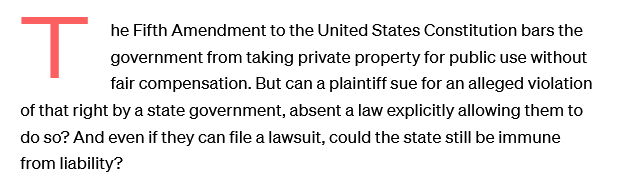
Check this out, a recently-filed cert petition asking whether, in order to sue for compensation for a taking, the government must first affirmatively provide a cause of action (an issue recently left unanswered by the U.S. Supreme Court). That’s an issue we’ve been following closely (our outfit recently filed this cert petition also). 

This one is a takings challenge to California’s unclaimed property scheme and the State’s immunity, vel non, to being sued for just compensation.

Here are the Questions Presented:

The State of California, pursuant to its unclaimed property laws, regularly seizes possession of owners’ unclaimed personal property, holds it in custody and trust for the owners, uses it for the state’s purposes to pay its obligations, without paying the owners of that unclaimed property any compensation for its use of the owners’ property pursuant to California Code of Civil Procedure §§1540(c) and 1562. That is an

Continue Reading New Cert Petition: Can An Owner Whose Property Has Been Taken Sue A State Directly Under The Fifth Amendment?

Because the latest takings cert petition is one of ours (our colleagues Dave Breemer and Deb La Fetra are counsel for the petitioner), we won’t be commenting all that much on it.

Except to say that this is the latest in a series of cases where the obligation to provide just compensation for takings butts up against a state government’s claim that it cannot be sued in federal court unless it agrees to be sued. We wrote up the Seventh Circuit’s opinion below here (“Coming And Going: Eleventh Amendment Trumps Fifth Amendment – States Must Consent To Be Sued In Federal Court, Even For Just Compensation“)

Here are the Questions Presented:

1. Whether a state’s constitutional obligation to pay just compensation when taking property waives its sovereign immunity from a claim seeking damages for an unconstitutional taking?

2. Whether a property owner may sue state officials in their

Continue Reading New Cert Petition: Does The Obligation To Provide Just Compensation Waive Sovereign Immunity?

A short one (per curiam is one two-sentence paragraph), with an interesting concurring opinions from the Florida District Court of Appeals (4th District).

In Vazquez v. City of Hallandale Beach, No. 4D2023-0833 (June 12, 2024), the court held that a restrictive covenant that ran with Vazquez’ land (and others in his subdivision, including the city, which had agreed to be bound by the covenant in the settlement of a 1969 lawsuit) is not a compensable real property interest that must be compensated when wiped out by what otherwise would be a regulatory taking.

Vazquez sued the city, asserting that its marina and parking lot violated a buffer zone which had been created by the 1969 settlement. The city was a party to that lawsuit and settlement agreement. The city agreed that yes, the buffer zone indeed had that effect. But we’re the government and even though we agreed to

Continue Reading Fla App: Govt Agreed To Be Bound By Restrictive Covenant, But So What!

The Texas DOT had an easement over a portion of the Self property. The Selfs rebuilt a fence a few feet inboard of the easement (in other words, well into the part of the land not burdened by the easement). On the TxDOT side of the fence — but still outside the TxDOT easement area — grew some old trees.

As part of a highway maintenance project, TxDOT worked with a private contractor which it hired to remove brush and trees from the easement. The trees to be removed were supposed to be marked with an “X,” but the instructions to the contractor said to “clear everything between the fences.” Whoops.

The contractor did as instructed and “cut all trees up to the Selfs’ fence line.” TxDOT acknowledged that the trees were cut at its direction and that it has not undertaken a survey, but asserted that the trees were

Continue Reading Texas: If TxDOT Intentionally Cut Down Trees Outside Of Easement Area…You Have An Inverse Claim