A reminder: there’s still time to join us for the upcoming American Law Institute-CLE Eminent Domain & Land Valuation Litigation Conference in Savannah.

Now in its 43rd year, this flagship gathering remains the undisputed national hub for practitioners, academics, appraisers, and anyone else who lives and breathes property and eminent domain law. We will be at the JW Marriott Plant Riverside District in Savannah, where historic charm meets Southern hospitality, moss-draped oaks, riverfront vibes. If you can’t make it in person, live webcast option is available.
What makes this conference indispensable? It’s the place to reconnect and talk shop with the sharpest minds in eminent domain and property law. Whether you’re on the owner’s side, or serve as agency-side counsel, or an appraiser, the programming is customizable and multi-track: 30+ programs tackling everything from relocation benefits to regulatory takings, valuation, and courtroom techniques. With 40+ speakers from across the

Continue Reading There’s Still Time To Join Us In Savannah (Jan. 21 – 24, 2026) For ALI-CLE’s 43d Eminent Domain & Land Valuation Litigation Conference

Say hello to the country music duo The Doohickeys. They have a great sound (both country and western). Check ’em out!

With such songs as “All Hat, No Cattle(the title track of their latest album), “I Wish My Truck Was Bigger,” “This Town Sucks,” “Rein It In Cowboy,” “Too Ugly to Hitchhike,” and “City Folk

Above is a parody ad for a rural eminent domain lawyer, something they are familiar with. (Or at least we assume its a parody ad.)

And this, the song by which we first learned of them, “Farm Lawyer,” about singer Haley Spence Brown’s dad, Ward Brown, a Missouri eminent domain lawyer and colleague. 

But one day a man came knockin’ in a fancy pinstripe suit.
He said “I got a note here from the government, and

Continue Reading The Doohickeys – Eminent Domain Country & Western

Hyatt

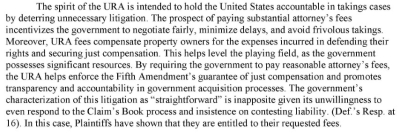
One from the U.S. Court of Federal Claims that is worth your time at least to skim. And the opinion is worth reading if only for the court’s conclusion which we’ve reproduced above.

Hyatt v. United States, No. 23-399 (Jan. 16, 2025) is, as the court described it, “a typical rails-to-trails action[.]” The issue resolved here was how much the property owners were entitled to recover in attorneys fees and expenses, now that they prevailed on the merits.

Under the Uniform Relocation Act, a property owner who obtains compensation for a regulatory taking may recover reasonable attorneys fees and costs. The opinion noted:

Specifically, in actions brought under the Tucker Act or the Little Tucker Act in which a plaintiff is compensated for the taking of property, the URA provides for the recovery of “such sum as will in the opinion of the court or the Attorney General reimburse

Continue Reading CFC: Attorneys Fee Shifting “incentivizes the government to negotiate fairly, minimize delays, and avoid frivolous takings”

2025 San Diego

Get ready to join your colleagues and friends in San Diego for the 42d ALI-CLE Eminent Domain & Land Valuation Litigation Conference.

The 41st Conference was in New Orleans. Here’s a report of that event, and here are our reports from prior conferences in Austin and Scottsdale.

Here are some of the highlights of the upcoming Conference:

  • Property Rights at the Supreme Court: DeVillier and Sheetz and What’s Next
  • Slow Take: Possession, Rent, Relocation, and Offset
  • The Jury’s View: How Jurors See Your Case
  • From Penn Coal to Penn Central: How to Prove “Too Far”
  • Leveraging Expertise in Eminent Domain Litigation: Working with Land Planners, Engineers, and Other Predicate Experts
  • Kelo at Twenty: What Changed, What Didn’t, and What’s on the Horizon
  • Viva Las Vegas: How the Nevada Judiciary Upheld Property Rights in 180 Land’s Inverse Condemnation Taking
  • Ethics: Guiding the Trolley: Perspectives on Professional Ethics in


Continue Reading Registration For The 42d ALI-CLE Eminent Domain & Land Valuation Litigation Conference Is Underway (Don’t Miss Out!)

This is a must-listen, the latest episode of John Ross’s Bound by Oath podcast. This season is covering property rights, and this episode details Berman v. Parker, which may be the first case in what we’ll call the “modern era” where the Supreme Court set the judicial hands-off tone for public use challenges.

The guest this episode is our friend and colleague Amy Lavine, who wrote what we think is the seminal article deconstructing Berman (we include it as required reading in our William and Mary Eminent Domain course).

This episode is a great companion piece to BBO’s episodes on Euclid (zoning), and Pennsylvania Coal (reg takings).

On this episode: Berman v. Parker, the Supreme Court’s decision in 1954 to abandon previous constitutional limits on the government’s power to take property from Person A to give it to Person B. The decision greenlit the era of urban

Continue Reading New Bound by Oath Episode: Berman, Public Use, And Urban Renewal

Here’s one about Lucasbackground principles” of property law, or maybe the Supreme Court’s current focus on “history and tradition” when it comes to defining private property for purposes of the Takings Clause. 

In So. Cal. Edison Co. v. Orange County Transp. Auth., No. 22-55498 (Mar. 13, 2024), the U.S. Court of Appeals for the Ninth Circuit affirmed a grant of summary judgment denying a takings claim by a public utility which sought compensation after the County ordered it to move its equipment off of a public right-of-way for a streetcar line at its own expense.

The utility raised a physical takings claim, but the court didn’t get to that issue, instead focusing on whether it owned property. The court noted that state law “generally” defines property but, citing Tyler, held that there are certain “traditional property law principles” and “historical practices” about

Continue Reading CA9: “Traditional common law rule” That Utilities Bear The Cost Of Relocating From Public Right-of-Way Isn’t A Taking

ALI-CLE brochure cover page

When it comes to the longstanding ALI-CLE American Law Institute-CLE Eminent Domain and Land Valuation Litigation Conferences, we’re always ready to go. You know that. But this year’s version — the 41st — was buzzing like no other in recent memory.

Maybe it was the New Orleans venue with its atmo, food, and music for our after-class activities, or even the timing (the second-to-last week on the Mardi Gras parade season, and our conference hotel was right on the routes). It might have been the nice weather (oh, it rained buckets one evening, but there wasn’t an ice storm like we experienced in Austin in 2023). Or maybe it was the capacity crowd, and new topics and speakers on the agenda. Or maybe it was just the prospect of seeing our friends and colleagues again after a year.

Here’s a photo essay of some of the Conference highlights.

And

Continue Reading Pass A Good Time: Our Report From The 41st ALI-CLE Eminent Domain & Land Valuation Litigation Conference, Feb 1-3, 2024, New Orleans

A quick one from the South Carolina Supreme Court.

In Applied Building Sciences, Inc. v. South Carolina Dep’t of Commerce, No. 28184 (Jan. 17, 2024), the court held that the $50,000 cap on relocation benefits provided to ABS by South Carolina’s version of the Relocation Act was enough, and did not deprive ABS of just compensation.   

Applied Building Sciences was a tenant in a building taken by the South Carolina Division of Railways, and was listed as an “Other Condemnee” in the eminent domain action. The taking forced it to relocate its business, which triggered its right to seek relocation benefits. South Carolina offers those displaced up to $50,000 in benefits, even if the taking isn’t federally funded (and thus not covered by the federal URA). 

ABS thought the cap was unconstitutional and asked for $560k in expenses, and raised an inverse condemnation claim. The Department said no

Continue Reading South Carolina’s Relocation Act Benefits Are Not “Just Compensation”

Don’t miss out!

We promise: this is the last time we’re going to try to entice you to the upcoming ALI-CLE Eminent Domain & Land Valuation Litigation Conference in New Orleans. We are getting close to capacity, but there is still room. In recent years, we have standing room only in the Conference halls, and have sold out the hotel block. After all, this is a pretty niche area of law. So what gives?

When we were in Austin last year, we thought it might be nice to try and answer that question. We asked Conference participants why they come, year-after-year (and in Austin, despite massive travel disruptions). Yes, it is the various venues (Nashville, Austin, Scottsdale, Palm Springs, to name a few recent locations), and yes, it is the excellent and useful programming.

But as we suspected it is more than that.

Continue Reading No FOMO: There’s Still Room For You To Join Us In New Orleans Feb 1-3, 2024 For The 41st ALI-CLE Eminent Domain & Land Valuation Litigation Conference

PXL_20231202_194330453.PORTRAIT

Here it is — Professor Gideon Kanner’s final law journal article, published shortly before his passing:

Gideon Kanner, Eminent Domain Projects That Didn’t Work Out, 12 Brigham-Kanner Prop. Rts. J. 171 (2023).

Appropriately, we think, published in William and Mary Law School’s Brigham-Kanner Property Rights Journal, named in part in Gideon’s honor.

This isn’t a typical law journal article, but an essay collecting Professor Kanner’s thoughts, comments, and (best of all) opinions on, well, eminent domain (and redevelopment) projects that didn’t work out.

In Gideon’s own words, from the Introduction:

But whether you favor widespread use of eminent domain or not, and whether the projects created by its use are sound or not, it is deplorable that the power of eminent domain has been often deployed to the detriment of racial and politically powerless minorities. Typically, redevelopment projects tend to displace middle class and poor people from

Continue Reading Professor Kanner’s Final Article: “Eminent Domain Projects That Didn’t Work Out,” 12 Brigham-Kanner Prop. Rts. J. 171 (2023)