The key quote from the Illinois Appellate Court’s recent opinion in Robinson v. City of Chicago, No. 1-23-2174 (Mar. 24, 2025), in which a property owner challenged the inclusion of his property in a new Chicago historic preservation district? This seemingly innocuous sentence setting out the standard of review:

The plaintiff acknowledges that his substantive due process and equal protection challenges to the ordinance designating the District as a Chicago landmark are subject to rational basis review.

Slip op. at 13.

Those of you for whom this ain’t your first rodeo know that rational basis review (aka aliens might have done it) being invoked isn’t a good sign for a challenger. It nearly always tells the challenger “you lose, no matter what.” And here, that prediction plays out: the court rejected the property owner’s arguments that the city’s designation of his small neighborhood — a neighborhood that

Continue Reading Who Cares Your “Evidence” Shows This Is Just An Old Part Of Chicago – All That Matters Is The City Says It’s Historic

Here’s the latest cert petition from the desk of Michael Berger,  a property rights case with an equal protection element. 

Demarest wanted to subdivide. Not that big a deal, right? Well, apparently it was. The Petition alleges that the Town had a burr under its saddle about the guy for a while, going back to when he purchased the property and built a home there more than 20 years ago, and had not treated him well, or fairly. Then, as the Petition notes, he “was vocal about his treatment by the Town.” Pet. at 5. We know how being that way endears one to the government, right?  As the Petition puts it:

Here, Mr. Demarest was vocal about his treatment by the Town. In consequence, the Town took the actions noted above to isolate his property from the general system of roads in the area. The Town removed

Continue Reading New Cert Petition (Michael Berger): Pleading Class-Of-One Equal Protection Claims

This is one we’ve been meaning to post for a while, but something else always seemed to intervene.

In BMG Monroe I, LLC v. Village of Monroe, No. 22-1047 (Feb. 16, 2024), the U.S. Court of Appeals for the Second Circuit affirmed the dismissal of a statutory and constitutional challenge to the Village’s .

The court did so on the basis of the surviving part of the Williamson County ripeness requirement, that the government has taken a definitive position on whether it will allow some development of the plaintiff’s land under the challenged regulations.

BMG wanted to build 181 homes, so it developed plans for a mix of uses across several parcels, and development of related infrastructure like roads and a community center. This “did not conform to the zoning codes of the Village and Town.” Slip op. at 4. The Village and Town were ok with the proposal

Continue Reading CA2: If You Want To Be A Land Use Player, You Gotta Play (And That Means Keep On Trying – Without Hitching Rides)!

ALI-CLE brochure cover page

When it comes to the longstanding ALI-CLE American Law Institute-CLE Eminent Domain and Land Valuation Litigation Conferences, we’re always ready to go. You know that. But this year’s version — the 41st — was buzzing like no other in recent memory.

Maybe it was the New Orleans venue with its atmo, food, and music for our after-class activities, or even the timing (the second-to-last week on the Mardi Gras parade season, and our conference hotel was right on the routes). It might have been the nice weather (oh, it rained buckets one evening, but there wasn’t an ice storm like we experienced in Austin in 2023). Or maybe it was the capacity crowd, and new topics and speakers on the agenda. Or maybe it was just the prospect of seeing our friends and colleagues again after a year.

Here’s a photo essay of some of the Conference highlights.

And

Continue Reading Pass A Good Time: Our Report From The 41st ALI-CLE Eminent Domain & Land Valuation Litigation Conference, Feb 1-3, 2024, New Orleans

Don’t miss out!

We promise: this is the last time we’re going to try to entice you to the upcoming ALI-CLE Eminent Domain & Land Valuation Litigation Conference in New Orleans. We are getting close to capacity, but there is still room. In recent years, we have standing room only in the Conference halls, and have sold out the hotel block. After all, this is a pretty niche area of law. So what gives?

When we were in Austin last year, we thought it might be nice to try and answer that question. We asked Conference participants why they come, year-after-year (and in Austin, despite massive travel disruptions). Yes, it is the various venues (Nashville, Austin, Scottsdale, Palm Springs, to name a few recent locations), and yes, it is the excellent and useful programming.

But as we suspected it is more than that.

Continue Reading No FOMO: There’s Still Room For You To Join Us In New Orleans Feb 1-3, 2024 For The 41st ALI-CLE Eminent Domain & Land Valuation Litigation Conference

This season of the Institute for Justice‘s podcast series “Bound by Oath” is devoted to property rights. It’s a fascinating series — produced by John Ross, it is more like an audio documentary than a typical podcast — focusing on constitutional issues. And we say this not just because we’ve been a guest a couple of times — see “Groping in a Fog“, this season’s immediate prior episode about regulatory takings, and Season 1, where we guested on the episode about the origins of the “incorporation” doctrine).

In the latest episode, “A Lost World,” John covers the world before zoning and the use (and abuse) of the plain-old police power to regulate the use of land and property.

Here’s the description:

On Episode 3, we journey back to a lost world: the world before zoning. And we take a look at a

Continue Reading “The Lost World – Land Use Before Zoning” – Bound by Oath Podcast, S3 E3: Hadacheck, Buchanan

PXL_20230223_024826759

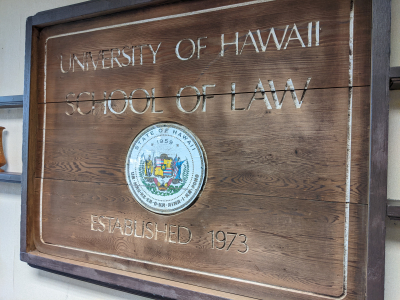
Starting in January, we’ll be helping our friend and former law partner Mark M. Murakami with the venerated and oh-so-important Land Use course (Law 580) at the University of Hawaii’s Law School.

We’re temporarily stepping into some mighty big slippers (this is Hawaii, so we don’t always wear shoes), as this is the course that our mentor Professor David Callies taught for decades. And is there a better venue in which to teach and study land use law and regulation, and its limits? After all, Hawaii may be the most heavily-regulated land on the planet, and is a focal point for every issue you can think of, from zoning to environmental restrictions to takings to public trust to subdivision to admin law to … well, you get the drift.

We’ll cover those topics, as well as the fundamentals. And we have a few surprises up our sleeves — some impressive

Continue Reading Hawaii Five-80: More Land Use (Law 580) At The University Of Hawaii

A quick one from the Alabama Supreme Court. In Dixon v. City of Auburn, No SC-2022-0741 (Oct. 27, 2023), the court rejected a property owner’s claim that the city outlawing short term rentals of residential properties — when the plaintiff had been renting his basement for a while — was not a violation of the Alabama Constitution.

The court rejected the argument that Dixon’s use was a nonconforming use or vested right, and concluded that his right to do so was not so because he had no legal right to rent out his property before the STR ordinance. The court rejected his claim that in the absence of regulations limiting that right, he could rent short term, because the zoning code prohibits any uses not expressly allowed. Slip op. at 10.

And here’s the interesting bit. Although Dixon styled one of his claims as “an ‘unlawful taking without just

Continue Reading Alabama: Banning Short-Term Rentals Is Constitutional (PS – “the Alabama Constitution does not recognize regulatory-takings claims”)

Why is it, you ask, that the ALI-CLE Eminent Domain & Land Valuation Litigation Conference (scheduled next February 1-3, 2024, in New Orleans) is an event that seems to be growing in popularity and attendance. In recent years, we have standing room only in the Conference halls, and have sold out the hotel block. After all, this is a pretty niche area of law. So what gives?

When we were in Austin earlier this year, we thought it might be nice to try and answer that question. We asked Conference participants why they come, year-after-year (and in Austin, despite massive travel disruptions). Yes, it is the various venues (Nashville, Austin, Scottsdale, Palm Springs, to name a few recent locations), and yes, it is the excellent and useful programming.

But as we suspected it is more than that. As the above video notes

Continue Reading ALI-CLE’s Eminent Domain & Land Valuation Litigation Conference (Feb 1-3, 2024, New Orleans): Why Attend? Here’s Why.

The voters of South Lake Tahoe, California, adopted an ordinance that forbade the city from issuing short-term rental permits for properties in residential zones unless the owner was a permanent resident of the city, and declared that all short-term rental permits would expire three years later. The trial court granted the city summary judgment on all claims raised by an association of property owners who rented short-term. 

In South Lake Tahoe Property Owners Group v. City of South Lake Tahoe, No. C093603 (June 20, 2023), the California Court of Appeal mostly agreed, holding that the owners’ vested rights and state law preemption claims did not survive. But the court disagreed with the trial court’s dismissal of a (dormant) Commerce Clause challenge to the residency component. As noted in this recent Fifth Circuit decision, local ordinances that discriminate between residents and non-residents are (or at least could be) too

Continue Reading Cal Ct App: Prohibition On Short-Term Rentals Might Have A Commerce Clause Problem