
The Supreme Court of Montana’s opinion in Tai Tam, LLC v. Missoula County, No. DA21-0660 (Nov. 15, 2022) starts off like a somewhat typical land use dispute turned into a constitutional fight. The property owner sought subdivision approvals for a 28-acre parcel to allow residential development, and the County denied the applications because “the proposal failure to adequately mitigate the loss of agricultural soils.” Slip op. at 2.(Oh, and “bird habitat.” Slip op. at 3.)

Next, the complaint, alleging some of the usual claims: due process, equal protection, and takings, and a statutory claim under Montana law. The trial court dismissed all claims: the statutory claims for failure to get in before the 30-day limitations period, and the constitutional property claims based on the court’s conclusion that the plaintiff lacked a “property” interest.

We’ll let you read the part of the opinion in which the court reversed the dismissal

Continue Reading Montana: Owning The Land Is Enough To Plead A Property Interest: Property Means “Rights Inherent In Ownership,” Not Extent Of Govt Discretion

Here it is, the official agenda and program for the 40th ALI-CLE Eminent Domain & Land Valuation Litigation Conference, February 2-4, 2023 (with a special event the evening of Wednesday, February 1, 2023 to entice you to arrive early).

Screenshot 2022-11-18 at 13-35-13 ALI CLE PA NY VA TX FL Continuing Legal Education

Here’s the brochure with the complete agenda, schedule, and faculty listing. But to tempt you, here are some of the highlights of the program:

  • Everything Old is New Again: Why Today’s Practitioners Need to Understand the Original Meaning of the Takings and Just Compensation Clauses
  • Private Utility Takeovers – Lessons From a 67 Day Trial

  • Valuation Issues When Billboards and Signs are Condemned

  • Setting Client Expectations and Identifying Red Flags

  • Developing Property Right Issues in Texas – Questions and Answers from the Bench: A View From the Bench (with Texas Supreme Court Justice Jimmy Blacklock)

  • Eminent Domain and Regulatory Takings Updates: Important Decisions You Need to Know

  • Ethics:


Continue Reading Here’s The Program For The 40th ALI-CLE Eminent Domain & Land Valuation Litigation Conference, Feb 1-4, 2023, Austin

To “slow the spread” in the early days of the Co-19 thing, the City ordered businesses to shut down. But not Wal-Mart, liquor stores, or churches. Golden Glow, a tanning salon objected, and told anyone who would listen that it could operate without person-to-person contact. Sorry, no exceptions.

Federal lawsuit followed, alleging the claims you might expect: equal protection and takings claims. Predictably, the district court granted summary judgment to the City.

And just as predictably, in Golden Glow Tanning Salon, Inc. v. City of Columbus, No. 21-60898 (Nov. 8, 2022), the U.S. Court of Appeals for the Fifth Circuit affirmed. The opinion, as you might expect is short.

Was Golden Glow treated differently from other businesses similarly situated without a rational reason? No. First, Golden Glow is similar to other shut down businesses: “[e]ach class of shut-down business provides recreational, social, or, as some would say, ‘nonessential’ services

Continue Reading Tanning Beds v. Liquor Stores – No Equal Protection, No Physical Take, No Lucas Take For Co-19 Biz Shutdown Order

Screenshot 2022-09-13 at 14-12-11 Feed LinkedIn

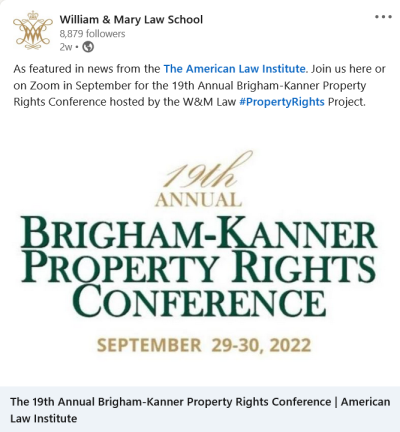
One last reminder that there’ still time to register for the upcoming Brigham-Kanner Property Rights Conference at the William and Mary Law School in Williamsburg, Virginia, September 29-30, 2022. If you can’t make it to the historic campus, there’s an option to attend remotely.

In our opinion, the Conference is the best of its kind because it brings together legal scholars and the practicing bar to talk dirt law theory and practice. We also a have a full supplemental program for law students, that covers property law and careers in eminent domain law, a recruiting session, a program on international property rights, and a program on land use law.

Registration for the Conference is ongoing, and you can sign up here.

Here is the full agenda. (We’ll be speaking on Panel #2, “Reshaping the Framework Protecting Property Under the Roberts Court.”)

Come on, join us!

Continue Reading Still Time To Join Us (In-Person Or Remote) For The 19th Annual Brigham-Kanner Property Rights Conference
A short one (unpublished) from the U.S. Court of Appeals for the Sixth Circuit, considering an issue we’ve been following: what is the effect of the government’s claim that it is regulating property for what looks like a valid “police power” purpose?

As noted, that’s a road we’ve been down before. Here’s a sampling:

In Bojicic v. Dewine, No. 21-4123 (Aug. 22, 2022), the Sixth Circuit was considering a takings and due process challenge to the governor’s Co-19 shutdown orders. The court rejected the district court’s rationale

Continue Reading CA6: No “Police Power” Exception To Takings (But It’s Nonetheless Dispositive As Penn Central’s Character)

We recommend you review the North Carolina Supreme Court’s opinion in Anderson Creek Partners, L.P. v. County of Harnett, No. 63PA21-1 (Aug. 19, 2022). It’s long (70 page majority, plus 19 pages of concurring and dissenting opinions), but worth your time because the majority concludes that legislatively-imposed fees, applicable to all, are “exactions” that are subject to the nexus/rough proportionality requirements of Nollan/Dolan/Koontz.

The county adopted a requirement that residential property developers pay a per-lot, one-time water and sewer capacity use fee as a condition of the county accepting applications for a water or sewer permit. The details:

Section 28(h) of the ordinance provides for the collection of “capacity use” fees for the purpose of “partially recover[ing] directly from new customers the costs of capacity of the utility system to serve them.” More specifically, the ordinance provides that, for each new residential connection to

Continue Reading NC: Generally-Applicable Impact Fee Is Subject To Nollan/Dolan/Koontz

Check out the U.S. Court of Appeals for the Second Circuit’s opinion in Village Green of Sayville, LLC v. Town of Islip, No. 19-3353 (Aug. 5, 2022), a case in which the court held the Town reached a final decision denying Village Green’s request to develop a 64-unit apartment complex on Long Island.

Final decision ripeness under the surviving part of Williamson County, you say? So this is a takings case, right? No, not quite. The claims asserted by the developer  included a takings claim (although it seems to have played a more minor role) and the claims were mostly about the Town allegedly discriminating against affordable housing and the people who build and live in affordable housing. See slip op. at 11.

But as you know, many courts — including the Second Circuit — apply Williamson County’s final decision ripeness requirements to anything vaguely land usey.

Continue Reading CA2: Land Use Challenge (Not Takings) Is Ripe – Govt Gave Its Final “No”

If you ever get the opportunity to teach in a law school — either as a full-time legal scholar, or part-time as an expert adjunct practitioner — take it if you can. You might think you know a lot about a particular subject, but there’s nothing like spending time at the lectern in a law classroom in front of sharp and eager lawyers-in-training to sharpen your thoughts, and get you to truly understand a subject.

And folks calling you “professor” can evoke a smile.

Sensei

But if there’s one downside to the law school experience from the teacher’s side of the lectern, it’s grading. Especially at a law school like William and Mary that has a pretty strict mandatory curve. In upper-division courses that we handle like Eminent Domain and Property Rights Law and Land Use — where we’re dealing with some very high-level stuff and the quality of the

Continue Reading The Circle Is Now Complete: A Sampling Of Final Paper Topics From William and Mary Law’s Eminent Domain & Property Rights, And Land Use Courses

Check out the U.S. Court of Appeals’ opinion in Andrews v. Mentor, No. 20-4030 (Aug. 25, 2021).

Property owners sought rezoning of their land from R-4 to “Village Green – RVG,” a higher density zone, so that the owners could build single-family homes. Under R-4, the maximum number of homes was 13 and had to leave 9 acres open. The city’s comprehensive plan expresses a preference for Village Green zoning.

But the city denied the application,despite having approved 9 other applications since 2004, and the owners’ application being “materially identical to a plan the City approved for rezoning and development in 2017.” Slip op. at 3.

So off to federal court they went, filing (Lucas and Penn Central) takings, due process, and class-of-one equal protection claims. [Disclosure: the property owners are represented by my law firm colleague Dave Breemer; we didn’t have anything to do with this

Continue Reading CA6: There’s A Difference Between Due Process “Property” And Takings Clause “Property”

All the topics you want to know about, presented by top-notch faculty from across the nation. Sessions include:

  • Property Rights as Civil Rights
  • Eminent Domain National Update
  • Just Relocation: Understanding the Law and Regulations to Ensure Fairness
  • Challenging Public Use: Lessons From a 67-Day Trial
  • COVID Takings
  • Federal Court and the Daubert Challenge: How to Prepare
  • Did the Supreme Court Signal a New Direction in Property Rights in Cedar Point Nursery?
  • How to Position Your Client for the Fallout When Projects Don’t Get Built
  • Rural Broadband and the Emerging Constitutional Challenges
  • Are Precondemnation Entry Statutes Still Valid After Cedar Point Nursery?
  • How Condemnor and Property Owners’ Counsel Prepare the Battlefield
  • How Will the Trillion Dollar Infrastructure Bill Impact Your Practice?
  • Ethics
  • …and more, including a full slate of networking and social events!

We’ve sold out the last few years, so don’t miss out. Room block now taking reservations. Continue Reading Join Us For The 39th Annual ALI-CLE Eminent Domain & Land Valuation Litigation Conference, Jan 26-29, 2022 (Scottsdale, AZ)