Check out the U.S. Court of Appeals for the Tenth Circuit’s recent opinion in Knellinger v. Young, No. 23-1018 (Apr. 11, 2025). 

It’s worth reading because the court doesn’t fall into the common trap of concluding that although an owner need not exhaust administrative remedies before asserting a takings claim, he nonetheless doesn’t have “private property” because … he hasn’t exhausted administrative remedies to get his property returned. As the court summed it up:
[The owners] … argu[e] that they alleged facts sufficient to state a claim that Colorado took their property for public use without just compensation. We agree. Property owners who plausibly allege that Colorado has taken custody of their property under RUUPA, and used it for public purposes, need not file administrative claims with Colorado before they may sue for just compensation. The moment a state takes private property for public use without just compensation, a

Continue Reading CA10: Takings Clause Means Never Having To Administratively Ask To Get Your Property Back

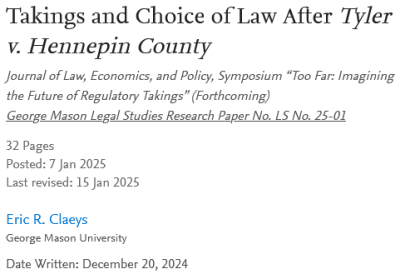
Screenshot 2025-01-23 at 15-10-58 Takings and Choice of Law After i Tyler v. Hennepin County _i by Eric R. Claeys SSRN

Check out this article, forthcoming in the George Mason Journal of Law, Economics, and Policy from lawprof Eric Claeys, “Takings and Choice of Law After Tyler v. Hennepin County.”

This is one of the pieces coming out of the recent symposium “Imaging the Future of Regulatory Takings” at George Mason Law School.

Here’s the Abstract:

This Essay contributes to a symposium on the future of regulatory takings. It focuses on choice of law in eminent domain disputes. When claimants bring eminent domain claims in federal courts, the courts must determine whether the claimants have constitutional “private property” in the entitlements allegedly taken. Should that determination be made with federal law, with the law of the state allegedly taking property, or law from some other source?

The 2023 Supreme Court decision Tyler v. Hennepin County addressed that issue. Under Tyler, it is a federal question whether an eminent domain claimant has constitutional private property. To answer the question, federal courts usually consult the law of the state where the alleged taking took place. But that presumption applies only if state law seems to secure and not to circumvent the federal right. And if that reservation is not satisfied, federal courts may consult a wider pattern of legal sources—Anglo-American history, the general law of the several United States, federal court precedents, and a broader cross-section of law from the state allegedly taking property. That approach resembles the approach taken generally for federal constitutional rights—especially in Indiana ex rel. Anderson v. Brand (1938)—but varies from the general approach in the sources it makes relevant to settle what counts as private property under the Fifth Amendment. This Essay interprets Tyler, and it offers a normative justification for Tyler’s approach to choice of law in eminent domain. 

Don’t miss this one.Continue Reading New Article (Eric Claeys): “Takings and Choice of Law After Tyler v. Hennepin County”

Screenshot 2024-03-14 at 19-30-43 Fines Forfeitures and Federalism

When it comes to property rights, we’re most often focused on takings, compensation, and due process. But as you all know, the concept of property rights encompasses a whole lot more.

Our colleague, lawprof Jessica Asbridge, has posted on SSRN an article that is forthcoming in the Virginia Law Review, “Fines, Forfeitures, and Federalism,” in which she delves into the question of how the Excessive Fines Clause applies to state and local forfeitures and fines. To resolve the federalism concerns she identifies, the article argues that courts “should look to the exactions doctrine under the Takings Clause.”

Count us as intrigued.

Here’s the Abstract:

Fines are ubiquitous in modern society, and they are imposed for both serious crimes and minor civil wrongs. The U.S. Supreme Court recently recognized that the Constitution’s Excessive Fines Clause applies to the states, but that decision raises previously unexplored questions as to how to enforce the Clause’s protections in the states. A key question is what role, if any, federalism should play in crafting doctrinal rules that apply the Clause’s protections to state and local fines and related property forfeitures. This Article is the first to accord in-depth treatment to that important question.

The extent to which federalism principles should apply does not have an immediate and obvious answer. On the one hand, federalism plays a significant role in the Court’s jurisprudence on the Cruel and Unusual Punishment Clause. The Court therefore generally takes a highly deferential approach in reviewing sentences of imprisonment. Lower courts have applied that same deferential review in the context of the Excessive Fines Clause. On the other hand, fines and forfeitures are unlike other forms of punishment—such as prison—because they are often used as a revenue source for state and local governments, creating a conflict of interest for state and local decision-making bodies.

To address this conundrum, this Article makes the novel argument that the Court should look to the exactions doctrine under the Takings Clause, which often implicates similar concerns of government self-interest and overreaching. Exactions and excessive fines are conceptually similar, but scholars thus far have overlooked the close relationship between them. The exactions doctrine gives minimal weight to federalism concerns, and it applies a heightened-scrutiny standard that is well suited to the excessive fines context. Indeed, differences between federal practice and state and local practices as to fines suggest that discretionary state and local fines should be subject to closer constitutional scrutiny than federal fines. As a recent example illustrates, such heightened scrutiny would ensure that the Excessive Fines Clause is not merely a parchment barrier, while still accounting for variations between states and localities in terms of their communities’ values and needs.

Check it out. Download your copy on SSRN here.
Continue Reading New Article: “Fines, Forfeitures, and Federalism” (Jessica Asbridge)

ALI-CLE brochure cover page

When it comes to the longstanding ALI-CLE American Law Institute-CLE Eminent Domain and Land Valuation Litigation Conferences, we’re always ready to go. You know that. But this year’s version — the 41st — was buzzing like no other in recent memory.

Maybe it was the New Orleans venue with its atmo, food, and music for our after-class activities, or even the timing (the second-to-last week on the Mardi Gras parade season, and our conference hotel was right on the routes). It might have been the nice weather (oh, it rained buckets one evening, but there wasn’t an ice storm like we experienced in Austin in 2023). Or maybe it was the capacity crowd, and new topics and speakers on the agenda. Or maybe it was just the prospect of seeing our friends and colleagues again after a year.

Here’s a photo essay of some of the Conference highlights.

And

Continue Reading Pass A Good Time: Our Report From The 41st ALI-CLE Eminent Domain & Land Valuation Litigation Conference, Feb 1-3, 2024, New Orleans

DSCF3357

If you dream such dreams as this photo, read on.

My law firm, Pacific Legal Foundation, is on the hunt for lawyer to join our Property Rights group (yours truly is the Director of Property Rights Litigation, so you will be working with me and the other takings and con law mavens in our practice). Here’s the full description of the spot:

You: An entrepreneurial freedom fighter with a passion for property rights litigation. You work with more senior-level attorneys to find and win cutting-edge property rights cases in trial and appellate across the country. You work as a part of a collaborative team, but are also self-motivated and able to work independently with minimal supervision. You are eager to learn, relentless, and a focused lawyer.

Them: Bureaucrats, city councils, mayors, governors, and federal agencies stripping Americans of their rights every day. There’s a lot of government overreach out there

Continue Reading Dig Property Rights? Join Our Firm As A Courtroom Property Rights Lawyer

Don’t miss out!

We promise: this is the last time we’re going to try to entice you to the upcoming ALI-CLE Eminent Domain & Land Valuation Litigation Conference in New Orleans. We are getting close to capacity, but there is still room. In recent years, we have standing room only in the Conference halls, and have sold out the hotel block. After all, this is a pretty niche area of law. So what gives?

When we were in Austin last year, we thought it might be nice to try and answer that question. We asked Conference participants why they come, year-after-year (and in Austin, despite massive travel disruptions). Yes, it is the various venues (Nashville, Austin, Scottsdale, Palm Springs, to name a few recent locations), and yes, it is the excellent and useful programming.

But as we suspected it is more than that.

Continue Reading No FOMO: There’s Still Room For You To Join Us In New Orleans Feb 1-3, 2024 For The 41st ALI-CLE Eminent Domain & Land Valuation Litigation Conference

Conf-2024-flyer
Bismarck in January is looking pretty good.

Here’s what we’re reading today:

  • Christian Britschgi, Court’s Wild Zoning Decision Blocks ‘Montana Miracle’, Reason (Jan. 2, 2024) (“In an eyebrow-raising decision, a Montana judge has halted the implementation of two laws legalizing duplexes and accessory dwelling units on residential land across the state, writing that they’d likely do ‘irreparable’ damage to residents of single-family neighborhoods.”).
  • Richard Frank, The U.S. Supreme Court & Environmental Law in 2024, LegalPlanet (Jan. 3, 2024) (“First up before the Court in 2024 is this “regulatory takings” case from California…. Over the past four decades, U.S. Supreme Court decisions have developed the so-called ‘unconstitutional conditions’ sub-doctrine of regulatory takings law, but to date have only applied it to individually-negotiated land use permit conditions and fees. California state courts–including in the Sheetz case–have consistently refused to extend the doctrine to broadly-applicable fees and conditions imposed on landowners


Continue Reading What We’re Reading Today, Property Rights Edition

ALI-CLE brochure cover page

Here’s the brochure and the full agenda and registration information for the upcoming ALI-CLE Eminent Domain and Land Valuation Litigation Conference at the JW Marriott in New Orleans, February 1-3, 2024.

This is the long-running nationally-focused conference on all things eminent domain, takings, valuation, and related. We have three tracks, from which you can choose a la carte – Practice, Substantive, and Condemnation 101:

For over 40 years, we’ve been bringing eminent domain practitioners together to examine the latest issues, engage in healthy debate, and get the information they need to stay current in their practice. This year – our 41st – is THE perfect time to reunite with your eminent domain colleagues. There will be plentiful opportunities to meet and mingle with the faculty and other registrants – throughout the conference and at evening social events. Attendees come back year after year to make new friendships and renew

Continue Reading Here’s The Program For The 41st ALI-CLE Eminent Domain And Land Valuation Litigation Conference, Feb 1-3, 2024, New Orleans

The Sixth Circuit these days. Lots of property and takings-related stuff being decided in that court. See here, here, here, here, here, and here for some examples.

The latest is O’Connor v. Eubanks, No. 22-1780 (Oct. 6, 2023), in which an unsigned panel opinion (with concurrence of Judge Thapar in the result, but not in the reasoning), held that state officials sued in their individual capacities have qualified immunity from takings claims which seek just compensation. But are not similarly immune from procedural due process claims.

Short story: O’Connor was the payee on two checks that were delivered to his property. Apparently he got neither, so the payors turned the checks over to the State of Michigan, which treated them as unclaimed property.

Michigan’s unclaimed property statute moves fast. It requires that the State, after first publishing notice, to sell or liquidate the property

Continue Reading Backing Into Williamson County Again – CA6: We Already Said That State Officials Sued Individually For Compensation Have Qualified Immunity

Screenshot 2023-08-26 at 10-33-05 Brigham-Kanner Property Rights Conference

Heads-up: the registration page for the 20th Brigham-Kanner Property Rights Conference, October 26-27, 2023, at the William and Mary Law School in Williamsburg, Virginia, is now up.

Early registration is a good thing because space is limited, especially at the Wren Building banquet on the 26th, at which the 2023 B-K Property Rights Prize will be presented to Prof. Gregory Alexander.

So please don’t miss out.

2022 BK plaque
The Property Rights Hall of Fame (second plaque)

If you are not already familiar with the Conference, it is (in our opinion) the best one-day event on property and property rights theory and practice. Expressly designed to bring together the legal academy and the practicing dirt law bar, the conference is where we discuss the burning property and property rights issues of the day. Here’s the 2023 Program:

  • Property and Propriety (or a Well-Ordered Society): A Tribute to Gregory S.


Continue Reading Register Now For The 20th Brigham-Kanner Property Rights Conference, Oct. 26-27, 2023