Property tax

Here’s the latest in an issue we’ve been following for a long time.

In Jackson v. Southfield Neighborhood Revitalization Initiative, No. 166320 (July 16, 2025), the Michigan Supreme Court re-confirmed its ruling in Rafaeli v. Oakland County, that the government “keeping the change” after liquidating property to satisfy a delinquent tax debt

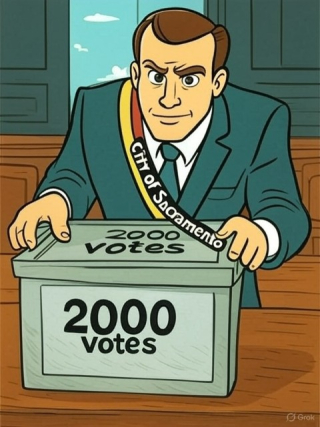
Sacto_votes

The above is the image Skynet returned when we
asked for a graphic for this post

The California Court of Appeal’s recent opinion in Dessins LLC v. City of Sacramento, No. C100644 (July 9, 2025) doesn’t deal with eminent domain or takings, but is about municipal fees and the way California requires these things

Take a look at the New Jersey Appellate Division’s opinion in Johnson v. City of East Orange, No. A-2586-23 (June 27, 2025). 

The court vacated the dismissal of a property owner’s takings claim, holding that it was timely. We aren’t going into too much detail because this one is out of our shop. As

A brief, but important, decision from the U.S. Court of Appeals for the Second Circuit.

In Sikorsky v. City of Newbergh, No. 23-1171 (May 2, 2025), the court held that the plaintiff adequately pleaded a regulatory takings claim which was based on Tyler v. Hennepin County, where the U.S. Supreme Court held that

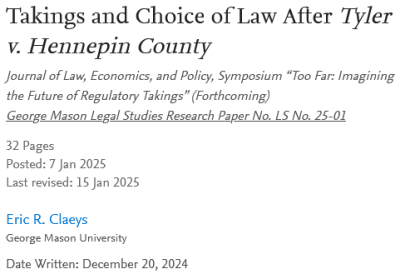
Screenshot 2025-01-23 at 15-10-58 Takings and Choice of Law After i Tyler v. Hennepin County _i by Eric R. Claeys SSRN

Check out this article, forthcoming in the George Mason Journal of Law, Economics, and Policy from lawprof Eric Claeys, “Takings and Choice of Law After Tyler v. Hennepin County.”

This is one of the pieces coming out of the recent symposium “Imaging the Future of Regulatory Takings” at George Mason Law School.

Here’s the Abstract:

This Essay contributes to a symposium on the future of regulatory takings. It focuses on choice of law in eminent domain disputes. When claimants bring eminent domain claims in federal courts, the courts must determine whether the claimants have constitutional “private property” in the entitlements allegedly taken. Should that determination be made with federal law, with the law of the state allegedly taking property, or law from some other source?

The 2023 Supreme Court decision Tyler v. Hennepin County addressed that issue. Under Tyler, it is a federal question whether an eminent domain claimant has constitutional private property. To answer the question, federal courts usually consult the law of the state where the alleged taking took place. But that presumption applies only if state law seems to secure and not to circumvent the federal right. And if that reservation is not satisfied, federal courts may consult a wider pattern of legal sources—Anglo-American history, the general law of the several United States, federal court precedents, and a broader cross-section of law from the state allegedly taking property. That approach resembles the approach taken generally for federal constitutional rights—especially in Indiana ex rel. Anderson v. Brand (1938)—but varies from the general approach in the sources it makes relevant to settle what counts as private property under the Fifth Amendment. This Essay interprets Tyler, and it offers a normative justification for Tyler’s approach to choice of law in eminent domain. 

Don’t miss this one.Continue Reading New Article (Eric Claeys): “Takings and Choice of Law After Tyler v. Hennepin County”

In Turner v. Jordan, No. 22-13159 (Sep. 17, 2024), the U.S. Court of Appeals for the Eleventh Circuit held that even though the federal courts have jurisdiction over Turner’s takings claim, the court nonetheless has the discretion to choose to wash its hands of the case in order to protect a state’s administrative procedures.

A fairly short one from the North Carolina Court of Appeals, but well worth your time to read.

Mata v. N.C. Dep’t of Transportation, No. COA23-1140-1 (July 16, 2024) is the latest in the “Map Act” takings cases that we have long covered. There, N.C. legislature adopted a statute that identified future highway corridors

If there’s a money quote in yesterday’s opinion by the Supreme Court of Nevada which “wholly affirm[ed] a trial court judgment awarding $48 million in just compensation for Las Vegas’s regulatory taking in City of Las Vegas v. 180 Land Co., LLC, No. 24-13605 (Apr. 18, 2024), it might just be this sentence:

Although