
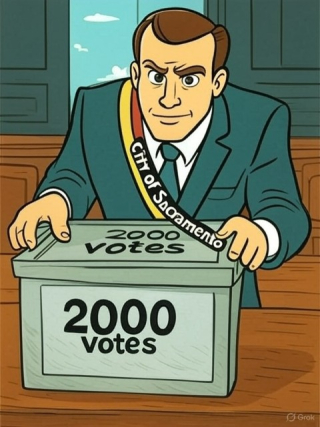
Sacto_votes

The above is the image Skynet returned when we
asked for a graphic for this post

The California Court of Appeal’s recent opinion in Dessins LLC v. City of Sacramento, No. C100644 (July 9, 2025) doesn’t deal with eminent domain or takings, but is about municipal fees and the way California requires these things get adopted. But we’re going to cover it, if only briefly. 

Why? Because it turns out that this decision tells us a lot about how California courts seem to look for any way to uphold exercises of government power. And when that power comes directly into conflict with the voters as it does here, one guess who wins.  

A bit of background for you non-Californians.

If you were to not have an understanding of the history of local fee collection and property taxation in California, you might be under the impression that it is pretty tough

Continue Reading One City, Many Votes: Cal App OK’s Municipal Sleight-of-Law To Permit City To Impose Fees… On Itself (And Others)
Florida law makes it really difficult for municipalities to adopt rent controls. State statutes and the Florida Constitution erect all sorts of substantive and procedural hurdles that must be crossed. For example, a statute requires findings that any such measures are responding to an emergency, a “grave … menace to the general public,” and places the burden on the municipality to not just make findings, but back up those findings with facts, and show that rent control will actually “eliminate” the emergency. Single-family properties cannot be rent controlled. And any ordinance adopted by a municipality must be approved by the voters.

Facing what it concluded was a problem — a shortage of 26,500 housing units and a population increase of 25% in the last decade – Orange County’s County Commission voted, 3-2, to control rents. The measure limited the frequency and amount of rent increases.

After the measure was placed

Continue Reading County: We’re Short Of Housing, So Let’s Do Rent Control! Court: Not So Fast.

IMG_4261
Come at me!
(Bolick, J., dissenting)

We have a Wexis alert for “Kelo,” because that’s one of the ways we keep up on the latest developments in this area. That alert doesn’t ping all that often, so we were all excited when yesterday, we received an alert notifying us of the Arizona Supreme Court’s opinion in State of Arizona v. City of Tucson, No. CV-20-0244-SA (Apr. 14, 2021)? Was it a case of government-to-government takings? Prior public use? 

So imagine our disappointment when in reading the opinion, it turns out to be a question of municipal home rule, and election law. Now don’t get us wrong: we are muni law nerds as well as takings nerds, so we dig any opinion in which a court is looking at a local government’s power to frame its own “constitution” and how (or whether) it conflicts with state law. But

Continue Reading What Is A Kelo Reference Doing In An Opinion About Elections And Municipal Home Rule?

Nothing much to see in the Massachusetts Court of Appeals’ opinion in Comstock v. Zoning Board of Appeals of Gloucester, No. 19-P-1163 (Aug. 3, 2020), a somewhat typical zoning dispute.

Neighbor vs neighbor, over whether permits issued by a municipality (and approved by the ZBA) to renovate and replace an existing — but dilapidated — residential garage, were valid. The replacement garage was to be built on the same footprint as the old garage, even though some elements of the design were different.

Issue: is the separate garage covered as a pre-existing nonconforming use under Massachusetts statutes? 

Short answer: yes, the nonconforming use statute covers separate buildings. The term “single-family residence” includes accessory structures. Nothing too surprising there.

But what caught our eye and makes us post this case here is footnote 11 on page 8 of the slip opinion, about the “certain level of protection to all structures

Continue Reading Mass App: “Grandfathering” Is Term We’re Not Going To Use Because “it has racist origins”

Eminent domain lawyers know that even though the U.S. Supreme Court ruled against the property owner in Kelo, it acknowledged that there was a (slight?) hope in some cases where the condemnor’s stated public use or purposes is actually “pretext” to private benefit.

Pretext may be present in at least three situations: (1) when eminent domain is used to transfer the private property of one party to another private party where the magnitude of public benefits outweighs the private benefit; (2) when eminent domain is used for a one-to-one transfer of private property without a comprehensive, integrated, and carefully considered development plan; and (3) where a particular private party is identified before the taking. See Kelo v. City of New London, 545 U.S. 469, 478 & n.6 (2005). 

But in the 15 years since Kelo, the Court has never agreed to take up the question of how a property

Continue Reading Why Eminent Domain Lawyers Should Read The Supreme Court’s Census Case

IMG_20161026_112153

Here’s what we’re reading today:


Continue Reading Monday Reading: Pirates (Twice), Monet Land Use Pilgrimage

Here’s the latest in a case we’ve been following (because we represent the Petitioner), an election law case about the timing of appeals in challenges to a voter’s registration.

In Hyland v. Gonzales, No. SCWC-15-0000053 (Mar. 2, 2017), the unanimous court held that the appellant timely “brought” his appeal to the Hawaii County Board of Registration by mailing it within the statute’s 10-day appeal window. The opinion was just issued, and we’re reading it now. Here’s the brief we filed in the case. 

While the case involved specific statutes under the Elections Code, Hawaii appellate lawyers should pay attention to this case because it involves how time is calculated for appeals, and what is considered a “holiday” for purposes of the calculation.

We’ll have more once we’ve digested it.

Hyland v. Gonzales, No. SCWC-15-0000053 (Haw. Mar. 2, 2017) 


Continue Reading Hawaii Supreme Court: Election Law Appeal Timely Brought When Mailed

Here’s the recording of Hawaii Supreme Court oral arguments from last month in a case we first were following, and then later became involved in as counsel.

As we previewed here, the question which the court is reviewing is whether an appeal in a voter registration challenge case is timely brought when it is mailed by the appellant, or when received by the Board of Registration Appeals. Under the statute, challengers have ten days in which to “bring” an appeal, and the Intermediate Court of Appeals concluded that means to be timely brought, the appeal papers must be delivered to the Board within that time, not merely deposited in the mail.

If election or administrative law, or the timing of bringing appeals is your thing, you might want to listen along.  Continue Reading Hawaii Supreme Court Oral Arguments: When Is Election Law Admin Appeal “Brought?”

Our colleague Rebecca Copeland has posted a preview and the briefs in an election law case we’re arguing next week in the Hawaii Supreme Court. SeeWrit to Watch: Hyland v. Gonzales.” We’ve written about the case earlier here and here

The question for the court’s review is whether an appeal in a voter registration challenge case is timely brought — when mailed by the appellant, or when received by the Board of Registration Appeals? Under the statute, challengers have ten days in which to “bring” an appeal, and the Intermediate Court of Appeals concluded that it must be delivered to the Board within that time, not merely mailed. The court’s decision in this case could have an impact beyond the relatively rare election law context, because many administrative procedures and appeals are subject to similarly-phrased deadlines.  

Rebecca writes:

In the underlying case, Hyland challenged the

Continue Reading Upcoming Election Law Hawaii Supreme Court Argument Preview: When Is A Registration Challenge “Brought?”

Here’s the Ninth Circuit’s opinion in a election law case we’ve been following, Davis v. Commonwealth Election Comm’n, No. 14-16090 (Dec. 27, 2016). 

The issue in the case is whether limiting voting on certain constitutional amendments in the Commonwealth of the Northern Marianas Islands to a “person who is a citizen or national of the United States and who is of at least one-quarter Northern Marianas Chamorro or Northern Marianas Carolinian blood or a combination thereof or an adopted child of a person of Northern Marianas descent if adopted while under the age of eighteen years” is a race-based limitation on voting, prohibited under the Fifteenth Amendment.

You know the answer, don’t you? Of course it is, and the Ninth Circuit panel, in a short opinion, said so. Ancestry, as Rice v. Cayetano, 528 U.S. 495 (2000) held, can be a proxy for race, and “[j]ust as the definitions of Hawaiian and native Hawaiian in the

Continue Reading 9th Cir: Restricting Voting To People Of Northern Marianas Descent Is Race-Based Voting Limitation