Texas court of appeals fifth

Here’s the latest in a case we’ve been following

Recall that a couple of months ago, the court of appeals held that the challengers were likely to succeed in their challenge to Dallas’s short-term rental ban. The case was up on appeal from a preliminary injunction, so there wasn’t a lot in that decision. 

Now, we have a decision after fuller consideration after the city asked for en banc review. In City of Dallas v. Dallas Short-Term Rental Alliance, No. 05-23-01309 (July 18, 2025), the court again concluded that the challenger property owners were likely to succeed on their claim that the city’s ban on short-term renting violated the due-course-of-law requirement under the Texas Constitution:

Under the circumstances, we conclude appellees Dallas Short Term-Rental Alliance, Sammy Aflalo, Vera Elkins, and Denise Lowry proved their probable right to relief against the City’s zoning ordinance under their due-course-of-law argument

Continue Reading Tex App: Like We Said Before, Property Owners Are Likely To Succeed In Challenge To Short-Term Rental Ban

Charlottesvillezoning

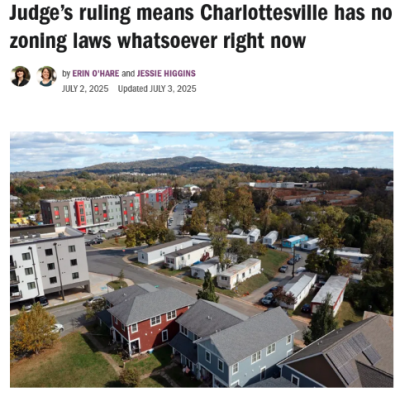
This interesting — and kind of funny — story has been circulating: “Judge’s ruling means Charlottesville has no zoning laws whatsoever right now.” 

What happened? Is the counter-Euclid revolution underway? Did the judge rediscover Nectow? Did Charlottesville voters decide to go Full Houston

No, nothing quite as dramatic. The story notes that the city’s attempt to adopt a new zoning code was held invalid. But, the story notes, the former zoning ordinance was repealed so that the new one could be adopted. With the former code ineffective and the new code invalidated … just like that, no zoning!

We haven’t checked, but we would not be surprised if the most popular search on WEXIS right now in the Blue Ridge is “Virginia /s vested /s rights or ‘estoppel.'”

In the meantime, the city has stopped processing new development applications, while claiming this is all

Continue Reading Houston Says ‘Welcome!’ – What Happens When Another City Has No Zoning?

In City of Dallas v. Dallas Short-Term Rental Alliance, No. 05-23-01309-CV (July 18, 2025), the Texas Court of Appeals affirmed a preliminary injunction, suspending operation of two ordinances which (1) restrict, and (2) require registration of short-term rentals in Dallas.

It’s a short opinion and up on appeal from interlocutory emergency relief, so there isn’t a ton there. But it is still worth reading because the court concludes the challengers have a likelihood of eventually showing that the ordinance restricting short-term renting violates “due-course-of-law” (aka substantive due process). Texas recognizes a property right in leasing property, and the owners here asserted they have a vested right to do so:

Under the circumstances, we conclude appellees Dallas Short Term-Rental Alliance, Sammy Aflalo, Vera Elkins, and Denise Lowry proved their probable right to relief against the City’s zoning ordinance under their due-course-of-law argument because they alleged they possessed well-established rights to

Continue Reading Tex App: Challengers Likely To Succeed On Due Course Of Law Claim For Short-Term Rental Ban

In this order, the U.S. District Court for the Northern District of Illinois temporarily enjoined enforcement of Chicago suburb Glen Ellyn‘s prohibition on renting property for less than 30 days.

Blakelick owns a five-bedroom single family home that when purchased was not located in Glen Ellyn. Since 2022, it has been offering the home for short-term rental on platforms like Airbnb. But in 2024, the property was annexed by the Village of Glen Ellyn. Blakelick continued to rent the property for less than 30 days. 

The dispute apparently began six months earlier when a neighbor began complaining about noise, culminating in the threat to “do everything in [his] capability to see to it that such use of property is banned in this area.” Slip op. at 2. Apparently he was successful, because in 2025, the Village, now having jurisdiction over the property, adopted an ordinance prohibiting owners from

Continue Reading Property Owner Likely To Succeed On Claim That Prohibition Of Short-Term Rentals Is A Penn Central Taking

The question in today’s case is an old one: can you own wild animals?

In Texas Parks & Wildlife Dep’t v. RW Trophy Ranch, Ltd., No. 15-24-00112-CV (Apr. 10, 2025), the Texas Court of Appeals said no. At least not when that wild animal is a white-tailed deer.

Here are the facts. Generally, you can’t possess a white tailed deer in Texas. (We bet you can hunt ’em. But you can’t, like, domesticate them.) But there are exceptions to that general rule. One of these exceptions allows you to obtain a breeder permit, by which you can keep breeder deer in captivity for propagation purposes. The Ranch is such a deer breeding facility.

But white-tailed deer in Texas — and elsewhere — are susceptible to a disease that sounds truly horrible: Chronic Wasting Disease, “a type of transmissible spongiform encephalopathy[.]” Slip op. at 2. One of

Continue Reading Deer Me! No Property Interest In Deer, Even If You Possess Them

You should already know Short Circuit is the Institute for Justice’s frequently-updated podcast on important and interesting decisions from the federal courts of appeals (the “Circuit” part of the title, we assume).

If you are not already a regular listener you are missing out, because it is a fantastic and easy way to keep up with what is going on, and to hear insightful analysis.

We’ve visited the SC studios in the past, and this week made a return visit, joining host Anthony Sanders (Director of the Center for Judicial Engagement), and guest Justin Pearson (Managing Attorney of IJ’s Florida offices), to talk cattle feedlots, “new” vs. “old” property, North Carolina’s Law of the Land Clause, and methods of constitutional interpretation.

Here’s the episode summary, and show notes, from the Short Circuit site:

A long-time friend of the Institute for Justice, Robert Thomas, joins us this week. For

Continue Reading “I Like Old Property” – We Return To The “Short Circuit” Podcast To Talk Law Of The Land & Magna Carta

Magnachartasupremecourtdoor

Readers know that the North Carolina Constitution does not contain a “takings” or “just compensation” clause. Does that mean that the government can simply take property, and not have to worry whether the taking is for a public use, and with just compensation? Of course not.

Because we also know that the N.C. Constitution contains a Law of the Land Clause which says:

No person shall be taken, imprisoned, or disseized of his freehold, liberties, or privileges, or outlawed, or exiled, or in any manner deprived of his life, liberty, or property, but by the law of the land. No person shall be denied the equal protection of the laws; nor shall any person be subjected to discrimination by the State because of race, color, religion, or national origin.

That provision is interpreted to include the usual historic and traditional limits on both the eminent domain and police powers.

Continue Reading NC: Law Of The Land Clause Doesn’t Bar Legislature From Reviving SOL’d Tort Claims

The owner’s land is a peninsula most of the time, but when Flathead Lake, Montana, rises a few months each year, it needed a bridge to access. So it asked the County “How about a bridge? We will only use it when the water rises.” County said yes, issued a permit.

NIMBY neighbors, however, had another idea, They sued the County to void the permit: “What about the Montana Lakeshore Protection Act?” they asked. Trial court agreed, declared the permit void, and ordered the owner to restore the area to its natural state. Montana Supreme Court affirmed.

Next up: the owner’s inverse claim against the County. We got a vested property interest, and “removal of the bridge by court order amounted to a taking[.]” Slip op. at 3. Trial court agreed with the County that the permit was void ab initio, and thus no vested property right. Moreover, the owner

Continue Reading Montana: It Doesn’t Take Much To Allege An Inverse/Takings Claim (Nor Should It)

Screenshot 2024-11-20 at 09-16-50 Lake Worth Lagoon - Google Maps
Lake Worth: the “lago” in Mar-a-Lago

You know his name. He’s taken on the City of Riviera Beach twice at the U.S. Supreme Court. And won both times. The houseboat that isn’t a boat. The government can’t shut you out from speaking your mind simply because you irritate them.

That’s right, it’s Fane Lozman. A “Florida Man” that you can like and admire. And he’s back for Round 3.

He owns property that’s mostly in (in, not near) Lake Worth. Two-tenths of an acre is uplands, and the rest (7.75 acres) is submerged. As the Eleventh Circuit noted, “[o]nly a sliver of Lozman’s property is above water.” 

The city, in accordance with the usual approach to land use regulation has a comprehensive plan. That plan designates submerged lands as “Special Preservation Future Land Use,” a label which should set off your Lucas

Continue Reading CA11: Takings Claim Not Ready Despite Govt’s Enforcement Actions

PXL_20240422_045016733.MP
There are some rewards for working late in the 808

Yesterday was the last day of instruction for the Spring 2024 semester at the University of Hawaii Law School. Did these last few months ever go by fast. 

A big thank you to Professor Mark M. Murakami, with whom I guest-lectured at the Old School (both of us earned our JD’s at the Law School) over the semester, on such topics as Euclid, vested rights and development agreements, and of course limitations on the police power such as takings.

Although our students have another couple of weeks to finish up with their final papers, we can say with certainty that the future of Hawaii land use law is in good hands. We had some very intriguing and educational discussions over the past few months. 

PXL_20230426_222214630

Law of the Splintered Paddle

PXL_20240423_050055849.MP       
Old School chalkboards remain in some of the classrooms.

Continue Reading Aloha To Another Semester Of U. Hawaii Land Use