Each year, the Texas A & M Journal of Property Law publishes a symposium on some aspect of dirt law.

This year, the subject is “Day Zero: How Cities Run Out of Water.”

Here’s the program description:

This symposium is centered around Professor Rhett Larson’s (Arizona State University) forthcoming book, Day Zero: How Cities Run Out of Water (Cambridge University Press).

For many people around the world today, “Day Zero” refers to the day a city runs out of water. Cities across the globe have faced a Day Zero Crisis: Cape Town, South Africa; Chennai, India; and Mexico City, Mexico. The experience of potentially confronting Day Zero has given rise to prophets of doom, heroic reformers, complacency and overreaction, propaganda to frighten and mollify, false starts, and stagnant failures.

In this symposium, legal experts from across the country will explore how these and other cities experience Day

Continue Reading TAMU Law’s Journal Of Property Law 2026 Symposium: “Day Zero: How Cities Run Out of Water” (Feb 6, 2026)
A fascinating dirt … err water law (?) decision from the Texas Supreme Court.

We were all set to write up the recent decision in Cactus Water Services, LLC v. COG Operating, LLC, No. 23-0676 (June 27, 2025), when the Texas Agriculture Law Blog beat us to the punch and published a great summary and analysis of the case that we could never beat. Check out Tiffany Lashmet, “Texas Supreme Court: Produced Water Conveys to Mineral Lessee” (June 30, 2025) for details and analysis. 

The fight was between the surface owner and the owner of the mineral estate about who owns “produced water,” a fancy way of saying the byproduct of fracking for oil and gas. As the court described it, it is “a mixture of fracking fluid, hypersaline brine, residual hydrocarbons, and other substances of varying concentrations.” Slip op. at 6-7. Perhaps not surprisingly, until fairly recently

Continue Reading Texas: Liquid Oil And Gas Waste Belongs To Mineral Owner

Here’s more on an issue we recently covered involving Texas’s “depopulation” of captive white-tailed deer in order to curb Chronic Wasting Disease. In the earlier opinion, the court held that the owner of a deer-breeding facility did not have a property interest in the deer, and thus could not assert a due process or takings claim.

The court in Young v. Texas Parks & Wildlife Dep’t, No. 15-24-00052-CV (Apr. 24, 2025) reached the same conclusion. We’re posting the latest opinion because it elaborates on the “ferae naturae” issue, and every law student and lawyer’s old (very old) friend, the rule of capture

The court rejected the owner’s arguments:

Comparing the facts in Tyler to those here, Young argues that the common law doctrines of ferae naturae and the rule of capture existed long before the Texas Legislature stepped in and began regulating white-tailed deer. In

Continue Reading More On That White-Tailed Deer Takings Case: Law Of Capture Subject To Public Trust

The question in today’s case is an old one: can you own wild animals?

In Texas Parks & Wildlife Dep’t v. RW Trophy Ranch, Ltd., No. 15-24-00112-CV (Apr. 10, 2025), the Texas Court of Appeals said no. At least not when that wild animal is a white-tailed deer.

Here are the facts. Generally, you can’t possess a white tailed deer in Texas. (We bet you can hunt ’em. But you can’t, like, domesticate them.) But there are exceptions to that general rule. One of these exceptions allows you to obtain a breeder permit, by which you can keep breeder deer in captivity for propagation purposes. The Ranch is such a deer breeding facility.

But white-tailed deer in Texas — and elsewhere — are susceptible to a disease that sounds truly horrible: Chronic Wasting Disease, “a type of transmissible spongiform encephalopathy[.]” Slip op. at 2. One of

Continue Reading Deer Me! No Property Interest In Deer, Even If You Possess Them

Here’s the U.S. Court of Appeals for the Federal Circuit’s opinion in United Water Conservation District v. United States, No. 23-1602 (Apr. 2, 2025), which gets a bit metaphysical.

The District is responsible for a dam and canal that diverts water from the Santa Clara River in southern California. Under the authority of the Endangered Species Act, the NOAA required the District to leave more water in the river for steelhead trout habitat. Either that, or seek an incidental take permit allowing the District to “take” (i.e., kill) steelhead.

The District asserted this is a physical taking of its water rights, but the government said no, this is a regulatory taking. Why is this important? Because a physical takings claim is ripe right now, without any need to exhaust any avenues for administrative relief from the NOAA, But if this is a regulatory takings claim, it isn’t ready for judicial review until the NOAA has provided a final decision in the form of a yes or no on an incidental take permit. Which it has not done because the District hasn’t applied for an incidental take permit. The Court of Federal Claims agreed with the government, and the District appealed. 

The Federal Circuit saw the difference between physical and regulatory takings thusly:

Regulatory takings differ from physical takings in that, instead of asking “whether the government has physically taken property for itself or someone else—by whatever means,” the question is whether the government “has instead restricted a property owner’s ability to use his own property.” Id. (citing Tahoe-Sierra Pres. Council, Inc. v. Tahoe Reg’l Plan. Agency, 535 U.S. 302, 321–23 (2002)). “While there is no ‘set formula’ for evaluating regulatory takings claims, courts typically consider whether the restriction has risen to the level of a compensable taking under the multi-factor balancing test articulated in Penn Central, 438 U.S. at 124.” Casitas I, 543 F.3d at 1289; see Tahoe-Sierra, 535 U.S. at 322 n.17 (“When, however, the owner contends a taking has occurred because a law or regulation imposes restrictions so severe that they are tantamount to a condemnation or appropriation, the predicate of a taking is not self-evident, and the analysis is more complex.”).

Slip op. at 7.

The Federal Circuit concluded that the District has a property right in the use of water it diverts. But it rejected the District’s argument that NOAA’s order to not divert as much water as it had been diverting and instead leave it in the river is the same as the government seizing the water. Not so, held the court. This is merely a restriction on the District’s use.

But what about that earlier case in which the Federal Circuit held that the government requiring another water rights owner to put water into a fish ladder was a physical taking?  See Casitas Municipal Water Dist. v. United States, 543 F.3d 1276 (Fed. Cir. (2008). Nope. The difference is that in Casitas, the water district already had diverted the water from the river into its own system and the government ordered it to redirect the already-appropriated water to the fish ladder. Whereas here, the water district was merely ordered to not divert it and leave it in the river for the fish.

The Federal Circuit also distinguished a a Supreme Court case which held that the government’s stopping the water flow to the plaintiff’s mill was a physical appropriation. By contrast, here, the government had not “completely cut off [the District’s] access to the water or cause it to return any volume of water it had previously diverted to its possession[.]” Slip op. at 10. “In fact, [the District] alleges that [NOAA], at most, required more water to stay in the Santa Clara River.” Id.

The District argued the court shouldn’t view this so hyper-technically: we had the right to X amount of water before, and due to the government’s restrictions has X-minus amount now. We think that makes a lot of sense. 

But let’s put that aside for the moment and get to what we see as the more fundamental issue. Should there be a difference between a physical claim and a regulatory claim such that they should be subject to different ripeness requirements?

The idea that there’s a meaningful (or as the Federal Circuit says, “material”) difference between a physical takings theory and a regulatory takings theory is difficult for us to wrap our mind around. There’s but a single cause of action to describe the situation where an owner claims some action by the government has the same effect on property as would an exercise of eminent domain (aka inverse condemnation, regulatory taking, de facto taking). See Yee v. City of Escondido, 503 U.S. 519, 534-35 (1992) (“Petitioners’ arguments that the ordinance constitutes a taking in two different ways, by physical occupation and by regulation, are not separate claims. They are, rather, separate arguments in support of a single claim—that the ordinance effects an unconstitutional taking.”).

Reminds us of that perhaps-apocryphal story about LBJ getting into the “wrong” helicopter. They’re all de facto takings, son. After all, in eminent domain the taking of a nonpossessory easement is treated exactly the same way as a taking of the fee simple interest.

Nonetheless, the Federal Circuit thinks there’s a big difference. But what’s the difference between having a right to divert water, and a right to water already diverted? We can’t see a whole lot. But here’s the court’s thinking:

The Supreme Court precedent that United relies upon, however, does not acknowledge any distinction between physical and regulatory takings. That is presumably because it was not until 1978, decades after the decisions in International Paper, Gerlach, and Dugan, that the Court, in Penn Central, “clarified [ ] the test for how far was ‘too far’” for a regulation to be recognized as a taking. Horne v. Dep’t of Agric., 576 U.S. 350, 360 (2015). It may also be because the alleged takings in those cases did not arise from a regulation, as it clearly does here under the ESA. Moreover, Gerlach and Dugan involve riparian water rights, not appropriative water rights as here. The difference between the two is meaningful in the context of this case because riparian rights exist by virtue of land ownership and, therefore, their acquisition by the landowner does not depend on any physical acts of diversion and beneficial use of water as is required for appropriative water rights. See Colorado, 459 U.S. at 179, n.4 (“Appropriative rights do not depend on land ownership and are acquired and maintained by actual use. Riparian rights, in contrast, originate from land ownership and remain vested even if unexercised.”). Unlike the riparian-rights holders in Gerlach and Dugan, therefore, the appropriative-rights holder here needed to have physically diverted water for its property right to vest and thus become subject to a physical taking, as in Casitas. For at least those reasons, the Supreme Court precedent and related cases United cites are consistent with our decision here.

Slip op. at 12.

United Water Conservation Dist. v. United States, No. 23-1602 (Fed. Cir. Apr. 2, 2025)

Continue Reading CAFED: Sleeping With The Fishes – Requiring Water To Stay In River Is A Regulatory, Not Physical, Taking

Kudos to whomever added the Wilhelm Scream

In trial court litigation, the “final judgment” is a milestone. That’s when your window to an appeal starts, that’s when it is truly done in a trial court. If you are one of the parties or lawyers in the trial court, that’s when you can respond to the question “did you win?” truly with a “yes” or “no.”

And that little voice in our head keeps reminding us that until final judgment, in the (perhaps apocryphal) words of Yogi Berra, “it ain’t over ’til its over.” Yes, you might win a partial summary judgment. Or that motion gets denied. Or the court decides that yes, the court has jurisdiction. Or whatever. All that stuff is mostly interlocutory and therefore subject to revision, revocation, or reconsideration. Or in the case of subject-matter jurisdiction, something that can come back to bit a plaintiff

Continue Reading CAFED: It Ain’t Over Til It’s Over – CFC Free To Revisit Seven-Year-Past Denial Of Motion To Dismiss

2025RMLUI_750x550_FNL

Registration is open and underway for this year’s edition of the Rocky Mountain Land Use Institute in Denver, March 5-7, 2025. Location: University of Denver Sturm College of Law.

This conference is more what we’ll call “land usey” than ALI-CLE’s Eminent Domain & Land Valuation Litigation Conference (as the respective titles suggest), but there’s a lot at RMLUI for those whose practices lean more on the eminent domain side than the land usey. As we know, any attempt to draw a clean line between these practices is futile, and there’s tons of crossover. That’s why we’ll be there, downloading the latest.

As always, there’s a great a la carte menu of programs and tracks for attendees to choose from, including sessions on “Sheetz and Exactions,” “Brownfields Re-Re-Development,” “Managing Growth and Infrastructure in the Southwest,” “ADUs for Aging in Place,” and, thankfully, “Legal Ethics.” And some add-on workshops the day

Continue Reading 2025 Rocky Mountain Land Use Institute, Denver (March 5-7, Denver U. Law School)

IMG_20180930_182039
Strong letter to follow!

A long-ish read (32 single-spaced pages) from the Federal Circuit in City of Fresno v. United States, No. 22-1994 (Dec. 17, 2024), but worth reading.

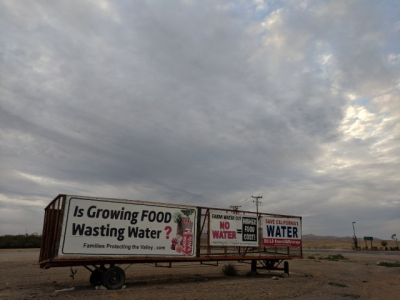
Not only will you get a crash course in how water is allocated in California’s vast central valley (as the billboards above, set up along the north-south I-5 corridor demonstrate, not everyone is happy about how that is accomplished), but you will also understand how the Federal Circuit approaches the predicate question in takings case: does the plaintiff own “private property?”

The court concluded no, the plaintiffs do not possess private property rights. Consequently, it affirmed the Court of Federal Claims dismissal of the takings claim.

The central valley, as the opinion explains, “is home to the largest federal water management project in the United States[.]” Slip op. Unsurprisingly named the Central Valley Project, is a series of dams, storage
Continue Reading CAFED: Feds Allocating California Water Isn’t A Taking Because Cal Says Only The Feds Have Water Rights

Screenshot 2024-11-20 at 09-16-50 Lake Worth Lagoon - Google Maps
Lake Worth: the “lago” in Mar-a-Lago

You know his name. He’s taken on the City of Riviera Beach twice at the U.S. Supreme Court. And won both times. The houseboat that isn’t a boat. The government can’t shut you out from speaking your mind simply because you irritate them.

That’s right, it’s Fane Lozman. A “Florida Man” that you can like and admire. And he’s back for Round 3.

He owns property that’s mostly in (in, not near) Lake Worth. Two-tenths of an acre is uplands, and the rest (7.75 acres) is submerged. As the Eleventh Circuit noted, “[o]nly a sliver of Lozman’s property is above water.” 

The city, in accordance with the usual approach to land use regulation has a comprehensive plan. That plan designates submerged lands as “Special Preservation Future Land Use,” a label which should set off your Lucas

Continue Reading CA11: Takings Claim Not Ready Despite Govt’s Enforcement Actions