

Today’s post is by our friend and Pacific Legal Foundation colleague Steve Davis, reporting on his recent attendance at the recent Texas A & M Journal of Property Law symposium.
————————————————————————————————————————
Property Law and “Aggie Spirit”
by Stephen D. Davis, Senior Legal Fellow Pacific Legal Foundation
This past Friday the Journal of Property Law at the Texas A&M School of Law — one of only a handful of property-law-centered law school journals (not including the dozens of intellectual property law journals — held its annual symposium. This year’s symposium, titled, “Day Zero: How Cities Run Out of Water,” centered on a forthcoming book of the same name by Arizona State University College of law professor Rhett Larson.
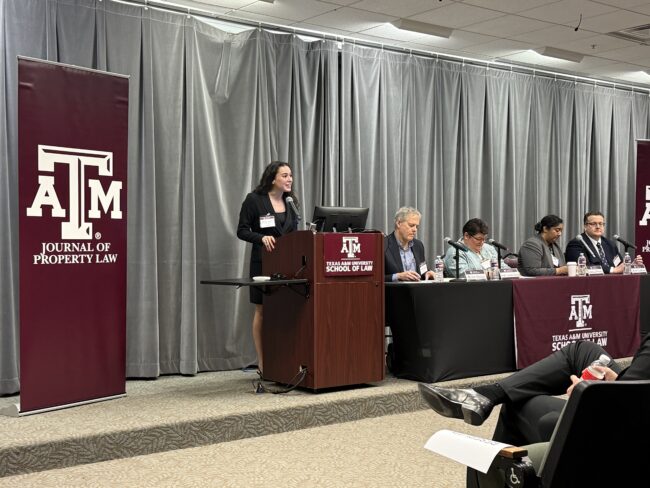
The symposium offered a fascinating look at water law, the history of urban-rural development throughout the American West, stories of the communities facing water-shortage crises (including native American communities), and a preview of Professor Larson’s study of impending water crises in three major cities, Mexico City, Cape Town, and Chennai (India), and what other cities can learn from their experience.
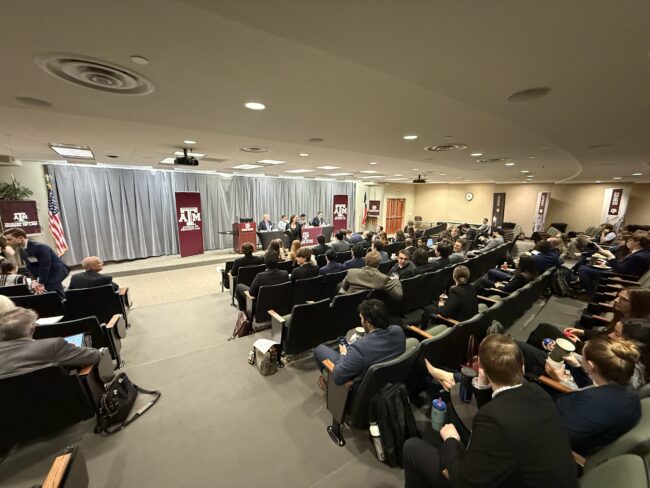
This was my first visit to the Texas A&M University (TAMU) School of Law, and I was in for a real Texas treat. The first thing I learned (thankfully, before I arrived) was that the TAMU law school ain’t in College Station, but instead lies “deep in the heart of [Forth Worth,] Texas.” Its location in Fort Worth, I discovered, is due to TAMU taking over the Texas Wesleyan University School of Law in Fort Worth just over a decade ago. And it’s no surprise that TAMU is the home of a renowned property law and water law faculty, including professors Gabriel Eckstein and Vanessa Casado Perez (who specialize in water law and served as moderators of the symposium panel presentations) and Tim Mulvaney, Chris Odinet and Aric Short.
I next discovered what I call the “Texas aloha.” TAMU has a hard-and-fast rule that every greeting, conversation, speech, address, and maybe even fight at TAMU begins with a loud “HOWDY!” which must be repeated back by the person or group thus addressed. And they’re not kidding. When I arrived at the school, I went hunting for a bottle of the official drink of Texas (Dr Pepper) in the student lounge. I tried not to disturb a student studying quietly, but as soon as the student saw me, he dutifully greeted me with a “howdy!” Caught off guard, I responded with an awkward (and probably offensive) “hello.”
The symposium was delightful. Well-attended by thoughtful, curious, and engaging law students, including many student-members of the Journal of Property Law and Law Review, what I expected to be a dry topic, water law, sprang to life. After an exchange of “howdies” (and “whoop” cheers for the alumni present), a who’s who of water law scholars, as well as a couple of expert Texas water law practitioners, relayed captivating story after story about what happens in a community on “day zero” — the day the water stops flowing out of faucets — and what led to it.
Scholarly papers were presented by leaders in the field of water law, including:
Professor Rhett Larson, of Arizona State University, who introduced his book, “Day Zero”
Professor Burke Griggs, of Washburn University
Professor Robin Craig, of the University of Kansas
Professor Camille Pannu, of Columbia University
Professor Shelley Saxer, of Pepperdine University
Professor Heather Tanana, of the University of Denver (home of the Rocky Mountain Law Use Institute)
Professor Buzz Thompson, of Stanford University
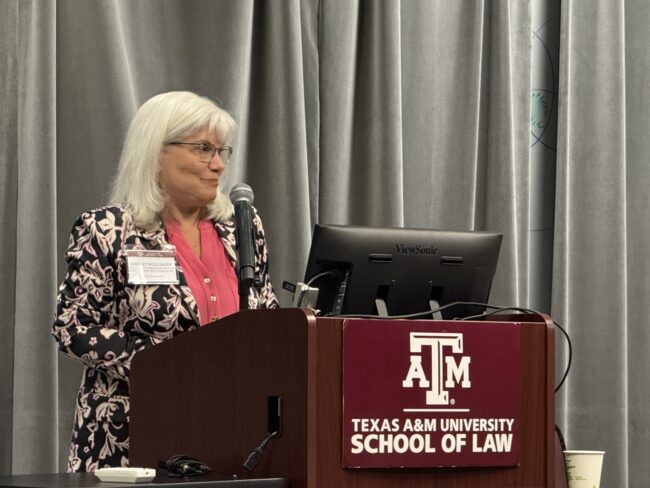
Professor Saxer
The symposium was an intriguing and captivating blend of law, history, and gritty human experience. Professor Griggs explained how the development of deep-well pumping upended orderly urban development in the West. Professor Saxer explored the question of whether water rights are property. Professor Tanana related how decentralized water systems within Indian reservations have resulted in generations of many native Americans living without indoor plumbing. Others related how major litigation over water rights, like Arizona v. Navajo Nation, and state-versus-state Supreme Court original-jurisdiction litigation regarding river water flow affect not only water law, but presage problems lying ahead.
Be sure to keep an eye out for Professor Larson’s “Day Zero,” which is sure to have appeal beyond water law, the forthcoming symposium issue of the TAMU Journal of Property Law, and next year’s symposium.