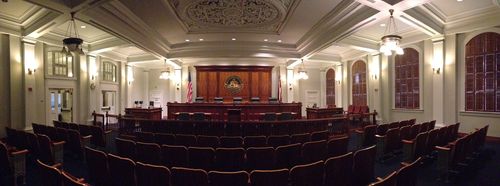
Remember that decision by the Hawaii Intermediate Court of Appeals that we posted a few months ago, after the Hawaii Supreme Court granted discretionary review? The case involved a question of how appeals are brought and filed in cases challenging a voter’s registration. In Hyland v. Gonzales, the ICA held that an appellant who was challenging another voter’s registration did not timely “file” his appeal, because he mailed it after the ten day statutory limitations period, and did not ensure it was delivered in that window. 

When we posted that case here, we didn’t have a dog in the hunt. But later, we were asked by the Hawaii Pro Bono Appellate Project to represent the losing appellant, now that the Supreme Court had agreed to hear the case. We signed on and asked the court for supplemental briefing and oral argument. The court agreed, and today, we filed our Supplemental

Continue Reading New HAWSCT Brief In Election Case: Voter Registration Appeal Is Timely Brought When Mailed

Are you like us and cannot type, write, or say “statue” without it coming out “statute?” That’s an affliction we’ve had since law school days, and one we’re probably never going to shake.  

As lawyers, we’ve all no doubt seen plenty of crappy statutes in our careers.

But, at the risk of being offensive, here’s an actual s**t statue, located in the City of Chicago. Created by an artist tired of dog owners allowing their Fidos to do their business on the artist’s front steps, he protested in the only way he knew how: by reproducing the offending items in bronze, larger than life, with water flowing out of the top.

Crass but apparently effective: evidence of actual dog doo was nowhere to be found during our recent visit.  

IMG_20160924_173444
The artist.

IMG_20160924_173527
Another angle on his work. 

Continue Reading NSFW (Maybe): A Chicago Statue

We love quo warranto cases. Not just because “if it ain’t Latin, it ain’t the law’ (as one of our favorite law school profs informed us), but because they are yet another means for citizens to challenge those holding and exercising power.  

Here’s the latest from the Hawaii appellate courts, Ford v. Leithead-Todd, No. CAAP-15-0000561 (Sep. 8, 2016).

The case involved the requirement in the County of Hawaii Charter that the Director of the Department of Environmental Management possess “an engineering degree or a degree in a related field.” The mayor and county council hired a lawyer who did not have an engineering degree — only a bachelors with a major in English and a minor in Hawaiian studies, plus a JD — and a citizen brought a quo warranto suit challenging her qualification for office.  

The circuit court granted the County’s motion for summary judgment

Continue Reading Quo Warranto Fu: Does County Environmental Manager’s Law Degree Qualify As “Engineering … or related?”

You may call us anti-Holmesian, but we’re wary of any judicial opinion that has “clear and present danger” as its standard of review. Like “shouting fire in a crowded theater,” this legal meme gives more heat than light in our estimation, and doesn’t really tell you much.

But the phrase was at the heart of the Ninth Circuit’s opinion in Democratic Party of Hawaii v. Nago, No. 13-17545 (Aug. 15, 2016), issued today in the case in which the DPH challenged Hawaii’s “open primary” election.  

We’ve been following the case since its inception, and won’t go into the background and details again except to say that Hawaii is really, really blue, and the goal of the lawsuit was to exclude those who have not sworn allegiance to The Party from the only election that truly matters in our one-party state, the Democratic Party Primary. As

Continue Reading In The Bluest Of Blue States, 9th Circuit Rebuffs (For Now) Attempt To Bar Republican Voters From The Only Election That Matters

Like many high-profile cases, the legal challenge to the actions of the State Office of Elections tracks two threads. On one hand, the Office’s travails are well known and frequently reported. The public understands only too well the difficulties the Office encountered when it failed to print enough ballots, and had other problems in recent Hawaii elections. The media reports in the wake of the disastrous oral argument (from the Office’s perspective) focused on how upset the Justices seemed to be with the way the Office approached the situation, and its arguments in the case. We had a similar view when we wrote, “After A Judicial Feeding Frenzy, The Hawaii Supreme Court Searches For Rules To Fix The Office Of Elections.” 

On the other hand, judicial opinions (particularly by a unanimous court) tend to focus on the legal nuances which a case presents, by detailing things like

Continue Reading Hawaii Supreme Court: Some Office Of Election Ballot Practices Are “Rules,” Some Maybe Not

The oral argument heard this morning in the  “Nai Aupuni” cases (Akina v. Hawaii, No. 15-17134, and No. 15-17453) by a panel of the Ninth Circuit (Chief Judge Thomas, and Judges Callahan and Murguia, riding circuit in Honolulu), was a study in contrasts.

On one side, representing the plaintiffs-appellants, was a lawyer from Washington D.C.’s Judicial Watch, who argued against the case being rendered moot on appeal by the machinations of the main defendant, Nai Aupuni, which in response to the U.S. Supreme Court earlier ordering it to halt the putatively private election to choose delegates to a native Hawaiian convention to frame a constitution, called off the election and dissolved. This, he argued, was a mere litigation strategy, and the “cognizable danger of a recurrent violation” remains, even though this defendant doesn’t legally exist any more. Having been busted by the Supreme Court, Nai Aupuni has adopted its actions to purposefully make the appeal moot. Appearing to understand

Continue Reading 9th Circuit Arguments In Nai Aupuni/OHA Case: Mooted On Appeal, Or Likely To Recur?

More on that case we reported on earlier this week, recently argued at the Hawaii Supreme Court:

  • Journalist Ian Lind posts “Hawaii Supreme Court skeptical of Office of Elections” which has links to the merits briefs in the court of appeals. These help us to understand the arguments better. Recall that with most cases granted review by the Hawaii Supreme Court, no additional briefing is taken. All the court reviews are the cert-stage briefs, the lower court briefs, and, of course, the lower court’s opinion and record. 
  • Civil Beat also has a column by Mr. Lind, “Justices Aren’t Buying That Voting Rights Weren’t Violated” (“However, the attorney representing the Office of Elections at the May 18 Supreme Court hearing ran into an unusual barrage of critical questions from all five Supreme Court justices in what Honolulu attorney and law blogger Robert Thomas called ‘as


Continue Reading More On The Election Office Snafu Case, Awaiting Decision By The Hawaii Supreme Court

Photo

“Mistakes Were Made”

During last week’s oral arguments (also streaming below) in Green Party of Hawaii v. Nago, No. SCWC 14-0001313 (May 18, 2016) — arguments that ran nearly 50% over the scheduled one hour length — the justices of the Hawaii Supreme Court appeared to be searching for a practical answer to the central question in the case: since the State Office of Elections admittedly goofed up the delivery and printing of ballots during the 2012 general election (and had other well-publicized problems), what, if anything, could the court do to make sure these problems don’t recur?      

Mea Culpa, Mea Culpa

All the lawyer for the agency could offer was the Election Officer’s mea culpa, and assurances that 2012’s problems wouldn’t be repeated. She opened her portion of the arguments like this:  

At the outset I want to acknowledge the mistakes that were

Continue Reading After A Judicial Feeding Frenzy, The Hawaii Supreme Court Searches For Rules To Fix The Office Of Elections

Cinematic Rude Awakenings from Roman Holiday on Vimeo.

If there’s one thing that makes lawyers sit bolt upright in a sweat at 3 am, it’s the prospect of missing a jurisdictional deadline. A statute of limitations, a notice of appeal. Come on, you know you’ve been there. Keep your carrier’s number on speed dial. 

Well here’s one that might help you sleep better by making the rules for when and how to file more clear, at least in voter registration challenges.

On May 11, 2016, the Hawaii Supreme Court accepted certiorari and agreed to review the Intermediate Court of Appeals’ unpublished memorandum opinion which upheld the dismissal by the Big Island’s Board of Registration of a voter registration challenge. The ICA held that the appeal to the BoR was not timely filed even though the challenger mailed the appeal to the state’s Office of Elections (located on Oahu) within

Continue Reading HAWSCT To Decide On Timing Of Voter Registration Appeals: When Is An Appeal “Filed?”

In this order, the Hawaii Supreme Court agreed to review (“accepted certiorari” in the local appellate lingo) the Intermediate Court of Appeals’ opinion in Green Party of Hawaii v. Nago, No. CAAP-14-0001313 (Dec. 18, 2015). That decision answered in part the often elusive question of “what is an agency ‘rule’ that triggers the rulemaking requirements?” 

There, the ICA held that certain practices by the State Office of Elections were not “rules,” and thus need not have been adopted via the rulemaking procedures in the Hawaii Administrative Procedures Act.

For more, see our post on that decision, “‘Mistakes Were Made’ – Elections Office Practices Were Not ‘Rules.’” 

The Supreme Court will be hearing oral arguments later this month (Wednesday, May 18, 2016, at 8:45 a.m.). Here is a summary of the issues from the Judiciary’s web site:

This case involves an action by the Green Party

Continue Reading Hawaii Supreme Court Election/Admin Law Case To Watch