Here’s the latest in an issue we’ve been following.

In Alban v. United States, No. 23-1363 (Dec. 22, 2025), the U.S. Court of Appeals for the Federal Circuit affirmed the Court of Federal Claims’s judgment concluding that the failure of the Corps of Engineers to properly operate two dams, which resulted in upstream flooding when Hurricane Harvey struck was a “permanent” taking.

The dams were built nearly 100 years ago to reduce downstream flood risks. The reservoirs are usually dry, and fill up when it rains a certain amount. At the time of construction, the Corps considered acquiring property which would be inundated when the reservoirs filled up to a certain level, but ultimately decided to not do so. The Corps made the decision to acquire only the properties predicted to be flooded in smaller storms. The Corps understood that flooding of additional property was predicted in more

Continue Reading CAFED: Like We Said Before, “Inevitably Recurring” Flooding Is A Taking

Here’s one you don’t want to miss. Lawprof Shelley Ross Saxer has published “Forfeiture Takings, Police Power, and Necessity Destruction,” 80 U. Miami L. Rev. 147 (2025).

Here’s the Abstract:

Civil forfeiture laws allow law enforcement to seize property when there is probable cause it has been used or possessed in violation of legal rules, often before an owner has a chance to contest the government’s seizure in court. In the criminal context, forfeiture is typically an in personam action that requires a criminal conviction and is part of a defendant’s sentence. In the civil context, however, forfeiture is an in rem proceeding brought against the property derived from or used to commit an offense––not against the person who committed the offense. As such, a civil forfeiture may not require a criminal conviction or predeprivation hearing, and, under the “guilty property” theory, developed in England before eventually being

Continue Reading New Article: Shelley Ross Saxer, “Forfeiture Takings, Police Power, and Necessity Destruction,” 80 U. Miami L. Rev. 147 (2025)

There’s not a lot of new territory forged in the U.S. Court of Appeals for the Ninth Circuit’s opinion in Pena v. City of Los Angeles, No. 24-2422 (Nov. 4, 2025), holding that the city could not be liable for a taking after SWAT officers severely damaged a home in the course of apprehending a suspect who had taken refuge there.

After all, the other federal courts which have addressed the issue of whether a local government’s damaging or destroying a home in the course of apprehending a criminal suspect is a taking have all concluded no, although for a variety of reasons. Some say there’s no absolute right to exclude, with the issue turning on whether the police are acting pursuant to a valid warrant, incorporating by reference Fourth Amendment property law. Some say the owner has no expectations of exclusion of the government as a

Continue Reading CA9: No Claim For A SWAT Taking Because There’s A Public Safety Exception To The Fifth Amendment

As we wrap up another year, it’s time to look ahead to the one event that always gets our eminent domain blood pumping: the annual ALI-CLE Eminent Domain and Land Valuation Litigation Conference. Details, including faculty list, a complete agenda, and registration information is posted here.

Now in its 43rd year, this flagship gathering remains the undisputed national hub for practitioners, academics, appraisers, and anyone else who lives and breathes property rights law. Mark your calendars for January 22-24, 2026, when we’ll convene at the JW Marriott Plant Riverside District in Savannah, Georgia. Think historic charm meets Southern hospitality, with moss-draped oaks, riverfront vibes, and enough ghost tours to inspire a dozen inverse condemnation hypotheticals. (For those of you who prefer pixels to palm trees, a live webcast option is available.)

What makes this conference indispensable? For starters, it’s the place to reconnect and talk shop with the

Continue Reading Savannah Bound: Don’t Miss The 43rd ALI-CLE Eminent Domain & Land Valuation Litigation Conference (Jan. 22-24, 2026)

This past week we were busy with the 22d Brigham-Kanner Property Rights Conference at the William and Mary Law School.

Here’s the text of the remarks which I prepared for the session on “Public Safety, Private Property, and Just Compensation.” Note: because of time, I truncated what I planned on saying and kept it shorter.

* * * *

Public Safety, Private Property, and Just Compensation

Before I begin, a prelude. As you learned earlier, yesterday the student Real Estate Law Society produced a reargument of Kelo.

Ms. Kelo won this time. Six-to-zero, adopting the rationale of Justice Thomas’s dissent in the original case, with one concurring opinion. (More about this event in a separate post.)

And for those of you in the audience who didn’t know, Ms. Kelo’s famous little pink house was saved, even though her property was not. The house was taken apart board-by-board

Continue Reading Salus Populi Est Suprema Lex: 2025 Brigham-Kanner Property Rights Conference Report

We’re back to bump stocks. Indeed, we have covered cases raising similar issues so we’re not going into too much detail on the U.S. Court of Federal Claims’ recent decision in The Modern Sportsman, LLC v. United States, No. 19-449 (May 8, 2025), and we’ll just assume you, like us, have been following along with this issue.

Suffice it to say that the federal government adopted regulations defining these devices as prohibited machine guns and gave those in possession 90 days to either turn them over to the government, or to destroy them. The plaintiffs destroyed their bump stocks and then sued the federal government for a taking.

The CFC dismissed the complaint under the government’s “police power” authority to prohibit contraband and noxious items. As we noted in this post, the line between uncompensated destruction and compensated takings was not as clear at the CFC saw it (the Armstrong rationale cannot be ignored, even where a taking may be for a very good public reason), and thus the Federal Circuit affirmed, but shifted the rationale from police power to a lack of a private property interest. After the Supreme Court denied cert, “that was that.” Slip op. at 2.

Meanwhile, other bump stock owners challenged the validity of the administrative rule declaring these things machine guns. And there, the owners found more success, with the Supreme Court eventually concluding that the agency lacked the authority to adopt the bump stock rule. The owners here “then asked this Court to revive this lawsuit, which the Court did … [t]he next day, plaintiffs amended their pleadings to add an illegal exaction claim in addition to their takings claim.” Slip op. at 3. 

The government sought dismissal, arguing that the bump stock owners alleged a physical taking but the government hadn’t physically seized anything. It merely required the owners to destroy the bump stocks: as the CFC put it, the government “acknowledges that plaintiffs alleged that ‘the Rule required bump stock owners to destroy or surrender the devices to ATF.’ Reply 2. That does not pass muster for the government, however, because the government ‘did not seize any devices or otherwise physically invade plaintiffs’ property.’ Id. at 3.” Slip op. at 4. In short, we didn’t actually seize anything of yours, plaintiffs; we merely required you to destroy your property. Really. 

The CFC wasn’t having any of that, and rejected this too-clever-by-half argument:

The Court cannot agree. Let us be clear that the government need not literally force private persons to turn over their property for a taking to occur; a legal requirement is sufficient. For example, in Horne, the Supreme Court held that an administrative order requiring raisin croppers to “give a percentage of their crop to the Government, free of charge” effected a compensable appropriation. 576 U.S. at 355. The government did not literally oust the farmers from possession of the raisins, yet a taking occurred because the order made a “formal demand” backed by fines and penalties. Id. at 362, 367–68. It is the same here. The Rule plainly states: “This final rule requires the destruction of existing bump-stock-type devices.” 83 Fed. Reg. at 66,549. It then instructs: “Individuals who have purchased bump-stock-type devices prior to the implementation of this rule must destroy the devices themselves prior to the effective date of the rule or abandon them at their local ATF office.” Id. Finally, it makes clear that “individuals are subject to criminal liability . . . for possessing bump-stock- type devices after the effective date of regulation.” Id. at 66,525. These statements undoubtedly constitute a formal demand to destroy or transfer possession of bump stocks, satisfying the standard under Horne.

Slip op. at 4-5.

If this argument strikes you as nonsense, welcome to our world, where arguments like this are put forth with a straight face on a regular basis. 

And if that wasn’t enough, the government next argued that the regulations didn’t actually require the owners to destroy their bump stocks, “but ‘merely clarified’ the ‘longstanding statutory law’ banning machineguns.” Slip op. at 5. “Put plainly, the government essentially argues that the Rule is an informational document apprising the public of pre-existing legal obligations.” Id. The CFC held “[t]hat too is incorrect.” Id. That seems to be putting it mildly. What do you think would have happened to bump stock owners who didn’t comply with this “informational” rule and held on to their bump stocks?

Short story: the complaint alleged a physical taking.

Next, however, the CFC rejected the exaction claim, based on the remedy sought. As we know, the CFC is limited to awarding monetary damages in these kind of cases. The CFC held that an “exaction” generally “involves money that was ‘improperly paid, exacted, or taken from the claimant.’” Slip op. at 7 (quotations omitted). Here, the CFC held, no money changed hands and there’s no statute otherwise authorizing a claim for money damages:

In sum, plaintiffs cannot be said to have paid money, directly or “in effect,” for a very straightforward reason: They lost personal property, not money. Indeed, plaintiffs have not alleged that they spent any money for any purpose; or paid any money to any In sum, plaintiffs cannot be said to have paid money, directly or “in effect,” for a very straightforward reason: They lost personal property, not money. Indeed, plaintiffs have not alleged that they spent any money for any purpose; or paid any money to any

Slip op. at 8-9.

The CFC wrapped up by — get this — calling out the property owners’ lawyers for failing to expressly clarify that one of the cases they cited and relied on didn’t actually hold that an exaction could be a demand for “money or property,” only money. Slip op. at 9. The court acknowledged that the citation didn’t actually misquote the case, but that the lawyers should have been more candid that they were arguing for an extension of the law, and that the case limited exactions to money.

We’re fine with that (especially in the AI era), and requiring advocates to be candid. 

But where’s the call-out of the government’s horse hockey arguments, noted above? Dead silence, of course. In our view, the borderline frivolous, time-and-expense wasting, divorced-from-reality arguments the government made are equally if not more deserving of censure. 

Call us if that ever happens. We’ll wait.

The Modern Sportsman, LLC v. United States, No. 19-449 (Fed. Cl. May 8, 2025)

Continue Reading CFC: Allegation That Gov’t Ordered Destruction Of Bump Stocks Pleaded Physical Takings Claim

The California Supreme Court has agreed to review and resolve a lower (California) court split regarding the standard of review a court should apply in challenges to a government taking of a privately-owned public utility.

In Town of Apple Valley v. Apple Valley Ranchos Water, No. E078348M (Feb. 13, 2025), the California Court of Appeal held that when a privately-owner public utility objects under the California Eminent Domain Code to the public use of a governmental takeover of the utility, the court must review the Resolution of Necessity with extreme deference (gross abuse of discretion). This means the reviewing court starts off with the presumption that the resolution is valid and its conclusions are true, and that no additional evidence may be considered to counter that conclusion.

One other Court of Appeal held otherwise, and the California Supreme Court agreed to resolve the divergence of analysis. Here’s

Continue Reading Cal Supreme Court Reviewing Necessity Challenge To Public Utility Takeover

Here’s the latest in a case (and issue) we’ve been following.

In this latest iteration of what we call the “SWAT takings” issue, the Sixth Circuit, like every other federal appellate court, denied the owner of property severely damaged in the course of a police dislodging of a criminal suspect. But the court applied a different analysis. Instead of (incorrectly, we think) looking and whether the police were acting with the scope of their (ha!) police power, the court concluded that the police had a “privilege” to enter, so thus could destroy in the course of that entry, the petitioner’s property.

In short, your bundle of sticks never included the right to exclude the po-po.

Here’s the Question Presented:

A few weeks ago, this Court denied certiorari in Baker v. City of McKinney, 23-1363, a case about whether the Fifth Amendment’s Takings Clause re-quires compensation when a

Continue Reading New Cert Petition: SWAT Takings, Part X

With our tongues firmly planted in cheeks, the Planning Chairs for the upcoming 42d edition of this popular and venerable Conference bring you this “breaking news” report from San Diego!

As you know, in addition to being the best nationally-focused conference on the subjects that we love and a venue that is nearly certain to have some of the warmest winter weather in the continental United States, and we went on-location from some of the local highlights: the beaches, Torrey Pines, the Zoo, Balboa Park, the Gaslamp Quarter, and Coronado to name but a few.

More about the Conference here, including registration information.

Here are some of the highlights:

  • Property Rights at the Supreme Court: DeVillier and Sheetz and What’s Next
  • Slow Take: Possession, Rent, Relocation, and Offset
  • The Jury’s View: How Jurors See Your Case
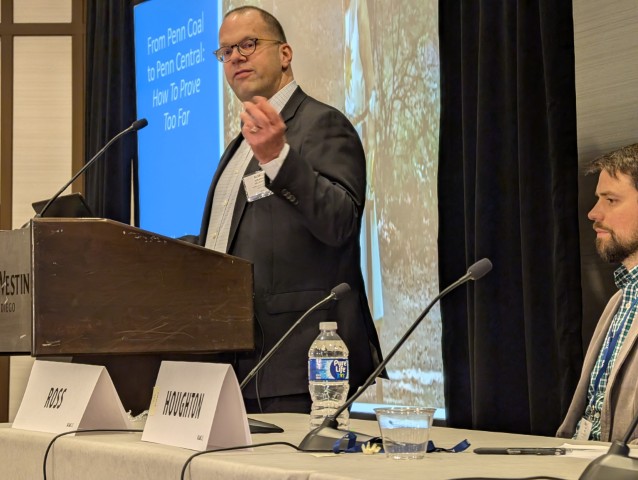
  • From Penn Coal to Penn Central: How to


Continue Reading Breaking News: Come Join Us For The 42d ALI-CLE Eminent Domain & Land Valuation Litigation Conference, San Diego, Jan 30-Feb 1

You all have likely seen ’em, those “We Buy Houses Any Condition” billboards letting the world know that no matter what condition it might be in, there’s an outfit that says it is willing to buy your house.

Well, that outfit ran into the one other outfit that is willing to buy your house, except here, that outfit can force you to sell it. That’s right, the government. In this case, the City of Ontario, California, exercising its power of eminent domain. (As someone once famously described the power of eminent domain: “whether you know it or not, your house is for sale.”)

The city went through the usual motions to forcibly take “multiple vacant lots” next to the Ontario International(!) Airport which it claimed were blighted:

In 2021, the City held a public hearing, after which the city council adopted a resolution of necessity authorizing the City to

Continue Reading Blight Slight: No Taking Of Property For “The Proposed Project” When No Project Has Been Proposed