Here’s the latest in a case we’ve been following.

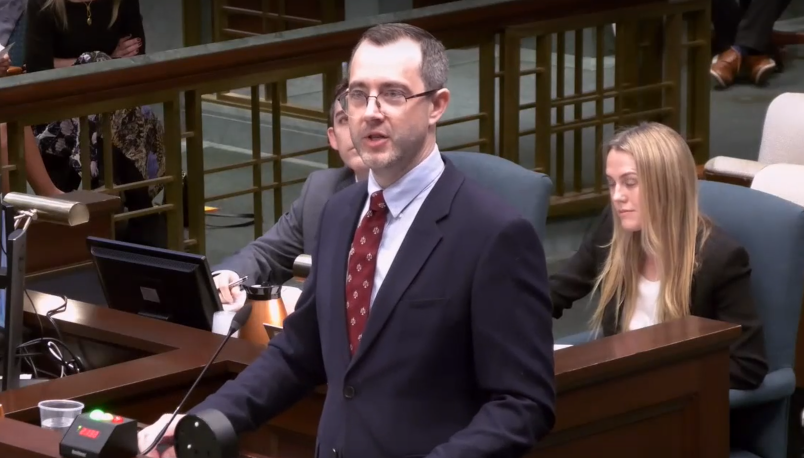
This is Fane Lozman. You know his name. Yes, the guy who has taken on the City of Riviera Beach, Florida twice at the Supreme Court, and is now coming back for a third shot on goal. Houseboat guy. Public hearing gadfly guy. And now, maybe the ripeness guy.

Lozman has filed a cert petition asking the Court to review the Eleventh Circuit’s opinion which dismissed his regulatory takings claim as unripe.

Here’s the Questions Presented:

Fane Lozman has a contentious relationship with the City of Riviera Beach, Florida. The City’s mistreatment of Mr. Lozman has twice required this Court’s intervention. See Lozman v. City of Riviera Beach, 568 U.S. 115 (2013); Lozman v. City of Riviera Beach, 585 U.S. 87 (2018).

In this third chapter, Mr. Lozman was forced to sue the City

Continue Reading SCOTUS Hat Trick? Houseboat Guy Returns For Shot At Lucas Ripeness

Check this out, a recent Fourth Branch pod featuring lawprof Donald Kochan and our law firm colleague Jeremy Talcott, “Explainer Episode 85 – Rebuilding California: Lessons from the Pacific Palisades Fire.”

Here’s the description:

The 2025 Pacific Palisades Fire has underscored the challenges of building in California’s complex regulatory landscape. In response, Governor Newsom issued an executive order suspending CEQA and Coastal Act requirements to expedite reconstruction, raising important questions about the future of development in the state. In this podcast, experts Jeremy Talcott and Donald Kochan examine California’s regulatory environment before the disaster and the broader implications of its permitting processes in the effort to rebuild. Join us for an in-depth discussion on balancing efficient recovery with long-term regulatory considerations.

The money quote from Jeremy:

And I think this fire really offers a very good inflection point for a reimagining or a revisiting of the utility

Continue Reading Fourth Branch Podcast: Talcott & Kochan On “Rebuilding California: Lessons from the Pacific Palisades Fire”

Here’s what we’re reading this day:

Good weekend reading as well. Continue Reading Friday Dirt Law Round-Up

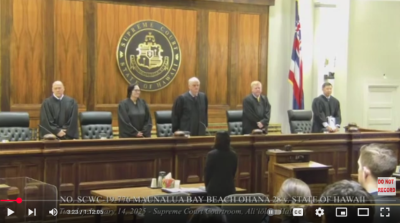
Screenshot 2025-01-18 at 14-58-03 No. SCWC-19-0000776 January 14 2025 10 30 a.m. Maunalua Bay v. State of Hawaiʻi - YouTube

Here’s the latest in a case we’ve been following for a long time.

As we previously noted, the Hawaii court of appeals affirmed a trial verdict that the just compensation owed to littoral property owners for the State’s regulatory taking of small portions of accreted beach is zero.

Last week, the Hawaii Supreme Court heard oral arguments. Here’s the video (sorry, can’t embed it here). Worth watching, if only because questions of just compensation and how it is calculated rarely are presented to this court (which is a frequent flyer in regulatory takings cases).

Here’s a description of the case and issues from the Hawaii Judiciary:

Petitioners Maunalua Bay Beach Ohana 28, Maunalua Bay Beach Ohana 29, and Maunalua Bay Beach Ohana 38 brought an inverse condemnation action against the State of Hawai‘i in 2005. At that time, they argued that the State effected a taking of accreted lands via Act 73 of 2005. In 2009, the Intermediate Court of Appeals (ICA) held that Act 73 “effectuated a permanent taking of littoral owners’ ownership rights to existing accretions to the owners’ oceanfront properties that had not been registered or recorded or made the subject of a then-pending quiet-title lawsuit or petition to register the accretions.” Maunalua Bay Beach Ohana 28 v. State, 122 Hawai‘i 34, 57, 222 P.3d 441, 464 (Ct. App. 2009).

On remand from the ICA, Petitioners sought just compensation for the alleged temporary taking of their accreted lands between 2005 and 2012. At trial, the circuit court concluded that $0 was just compensation for the alleged temporary taking of the accreted land and no nominal damages should be awarded to the petitioners. It also determined that the petitioners were not entitled to attorney’s fees.

The ICA affirmed the circuit court’s decision. With regard to attorney’s fees, the ICA held that the petitioners’ “claim for attorneys fees against the State for obtaining declaratory relief is barred by sovereign immunity.” The ICA further held that the Ohanas were not entitled to attorney’s fees under the private attorney general doctrine.

In their application for certiorari, the petitioners argue that the ICA erred in affirming the circuit court’s award of $0 in just compensation with no nominal or severance damages. Petitioners also contend that the ICA erred by concluding that sovereign immunity bars an award of attorney’s fees, and that they would not be entitled to fees under private attorney general doctrine. The State contends that the ICA did not err in affirming the circuit court’s award of $0 in just compensation or declining to award nominal damages to petitioners. It also argues that the ICA correctly held that sovereign immunity bars petitioners’ claim for attorney’s fees, and that even if it did not, petitioners would not be entitled to attorney’s fees under the private attorney general doctrine.

We watched live, and have a couple of thoughts:

  • Justice McKenna’s questions indicate she recalls that in an earlier regulatory takings case, the court concluded that even “speculation value” was enough to place a regulatory takings claim outside a Lucas wipeout analysis, an indicator that in this court’s view, property always has value, even if it has no use. Is that enough to say the owners here were entitled to, at the very least, nominal just compensation?
  • Does obtaining a decision holding the State to its constitutional obligation (after which the State repeals the unconstitutional statute) qualify the plaintiff for fee recovery from the State under the private attorney general doctrine, even where the adjudicated compensation is zero? We think so, because suing to keep the State in line when it has acted beyond its authority is exactly the kind of thing that the Attorney General should do (but didn’t here, because it has been too busy defending the State’s action). What about the advocate for the State who argued that there was no constitutional wrong here, because of the zero compensation verdict (the notion that the Takings Clause does not prohibit takings, only uncompensated takings)? The fact that the State withdrew the offending statute after the plaintiffs won the takings claim seems to contradict that argument because at the heart of it, the court ruled that the State should have used its eminent domain power to take future accreted land, and not the police power.

Stay tuned. We’ll continue to follow along and will post the court’s opinion when issued.Continue Reading Hawaii Supreme Court Arguments: Is Just Compensation For Even A Small Slice Of A Primo Hawaii Beach Zero?

You remember 1977, don’t you? No? Well surely you must know the soundtrack. Sublime and deeply resonant music, accompanied by complex-yet-meaningful lyrics like these:

I’m your boogie man, that’s what I am.
I’m here to do whatever I can.
Be it early morning, late afternoon.
Or at midnight, it’s never too soon.

To wanna please you, to wanna keep you.
To wanna do it all, all for you.
I wanna be your, be your rubber ball.
I wanna be the one you love most of all, oh, yeah.

I’m your boogie man
I’m your boogie man, turn me on.

We dig it. After all, we there, tuning in on AM radio at a time when disco dominated, before it fell from grace and then became hip again.

Well dust off your 1977 vibes. The year Elvis left the building for good, when Star Wars was just “Star Wars” and

Continue Reading Cal SCt Petition: Does “Existing Structures” Protected By The California Coastal Act Mean Only Those Existing In 1977?

Following up on our recent post about the California Coastal Commission denying permission for Space-X to increase the number of annual launches from Vandenberg, comes this, the other shoe.

The Commission has now been sued, with Space-X alleging that the Commission denied permission due to CEO Elon Musk’s political leanings and his public statements.

I really appreciate the work of the Space Force,” said Commission Chair Caryl Hart. “But here we’re dealing with a company, the head of which has aggressively injected himself into the presidential race and he’s managed a company in a way that was just described by Commissioner Newsom that I find to be very disturbing.”

Here’s the complaint, filed in the U.S. District Court (Central District of California). 

Was the Commission’s denial a product of concern for “wildlife like threatened snowy plovers,” or the Commission members’ dislike of Musk?

Continue Reading Apparently, The “Final Frontier” Isn’t Space, But The California Coastal Zone

The California Coastal Commission has now reached the parody stage.

In the “Star TrekTV shows and movies, Starfleet Headquarters is depicted as being across the Golden Gate from San Francisco, in the Marin Headlands. It’s a longstanding joke among those who know about the regulatory overreach of the California Coastal Commission that — ha, haTrek really is science fiction because the Commission would never allow a development like this in the coastal zone (especially in Marin County). Even in the 23d century. And even for an enterprise as noble as the exploration of space.

Now life is imitating humor: as the Los Angeles Times reports in “California officials reject more SpaceX rocket launches, with some citing Musk’s X posts.” We know that Space X isn’t quite Starfleet, but it is getting pretty close (and this is reality, not some fanciful

Continue Reading You Thought We Were Joking When We Said The California Coastal Commission Would Never Allow Starfleet Headquarters To Be Built

Check out this decision, entered by a Rhode Island Superior Court (a general jurisdiction trial court) denying the State’s motion for summary judgment. The court concluded that a recently-adopted statute shifting the boundary between public and private property on RI’s beaches is a taking.

We won’t be commenting in too much detail because this is one of ours (PLF colleague Dave Breemer represents the plaintiffs). But here’s what you need to know:

  • Until recently, RI law used the high water mark (mean high-tide line) as the boundary between the public beach and private property.
  • In 2023, the RI Assembly adopted a statute that redefined that boundary, and moved it shorewards to where “the land held in trust by the state for the enjoyment of all of its people ends and private property belonging to littoral owners begins.”
  • As a consequence, the public may enter and use “where


Continue Reading Statute Allowing Public To Access Formerly Private Portions Of Rhode Island Beaches Is A Taking

Check out this decision, entered by a Rhode Island Superior Court (a general jurisdiction trial court) denying the State’s motion for summary judgment. The court concluded that a recently-adopted statute shifting the boundary between public and private property on RI’s beaches is a taking.

We won’t be commenting in too much detail because this is one of ours (PLF colleague Dave Breemer represents the plaintiffs). But here’s what you need to know:

  • Until recently, RI law used the high water mark (mean high-tide line) as the boundary between the public beach and private property.
  • In 2023, the RI Assembly adopted a statute that redefined that boundary, and moved it shorewards to where “the land held in trust by the state for the enjoyment of all of its people ends and private property belonging to littoral owners begins.”
  • As a consequence, the public may enter and use “where


Continue Reading Statute Moving The Public/Private Beach Boundary Shoreward Is A Taking