BetterCoastalCommnReportCover

The California Coastal Commission is infamous for being the most out-of-control governmental agency in the nation. This regulatory leviathan fancies itself the undisputed czar of land use and other activities in its fiefdom, the California coastal zone.

Created in 1976 as an agency with regulatory authority across California’s 1,000+ miles of coast (and land in a defined shoreward zone), it has since expanded to its current role as a government-outside-the-government, whose main role it often seems is more about wielding an iron fist over anything that happens in the coastal area, than protecting coastal access and resources while also respecting property rights as its governing statutes require.

The Commission has been blessed with procedures that appear insanely unfair to anyone not familiar with how things work in California. For example, any two Commissioners may file an administrative appeal of a municipalilty granting a development permit to get it

Continue Reading Can The California Coastal Commission Be Reined In?

Screenshot 2024-06-12 at 16-43-41 California Courts - Appellate Court Case Information Screenshot 2024-06-12 at 16-43-31 California Courts - Appellate Court Case Information

Disclosure: this one is one of ours, so we’re not going to do a deep dive or do much commentary (must resist!).

Yesterday, the California Supreme Court granted a Los Osos property owner’s petition, and agreed to review an (unpublished) Court of Appeal opinion which held that the California Coastal Commission has the authority to appeal (to itself!) the County of San Luis Obispo’s decision to grant Shear a Coastal Development Permit to build a handful of homes in the coastal zone.

The County has adopted a Local Coastal Program ordinance regulating development in the coastal zone in the County. Under the California Coastal Act, a municipal government adopting a LCP delegates to the municipality to authority to make these type of land-use permitting decisions, with a very limited window for the Commission to inject itself. The point of the Coastal Act is to maintain

Continue Reading California SCT To Review Major Challenge To Coastal Commission’s Claimed Power To Overrule Local Govt’s Housing Approvals

ALI-CLE brochure cover page

When it comes to the longstanding ALI-CLE American Law Institute-CLE Eminent Domain and Land Valuation Litigation Conferences, we’re always ready to go. You know that. But this year’s version — the 41st — was buzzing like no other in recent memory.

Maybe it was the New Orleans venue with its atmo, food, and music for our after-class activities, or even the timing (the second-to-last week on the Mardi Gras parade season, and our conference hotel was right on the routes). It might have been the nice weather (oh, it rained buckets one evening, but there wasn’t an ice storm like we experienced in Austin in 2023). Or maybe it was the capacity crowd, and new topics and speakers on the agenda. Or maybe it was just the prospect of seeing our friends and colleagues again after a year.

Here’s a photo essay of some of the Conference highlights.

And

Continue Reading Pass A Good Time: Our Report From The 41st ALI-CLE Eminent Domain & Land Valuation Litigation Conference, Feb 1-3, 2024, New Orleans

A fairly short one from the U.S. Court of Appeals for the Fifth Circuit.

In Sheffield v. Buckingham, No. 22-40350 (July 31, 2023), the court affirmed the district court’s declining to issue a preliminary injunction enjoining State of Texas officials from enforcing the Open Beaches Act.

The presumptive public/private boundary on beaches in Texas is the mean high tide line, although the public may obtain an easement to access the beach landward of the MHTL through prescription or dedication. But as the Texas Supreme Court held, abrupt shifts in the topography of a beach caused by hurricanes and tropical storms does not automatically “roll” the line landward under the state’s Open Beaches Act. 

After the Texas court issued that ruling, the legislature amended the statute to permit the State to “suspend action on conducting a line of vegetation determination for a period of up to three years from

Continue Reading The Downside Of Seeking Injunctive Relief In Takings Cases

Here’s what we’re reading today:


Continue Reading Tuesday Property Round-Up (International Edition)

Here’s the cert petition, filed last week, in a case we’ve posted about. See here (Ninth Circuit arguments) and here (en banc petition).

The Ninth Circuit affirmed dismissal of a takings claim because (it held) the claim isn’t ripe. The government hasn’t made up its mind, and just might allow the owners to make some use of their residentially-zoned land (even though the property is also subject to an overlay zone that expressly prohibits residential development). More background here

This is one of ours, so we’re not going to be saying too much more about it. The petition also lays out the situation.

Here are the Questions Presented:

Randy Ralston and Linda Mendiola (Ralstons) wish to build a retirement home on their residentially-zoned land in San Mateo County, California. However, their property sits entirely within an overlay zone, the Montecito Riparian Corridor (Corridor), which categorically bans residential

Continue Reading New Takings Ripeness Cert Petition (Ours): Knowing The Permissible Uses “to a reasonable degree of certainty” Is All You Need For A Claim To Be Ripe

1992 Aerial Photo Island2
Shands Key, with the City of Marathon in the background

This just in: in Shands v. City of Marathon, No. 3D21-1987 (May 3, 2023), Florida’s Third District Court of Appeals held that the city’s downzoning the property (Shands Key, shown above in an exhibit from the Key West trial we participated in in June 2021) from General Use (density: one home per acre) to Conservation Offshore Island (one home per 10 acres; Shands Key is just under 8 acres) effected a Lucas taking.

We’re not going to go into too much detail, because this case is one of ours. Our Pacific Legal Foundation colleague Jeremy Talcott was the lead trial and appellate counsel, backed by Kady Valois.

Shandstrialteam_after
Trial (and appeal) team after closing arguments in Key West:
Valois, inversecondemnation.com, Talcott

But we’re not going to let you go without noting a few highlights from the Court of

Continue Reading This Just In – Florida Appeals Court: TDRs, Beekeeping, And Camping Are Not Economically-Beneficial Uses, So Downzoning Is A Lucas Taking

Alex Boone note

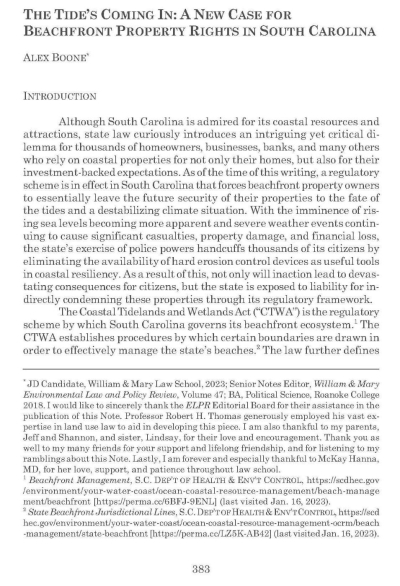
Check this out, a new student-authored note from William and Mary third-year law student Alex Boone, “The Tide’s Coming In: A New Case for Beachfront Property Rights in South Carolina,” 47 Wm. & Mary Envtl. L. & Pol’y Rev. 383 (2023).

Here’s the Abstract:

Part I of this Note explores the scientific data as it relates to the impending consequences of climate change on South Carolina’s coast and will introduce the disastrous scenarios that are predicted to arise as a result of rising sea levels and the accelerating strength and severity of extreme weather events. Part II compares the effectiveness of various coastal resiliency tools and highlights the regulatory framework that prohibits their use by beachfront property owners. Part III explores the topic of regulatory takings and their indirect prophylactic nature of protecting citizens from regulatory overreach and offers a case for a South Carolina court to find

Continue Reading New Article: Alex Boone, “The Tide’s Coming In: A New Case for Beachfront Property Rights in South Carolina” (Wm & Mary Envt’ L & Pol’y Rev)

D Callies Retirement Celebration Invite 4-27-2023.f

Come join us on Thursday, April 27, 2023, from 5-7pm, downtown Honolulu, to celebrate the retirement of Professor David L. Callies from the University of Hawaii Law School.

Join U.H. Law School Dean Camille Nelson, Professor Callies’ colleagues, his students (present and former), the Hawaii legal community, and family and friends as we honor 43 years of scholarship, teaching, service, and practice.

Professor Callies is a prolific scholar and author, and has mentored generations of lawyers. Known especially for his work in property, land use, takings, administrative law, and state and local government law, he has also been presented with numerous awards including William and Mary’s Brigham-Kanner Property Rights Prize, and the Owner’s Counsel of America’s Crystal Eagle

Invitation and how to RSVP (or click below). Space is limited, so please let us know you are attending as soon as you can.

Details:

Thursday,

Continue Reading April 27, 2023, 5-7pm, Honolulu: Join Us To Celebrate The Work And Career Of Professor David Callies