2025 San Diego

Get ready to join your colleagues and friends in San Diego for the 42d ALI-CLE Eminent Domain & Land Valuation Litigation Conference.

The 41st Conference was in New Orleans. Here’s a report of that event, and here are our reports from prior conferences in Austin and Scottsdale.

Here are some of the highlights of the upcoming Conference:
  • Property Rights at the Supreme Court: DeVillier and Sheetz and What’s Next
  • Slow Take: Possession, Rent, Relocation, and Offset
  • The Jury’s View: How Jurors See Your Case
  • From Penn Coal to Penn Central: How to Prove “Too Far”
  • Leveraging Expertise in Eminent Domain Litigation: Working with Land Planners, Engineers, and Other Predicate Experts
  • Kelo at Twenty: What Changed, What Didn’t, and What’s on the Horizon
  • Viva Las Vegas: How the Nevada Judiciary Upheld Property Rights in 180 Land’s Inverse Condemnation Taking
  • Ethics: Guiding the Trolley: Perspectives on Professional Ethics in


Continue Reading Registration For The 42d ALI-CLE Eminent Domain & Land Valuation Litigation Conference Is Underway (Don’t Miss Out!)

Here are the cases and other materials we discussed in today’s Section of State & Local Government Law Land Use group meeting on takings:


Continue Reading Links From Today’s ABA Land Use Session

Here’s the latest in a case we’ve been following, which asks whether a local ordinance which allowed non-paying tenants to remain in the lessor’s property is a physical taking, or merely the regulation of the lessor/lessee relationship under the Yee theory, which posits that once an owner voluntarily rents property to a tenant, the government then allowing that tenant to remain rent free isn’t facilitating an unauthorized physical occupation, but rather is merely a regulation of the existing lessor/lessee relationship. In short, you let ’em in property owner, so suck it up.

The property owner has now filed this cert petition challenging that rationale.

As we’ve noted previously, some courts’ reliance on Yee in this and similar situations is a misreading of that decision. Besides that, these courts essentially upend the longstanding common law of property governing the owner/tenant relationship, and the contractual nature of that relationship

Continue Reading New Cert Petition: Eviction Moratorium Transferred Possession Easement To Nonpaying Tenants

Excerpt

In this Order, the Michigan Supreme Court declined to consider a case which challenges the Michigan governor’s Co-19 shutdown executive orders, which, in the words of the dissenting Justices, reached “nearly every aspect of life in our state.”

There have been a lot of cases asserting that Co-19 shutdowns are takings, with most (but not all) of them crashing and burning, including this one. Here, the plaintiffs — a class of owners whose businesses suffered devastating losses as a result of the shutdown orders — sought just compensation for the regulatory taking. They alleged both types of takings, categorical and ad hoc (Penn Central). They also asserted claims under the Michigan Constitution (a trend we approve!).

We recommend you take a dive into the Statement of the two Justices who dissented. They would have taken up the case because “the majority leaves unresolved

Continue Reading Michigan, Over Dissent, Declines To Hear Co-19 Shutdown Takings Case

Be sure to read the entirety of Lawprof Ilya Somin’s recent post on Volokh,Federal Appellate Court Rules in Favor of Takings Lawsuit Against the CDC’s Covid-Era Eviction Moratorium.”

There, he analyzes the Federal Circuit’s recent 2-1 opinion in Darby Dev. Co., Inc. v. United States, No. 22-1929 (Aug. 7, 2024) (we wrote up the case here: “Deepening A Lower Court Split, Fed Cir (2-1) Reinstates CDC Co-19 Eviction Moratorium Temporary Takings Claim“).

Professor Somin does a better job that we did offering his thoughts on the “authorized” issue, concluding:

To me, the decisive factor should be that the Takings Clause nowhere says that compensation is only required for legal government actions or for those specifically authorized by statute. Rather, the Clause imposes a general rule that compensation must be paid whenever the government takes private property for “public use.” That, of course, can happen

Continue Reading Lawprof Somin: “Federal Appellate Court Rules in Favor of Takings Lawsuit Against the CDC’s Covid-Era Eviction Moratorium”

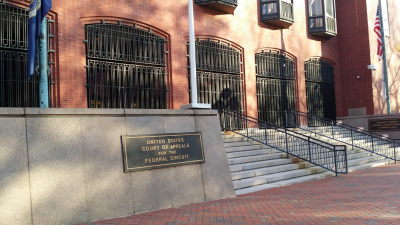
20151205_145921

This one is a must-read.

In Darby Dev. Co., Inc. v. United States, No. 22-1929 (Aug. 7, 2024), the U.S. Court of Appeals for the Federal Circuit held that the Court of Federal Claims should not have dismissed Darby’s complaint for failure to state a physical invasion takings claim.

The short takeaways:

  • Takings claims do not require the government action be legally authorized (here, the courts invalidated the government action, after which the plaintiff sued for a taking), only that the government action was “authorized” and thus can be “chargeable to the government.”
  • Prohibiting evictions is not merely a regulation of the landlord-tenant relationship. Yee v. City of Escondido is distinguishable, and does not categorically exempt all actions that implicate the landlord-tenant relationship from physical takings challenge.

We think the longer story is worth your time. Here it is.

As you may recall, the Center for Disease Control purported

Continue Reading Deepening A Lower Court Split, Fed Cir (2-1) Reinstates CDC Co-19 Eviction Moratorium Temporary Takings Claim

Games people play
Night or day they’re just not matchin’
What they should do
Keeps me feelin’ blue
Been down too long
Right, wrong, I just can’t stop it

This one isn’t about takings, but is nonetheless a must-read.

In Health Freedom Defense Fund, Inc. v. Carvalho, No. 22-55908 (June 7, 2024), a panel of the U.S. Court of Appeals for the Ninth Circuit (yes, the Ninth Circuit!) held that the litigation was not moot even though the government had revised the challenged regulation. The Ninth Circuit also vacated and remanded the District Court’s dismissal of the challenge to the Los Angeles Unified School District’s requirement that its employees be vaccinated 

The sequence of facts is important. Check out the shell game shenanigans that LAUSD went through, after which it told the courts with a straight face that this was just routine and not it playing litigation games:

  • LAUSD


Continue Reading Games Government Play: Ninth Circuit Doesn’t Buy Attempt To Moot Constitutional Challenge To Co-19 Vaccination Policy By Sandbagging And Withdrawing

Check out the North Carolina Court of Appeals opinion in North Carolina Bar and Tavern Ass’n v. Cooper, No. COA22-725 (Apr. 16, 2024).

We’re not going to go into great detail, mostly because this one tracks the most common judicial approach to takings challenges to business shut-down orders during the Co-19 period. The court concluded that the State’s selective shut down of certain bars but not others was neither an “emergency commandeering” under North Carolina’s emergency response statute, not a physical, Lucas, or Penn Central taking. Read the opinion for the reasons why.

But there is more than one way to skin that cat. The court held that the trial court should not have rejected the plaintiff’s motion for summary judgment on its North Carolina’s Fruits of Labor Clause claim.

That provision states:

We hold it to be self-evident that all persons are created equal; that they are endowed

Continue Reading Blinded Me With Science! No Taking For Selective Co-19 Business Shut-Down, But Might Violate North Carolina’s Fruits Of Labor Clause

New York state, as you might already know, regulates the rent an owner of residential property may charge to a tenant. Under a statute adopted in 1974, regulation is triggered by a locality’s declaration of a housing emergency, and the restrictions extend for the duration of the declared emergency. Most famously — or infamously — New York City has declared a housing emergency under the statute since that time, and indeed has considered housing an “emergency” for over a century. The 1974 statute also applied to three other NYC-adjacent counties, but not the entire Empire State.

Well, in 2019 the legislature changed that, and “allowed municipalities statewide to opt in to the rent adjustment scheme created by the [1974 Emergency statute] upon a declaration of emergency due to a housing vacancy rate of 5% or less[.]”

In 2019, Kingston was thwarted when it determined its vacancy rate was 6.7% —

Continue Reading NY App Div: Inflation, Bah! Rent Gets Cheaper In Kingston!

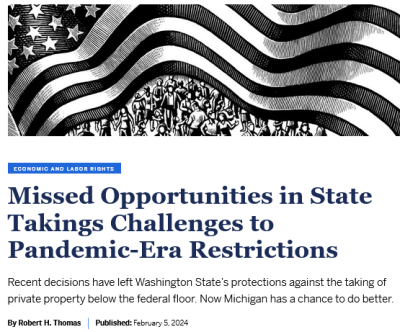
Screenshot 2024-02-05 at 12-23-56 Missed Opportunities in State Takings Challenges to Pandemic-Era Restrictions

Thank you to the Brennan Center for Justice at NYU Law School’s State Court Report (#statecourtreport) for publishing our piece “Missed Opportunities in State Takings Challenges to Pandemic-Era Restrictions.” The title gives a hint about what this is about: how state and local government’s reaction to Co-19 spurred challenges not only under the U.S. Constitution, but under state constitutions. We give examples of — and comment on — missed opportunities and out-and-out errors in several approaches.

Here are the opening paragraphs:

Responding to the Covid-19 pandemic, the federal government and many state and local governments imposed a variety of restrictions on individuals and businesses. The Centers for Disease Control and Prevention, for example, purported to suspend the ability of property owners to evict nonpaying tenants — a move the U.S. Supreme Court rejected as beyond the agency’s power. State and local governments adopted similar eviction moratoria, and many directed

Continue Reading New Article: Missed Opportunities in State Takings Challenges to Pandemic-Era Restrictions (Brennan Center’s State Court Report)