Yes, the mysterious ducks remain — and seem to have multiplied.

It’s that time of the year again. Fall’s-a-coming, and that means that starting today, we’re back at the William and Mary Law School in Williamsburg, Virginia to teach two courses:

  • Eminent Domain and Property Rights (W&M is one of the few law schools in the country that offer a course in eminent domain, just compensation, and takings)
  • Land Use Controls (an especially hot topic at the moment)

The registration numbers for both courses are good (really good), and two full classrooms of Dirt Law goodness tells us something about this area of law — it’s really interesting, and a good place to make your way in the practice, and law students recognize that.

PXL_20240819_121031630.MP
We don’t use $400 casebooks in either class.

Time to jack back into the (takings and land use) Matrix.

6a00d83451707369e20240a476d216200c-800wi
Continue Reading Back To School For Dirt Law @ William & Mary, Season 8

BK2025

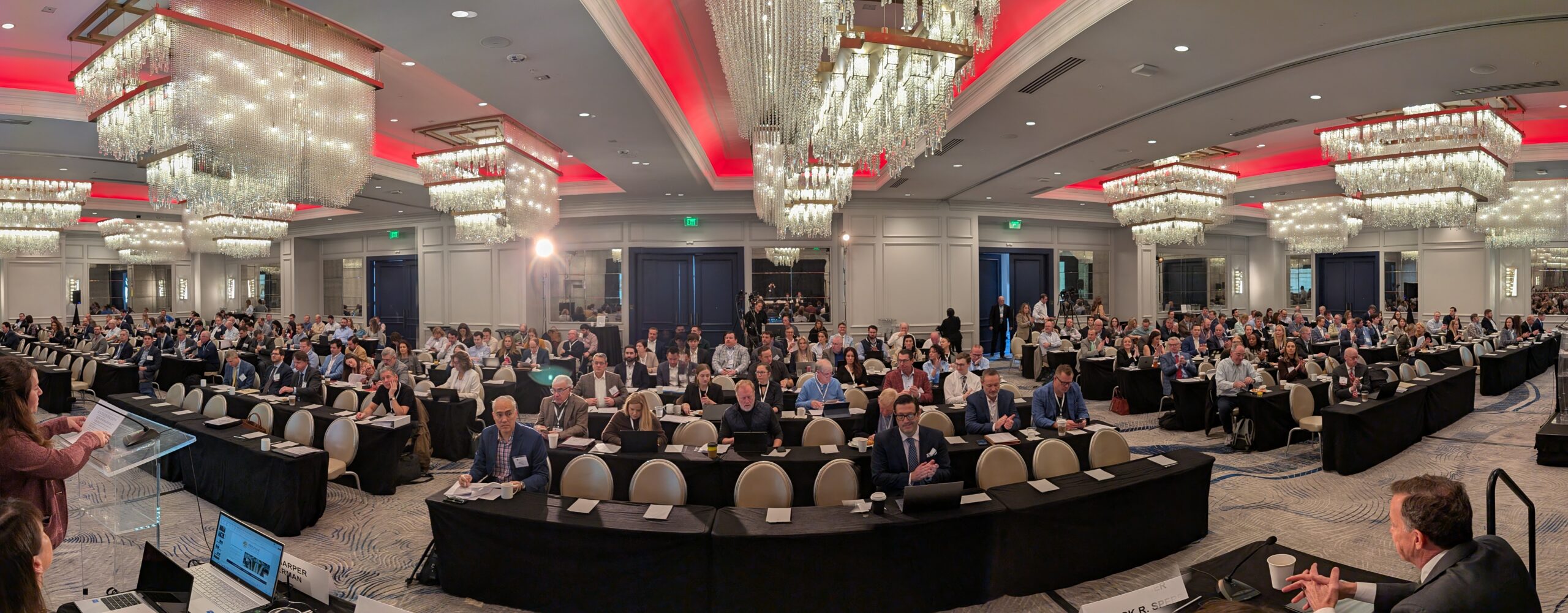
That’s right, it’s time to plan on joining us at the 22d edition of the best one-day property law conference, William and Mary Law School‘s Brigham-Kanner Property Rights Conference.

As we noted, Professor William Fischel will be awarded the 2025 Brigham-Kanner Property Rights Prize at the annual Wren Building candlelight ceremony in Williamsburg on October 23, with the following day being devoted to a celebration of his work and career, and discussions of the hot topics in property rights law.

The Conference is expressly designed to get legal academics and the nation’s best dirt law practitioners in the same room, discussion how legal scholarship and law practice work hand-in-hand to shape the law. 

More details:  

The Brigham-Kanner Property Rights Prize is presented annually to a scholar, practitioner, or jurist whose work affirms the fundamental importance of property rights. It is named in honor of the late Toby Prince

Continue Reading Registration Open: 22d Brigham-Kanner Property Rights Conference, Oct. 23-24, 2025, Williamsburg

PXL_20250624_180653444.MP

The room where it happened.

We’re not going to say much about the California Court of Appeal’s recent decision in Sheetz v. County of El Dorado, No. C093682 (July 29, 2025), which is back in the California court system after remand from the U.S. Supreme Court, because it is one of ours.  

Here’s the bottom line:

Upon further analysis as directed by the Supreme Court, we now conclude that the challenged permit condition (TIM fee) does not constitute an unlawful monetary exaction under the Nollan/Dolan test. The legislatively formulated generally applicable impact fee is not an unconstitutional condition imposed on land use in violation of the Fifth Amendment’s takings clause. Accordingly, we again affirm the judgment.

Slip op. at 5.

We don’t necessarily agree 100% with our colleague Ben Rubin’s assessment, but do urge you to read his piece, “California Court of Appeal Confirms Legislatively Enacted

Continue Reading Sheetz On Remand: “The legislatively formulated generally applicable impact fee is not an unconstitutional condition imposed on land use in violation of the Fifth Amendment’s takings clause.”

Catastrophe

Check this out, a new student note published in the latest edition of the William and Mary Environmental and Policy Review, J. Cameron Niemeyer, Stopping a Cat-tastrophe: States Must Develop Stricter Management Regimes for Controlling Feral Cat Populations, 49 Wm. & Mary Env’t L. & Pol’y Rev. 739 (2025). 

Download the pdf here

Although this article isn’t about takings and related, the issue of feral cats can give rise to takings questions. See, for example, this post: “Hey All You Cool Cats And Kittens: Creating A Feral Cat Colony Next To Your Property Isn’t A Taking.” 

If cats and cat law isn’t necessarily your thing, we suggest reading this piece especially. It will change your mind: 

Cats are among the world’s most popular pets. Cute, cuddly, relatively easy to care for, and intelligent, cats have been part of humans’ lives for generations. In fact, the author

Continue Reading New Article: “Stopping a Cat-tastrophe: States Must Develop Stricter Management Regimes for Controlling Feral Cat Populations,” 49 Wm. & Mary Env’t L. & Pol’y Rev. 739 (2025) (J. Cameron Niemeyer)

Charlottesvillezoning

This interesting — and kind of funny — story has been circulating: “Judge’s ruling means Charlottesville has no zoning laws whatsoever right now.” 

What happened? Is the counter-Euclid revolution underway? Did the judge rediscover Nectow? Did Charlottesville voters decide to go Full Houston

No, nothing quite as dramatic. The story notes that the city’s attempt to adopt a new zoning code was held invalid. But, the story notes, the former zoning ordinance was repealed so that the new one could be adopted. With the former code ineffective and the new code invalidated … just like that, no zoning!

We haven’t checked, but we would not be surprised if the most popular search on WEXIS right now in the Blue Ridge is “Virginia /s vested /s rights or ‘estoppel.'”

In the meantime, the city has stopped processing new development applications, while claiming this is all

Continue Reading Houston Says ‘Welcome!’ – What Happens When Another City Has No Zoning?

In City of Dallas v. Dallas Short-Term Rental Alliance, No. 05-23-01309-CV (July 18, 2025), the Texas Court of Appeals affirmed a preliminary injunction, suspending operation of two ordinances which (1) restrict, and (2) require registration of short-term rentals in Dallas.

It’s a short opinion and up on appeal from interlocutory emergency relief, so there isn’t a ton there. But it is still worth reading because the court concludes the challengers have a likelihood of eventually showing that the ordinance restricting short-term renting violates “due-course-of-law” (aka substantive due process). Texas recognizes a property right in leasing property, and the owners here asserted they have a vested right to do so:

Under the circumstances, we conclude appellees Dallas Short Term-Rental Alliance, Sammy Aflalo, Vera Elkins, and Denise Lowry proved their probable right to relief against the City’s zoning ordinance under their due-course-of-law argument because they alleged they possessed well-established rights to

Continue Reading Tex App: Challengers Likely To Succeed On Due Course Of Law Claim For Short-Term Rental Ban

Euclidsymposium

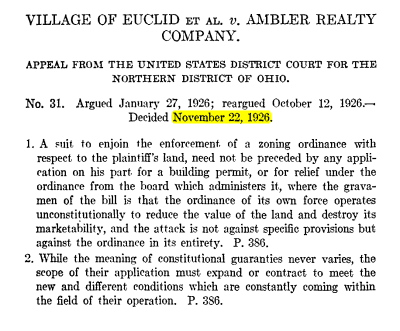
With the 100th anniversary of Village of Euclid v. Ambler Realty Co. nearly upon us in 2026, we’ve put together a series of events designed to reexamine the case that set the stage for a century’s-worth of intense land use regulations and restrictions.

Are Euclid‘s assumptions and conclusions still valid? If the original separation-of-uses and nuisance-prevention rationale of zoning made sense, does that rationale apply when “zoning” has become the shorthand for extremely granular regulation of property’s uses? What of the role of judicial review and a return to Nectowian review? 

Our Euclid series begins with a call for papers, and a follow-up conference at which these articles will be presented and discussed. For more, see the call for papers: “Euclid Turns 100: Rethinking an Antiquated Case and Reimagining Euclidean Zoning for the Century Ahead.” The link also has a few suggestions about

Continue Reading Call For Papers: “Euclid Turns 100: Rethinking an Antiquated Case and Reimagining Zoning for the Century Ahead”

Here’s the latest in a case we’ve been following.

In Hudson Valley Property Owners Ass’n v. City of Kingston, No. 59 (June 18, 2025), the New York Court of Appeals held that after a municipality declares a housing emergency allowing it to regulate the amount of rent, it has the power to order lessors to refund to tenants rent which exceeded the maximum allowed amount, even if those rents had been collected prior to the declaration of the emergency. 

At least that is how we read the opinion. Due to its somewhat unusual procedural posture, the court did not actually allow the city to nail property owners for retroactive “overcharges,” it merely rejected the owners’ claims that because the statute may allow it in particular cases, it isn’t facially unconstitutional.

This was a facial challenge by property owners to Kingston, New York’s declaration of a housing emergency during

Continue Reading NY: In A Housing “Emergency,” City Can Retroactively Lower The Rent, Even Rent Collected Before The Emergency

Kelo page - Copy

It hardly seems like two decades have passed. After all, it was a mere 10 years ago we were lamenting “Kelo At 10: Still Stinks, And A Decade Has Not Lessened The Odor.” 

But yes, it was twenty years ago today … the U.S. Supreme Court, by the thinnest of margins, held in Kelo v. City of New London, 545 U.S. 469 (June 23, 2005) that there’s nothing inherently suspect about “economic development” takings to justify a higher level of judicial scrutiny than the judges-as-poodles standard of review applied in Public Use challenges to takings for every other reason.   

Susette Kelo’s home was taken on the claim that it was needed as part of the package of incentives to lure a pharmaceutical company to set up shop in New London, which would in turn, raise the overall economic climate in the city. That butterfly-effect theory was

Continue Reading Unhappy 20th Anniversary, Kelo v. City of New London

Fischel_600

Here’s news we’ve been waiting for.

The William and Mary Law School announced that Professor William Fischel will be awarded the 2025 Brigham-Kanner Property Rights Prize at the annual conference in Williamsburg in October 2025. 

The Brigham-Kanner Property Rights Prize is presented annually to a scholar, practitioner, or jurist whose work affirms the fundamental importance of property rights. It is named in honor of the late Toby Prince Brigham, a leading property rights attorney, and the late Gideon Kanner, a devoted scholar of property rights who was Professor of Law at Loyola Law School in Los Angeles.

Professor Fischel taught in the Economics Department at Dartmouth from 1973 until his retirement in 2019. His scholarship focuses on the law and economics of local government, and his expertise includes local government law, school finance, zoning and land use controls, property taxation, and regulatory takings law. He is the author of five

Continue Reading And The 2025 Brigham-Kanner Property Rights Prize Goes To…Professor William Fischel