
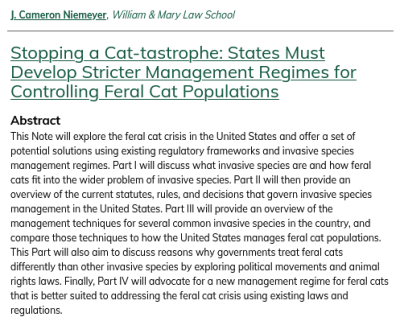
Check this out, a new student note published in the latest edition of the William and Mary Environmental and Policy Review, J. Cameron Niemeyer, Stopping a Cat-tastrophe: States Must Develop Stricter Management Regimes for Controlling Feral Cat Populations, 49 Wm. & Mary Env’t L. & Pol’y Rev. 739 (2025).
Although this article isn’t about takings and related, the issue of feral cats can give rise to takings questions. See, for example, this post: “Hey All You Cool Cats And Kittens: Creating A Feral Cat Colony Next To Your Property Isn’t A Taking.”
If cats and cat law isn’t necessarily your thing, we suggest reading this piece especially. It will change your mind:
Cats are among the world’s most popular pets. Cute, cuddly, relatively easy to care for, and intelligent, cats have been part of humans’ lives for generations. In fact, the author of this Note is a proud cat-dad to two. As all cat parents know, cats thrive on independence and time outdoors. Unfortunately, indulging this natural instinct can lead to catastrophic consequences.
Thankfully, no mention or discussion of the wretched “Cats.”
Here’s the Abstract:
This Note will explore the feral cat crisis in the United States and offer a set of potential solutions using existing regulatory frameworks and invasive species management regimes. Part I will discuss what invasive species are and how feral cats fit into the wider problem of invasive species. Part II will then provide an overview of the current statutes, rules, and decisions that govern invasive species management in the United States. Part III will provide an overview of the management techniques for several common invasive species in the country, and compare those techniques to how the United States manages feral cat populations. This Part will also aim to discuss reasons why governments treat feral cats differently than other invasive species by exploring political movements and animal rights laws. Finally, Part IV will advocate for a new management regime for feral cats that is better suited to addressing the feral cat crisis using existing laws and regulations.
The author is a former student of ours, and now a colleague. Great work and congratulations, Cameron!