
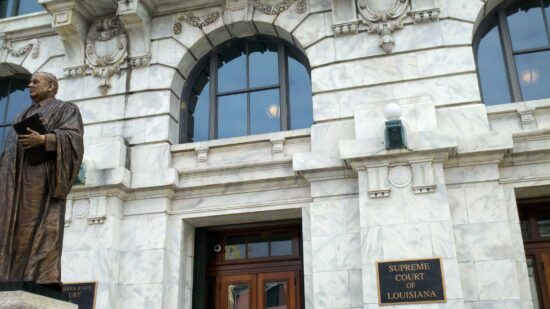
In Plaquemines Port Harbor & Terminal District v. Nguyen, No 2025-C-00827 (Mar. 6, 2026), the Louisiana Supreme Court invalidated a quick take by the Port of a vacant 29-acre parcel, because the property was to be leased to “a private company for its exclusive development and use.” Slip op. at 1.
[Disclosure: our shop filed an amicus brief, so we had a dog in the hunt.]
This was a challenge to a taking (or as they call it in Louisiana, an “expropriation”) under the Louisiana Constitution’s public purposes clause, which provides:
(B)(1) Property shall not be taken or damaged by the state or its political subdivisions except for public purposes and with just compensation paid to the owner or into court for his benefit. Except as specifically authorized by Article VI, Section 21 of this Constitution property shall not be taken or damaged by the state or its political subdivisions: (a) for predominant use by any private person or entity; or (b) for transfer of ownership to any private person or entity.
Here are the facts:
The property is located within the 630-acre footprint of a liquified natural gas and container port complex being developed in Plaquemines Parish as the Delta LNG Project. As part of the project, Plaquemines Port will lease property to Venture Global LNG, a liquified natural gas processing and transportation company. The project includes construction of pretreatment facilities, a liquification plant, liquified natural gas storage tanks, a power generation system, and three or more liquified natural gas berthing docks. To fulfill its lease obligation, Plaquemines Port must acquire land, including Nguyen’s property. Plaquemines Port alleged the expropriation of land for the Delta LNG Project is deemed a paramount public purpose as it aligns with the broader goals of economic growth, job creation, energy security, and environmental stewardship, and will assist Plaquemines Port in furthering its mission to expand and facilitate the transport of goods and services. Plaquemines Port deposited $441,600.00 into the registry of the court, representing the alleged amount of just compensation for the property.
Slip op. at 1-2. Both the trial court and the court of appeal concluded that the taking lacked a public purpose.
The Louisiana Supreme Court agreed. The court first noted that the state constitution was amended in reaction to Kelo. The amendment sets out in detail what constitutes public purpose. One of those public purposes supporting a taking is for “Public ports.” The Port pointed to this provision (article I, § 4(B)(2)(b)(vi) said “ah hah, we’re good.” In short, we’re a port and we’re going to own this property when this is all over, so this is a public purpose.
But that’s not enough, held the court. It would be one thing if the taking was to use the property as a public port. In that case, the Port’s arguments might have some traction. But here, “it is undisputed that Plaquemines Port’s expropriation of Nguyen’s property is for the sole purpose of leasing it to a private company to facilitate transportation of the private company’s own goods.” Slip op. at 8.
The short opinion sums the analysis up thusly:
The plain language of the constitution restricts a public purpose to the public port authority’s ownership of property dedicated to specified uses, including public ports. We reiterate that words and phrases of a constitutional provision must be read in context and construed according to the common and approved usage of the language. See La. R.S. 1:3. Such provisions are construed to give effect to the purpose indicated by a fair interpretation of the language used. Perschall, 697 So. 2d at 255. Applying these principles, Plaquemines Port is not seeking ownership of the property for dedicated use as a public port. Instead, this is a taking by a public port authority for its lessee to use as a private port—essentially what Kelo allowed as authorized under the United States constitution, and what the 2006 Louisiana constitutional amendments sought to prohibit. The fact that Plaquemines Port will own the property and benefit from the lease contract is immaterial. Article I, section 4(B)(3) specifically provides that “[n]either economic development, enhancement of tax revenue, or any incidental benefit to the public shall be considered in determining whether the taking or damaging of property is for a public purpose.”
Plaquemines Port’s reason for expropriation does not fit the constitutional definition of a public purpose. Without a public purpose for the expropriation, the exception for predominant use by a private entity is inapplicable.
Slip op. at 8-9.
The key quote: “this is a taking by a public port authority for its lessee to use as a private port—essentially what Kelo allowed as authorized under the United States constitution, and what the 2006 Louisiana constitutional amendments sought to prohibit.”
A good reminder of the importance of state constitutions.
Plaquemines Port Harbor &Terminal Dist. v. Nguyen, No. 2025-C-00827 (La. Mar. 6, 2026)