Euclidsymposium

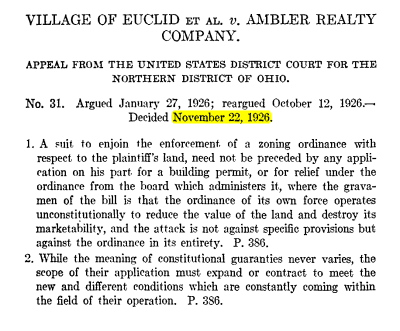
With the 100th anniversary of Village of Euclid v. Ambler Realty Co. nearly upon us in 2026, we’ve put together a series of events designed to reexamine the case that set the stage for a century’s-worth of intense land use regulations and restrictions.

Are Euclid‘s assumptions and conclusions still valid? If the original separation-of-uses and nuisance-prevention rationale of zoning made sense, does that rationale apply when “zoning” has become the shorthand for extremely granular regulation of property’s uses? What of the role of judicial review and a return to Nectowian review? 

Our Euclid series begins with a call for papers, and a follow-up conference at which these articles will be presented and discussed. For more, see the call for papers: “Euclid Turns 100: Rethinking an Antiquated Case and Reimagining Euclidean Zoning for the Century Ahead.” The link also has a few suggestions about

Continue Reading Call For Papers: “Euclid Turns 100: Rethinking an Antiquated Case and Reimagining Zoning for the Century Ahead”

CornercrossingYour Mission: go from Public to Public, without invading Private 

Here’s the latest in a case we’ve been following from its inception.

This is the “corner crossing” case, which as we noted here, is sure to be a mainstay in future Property Law casebooks, because the checkerboard pattern of public and private land ownership has resulted in a fascinating case. We’re not going to wait for the pocket part, and the case will almost certainly make an appearance in our William and Mary Eminent Domain and Property Rights course in the fall.

Hunters want to access the public lands. This can only be accomplished by crossing at the corners where the parcels connect as shown in the above illustration. Problem is that this cannot be done without trespassing on the private parcels. Even where the hunters go through “Twister“-like contortions to avoid touching the land or violating private airspace. Check this out:

Ladders
Now that is dedication.

After the Tenth Circuit held that the The private property owner has now filed a cert petition.

Before we go further, here’s the Question Presented:

Between 1850 and 1870, Congress ceded millions of acres of public land in the West to railroads in a distinct checkerboard pattern of alternating public and private plats of land. The result of Congress’s peculiar land-grant scheme is that many parcels of public land in the checkerboard are landlocked and accessible only by “corner crossing”—the act of moving diagonally from the corner of one public parcel to another, trespassing through the adjoining private property in the process.

Nearly fifty years ago, this Court unanimously rejected the government’s argument that Congress “implicitly reserved an easement to pass over the [privately-owned] sections in order to reach the [public] sections that were held by the Government” in the checkerboard. Leo Sheep Co. v. United States, 440 U.S. 668, 678 (1979). In Leo Sheep, that meant the government could not create public access to a Wyoming reservoir by clearing a dirt road that crossed two checkerboard corners—at least not without exercising the government’s power of eminent domain and paying just compensation.

In 2021, four hunters corner crossed through Iron Bar’s property to hunt on public land; Iron Bar sued for trespass. In the decision below, the Tenth Circuit recognized that, under Wyoming law, the hunters had trespassed on Iron Bar’s property. The court nonetheless held that an 1885 federal statute governing fences—the Unlawful Inclosures Act—implicitly preempted Wyoming law and “functionally” created a “limited easement” across privately-held checkerboard land.

The question presented is:

Whether the Unlawful Inclosures Act implicitly preempts private landowners’ state-law property right to exclude in an area covering millions of acres of land throughout the West.

Here are the actual parcels, and some of the corner crossings at issue (again, from the District Court).

Signs1

The Tenth Circuit started by noting that under Wyoming state law, corner crossings are likely actionable civil trespasses. But the court went on, concluding that the federal anti-fencing statute “preempts” state property law and prohibits the private owners from excluding the hunters. In short, the federal statute and interpreting caselaw “have overridden the state’s civil trespass regime[.]” Id.

In short, here is the Tenth Circuit’s rationale: The owners here have a right to exclude corner-crossers. But the statute says that the public has a right to access public lands, which means any private owner that is getting in the way of that — even where that owner does nothing affirmative to impede public access — is creating a nuisance.

Now the issue has been offered up for Supreme Court review. Stay tuned to see what the Court does with this fascinating case. 

Petition for Writ of Certiorari, Iron Bar Holdings, LLC v. Cape, No. ___ (U.S. July 16, 2025) 

Continue Reading New Cert Petition In “Corner Crossing” Case: Can A Federal Anti-Fencing Statute “Preempt” A State-Recognized Right to Exclude?

JLEPcover

Last year, we attended a conference devoted to the future of regulatory takings, hosted by the Antonin Scalia School of Law (George Mason U), and Pacific Legal Foundation.

The publisher, the Journal of Law, Economics, and Policy has released the articles and essays from that conference, and made them available here

Here’s the list of articles:

  • Michael M. Berger, Juries for Takings Liability: Treating Litigants Alike
  • Ethan W. Blevins, Cyber Takings: A Preliminary Study of Regulating Takings of Virtual Spaces
  • Eric R. Claeys, Takings and Choice of Law After Tyler v. Hennepin County
  • Emily Cruikshank Bayonne and Wesley M. Davenport, Counting Costs: the Institutional Effects of Regulatory Takings
  • Emily Hamilton and Charles Gardner, Legislative Responses to the Regulatory Takings Conundrum
  • Brian T. Hodges and Deborah J. La Fetra, Sheetz v. County of El Dorado: Legislatures Must Comply With the Takings Clause
  • Donald J. Kochan, Involuntary Regulatory Servitudes:


Continue Reading New Property Rights Symposium Published – “Too Far: Imagining the Future of Regulatory Takings”

Here’s the latest in a case we’ve been following.

In Idaho Power Co. v. Bean, No. 23CV12213 (July 9, 2025), the Oregon Court of Appeals reversed a trial court ruling which held that Oregon’s precondemnation entry statute, which requires “reasonable compensation” for physical damage or substantial interference with the owner’s possession or use, sets the bar too high and the U.S. and Oregon Constitutions require “just compensation” for any appropriation of a right to physically invade, not just for physical damage or substantial interferences.

The court of appeals held that “temporary precondemnation entries–at least insofar as they do not cause any ‘substantial interference with the property’s possession or use’ or ‘any physical damage’–are consistent with ‘longstanding background restrictions on property rights’ and ‘traditional common law privileges to access private property.'” Slip op. at 699. In short, the court concluded that the U.S. and Oregon constitutions permit exactly

Continue Reading Oregon App: Not All Precondemnation Entries Are Takings – It’s Gotta Be “Substantial”

“The Irrigation District will disavow any knowledge of your actions…”

In Hamann v. Heart Mountain Irrigation District, No. S-24-0234 (July 11, 2025), the Wyoming Supreme Court unanimously held that a state agency cannot avoid its obligation to provide just compensation when its employee causes a taking or damaging of private property, merely because the employee was not acting under an express instruction to take or damage property. 

In short, an agency can’t simply disavow actions of its employees that take take or damage property (or in this case, physically injure the owner). 

This is one of ours, so we are not going into great detail, but here is the short story.

A county road runs along the northern boundary of Hamann’s ranch. The Irrigation District operates and maintains a canal adjacent to the road and has used the northern road for access for decades. But the District also

Continue Reading Wyoming: Inverse Condemnation Claim Is How Owners Protect Property Rights Even Where Government Hasn’t Instituted Formal Action

Take a look at the New Jersey Appellate Division’s opinion in Johnson v. City of East Orange, No. A-2586-23 (June 27, 2025). 

The court vacated the dismissal of a property owner’s takings claim, holding that it was timely. We aren’t going into too much detail because this one is out of our shop. As the opinion notes:

Pacific Legal Foundation, plaintiff’s counsel in the instant matter, represented the plaintiff in Tyler, and appeared as amicus curiae in both the appellate, 257-261 20th Avenue Realty, LLC v. Roberto (Roberto I), 477 N.J. Super. 339 (App. Div. 2023), and state Supreme Court, 257-261 20th Avenue Realty, LLC v. Roberto (Roberto II), 259 N.J. 417 (2025), proceedings in what became the first published authority applying the holding in Tyler in this state.”

Slip op. at 2.  

But here are some of the highlights:

  • A takings claim does not accrue, and


Continue Reading NJ App: Takings Claim Accrues When Govt Keeps Property It Should Return To The Owner

DSCF3117
If you know, you know.

Sad birthday wishes to what just might be our most un-favorite decision ever, Penn Central Transp. Co. v. New York City, 438 U.S. 104 (1978), which turns 46 today. This in addition to the unhappy Kelo-versary earlier this week. A takings and regulatory takings one-two punch! 

Time has not treated the opinion well. Practitioners, judges, and legal scholars across the spectrum have called the three-factor Penn Central test for an ad hoc regulatory taking “demanding,” “fuzzy,” a four-part test, “neither defensible as a matter of theory nor mandated as a matter of precedent,” and “problematic” and “mysterious.”

No one but the Supreme Court professes to understand what that case means. Courts mess up the basic meaning of the factors, treat what is supposed to be a fact-centric “ad hoc

Continue Reading Not A Great Week For Property Rights Anniversaries: Penn Central Turns 46 Today

Check out this story from the Frontier Centre for Public Policy

Most pundits missed it, but Alberta’s revised Bill of Rights just strengthened property rights in a big way. Senior research fellow Joseph Quesnel breaks down how new amendments could protect landowners from regulatory takings—government actions that restrict property use without compensation. He examines key Supreme Court of Canada rulings and explains why every Canadian jurisdiction should take note. Could this be a game-changer for property rights?

As you may know, property rights are not a national constitutional right north of the border as they are here in the U.S. We’re no experts on Canadian law, but in our view it looks like Alberta is heading in our direction, at least as a province. 

Premier Danielle Smith faced controversy last year for amending Alberta’s Bill of Rights. While most commentators focused on the amendments protecting the right to refuse

Continue Reading O, Canada! “Alberta Trailblazing on Property Rights Protections”

Kelo page - Copy

It hardly seems like two decades have passed. After all, it was a mere 10 years ago we were lamenting “Kelo At 10: Still Stinks, And A Decade Has Not Lessened The Odor.” 

But yes, it was twenty years ago today … the U.S. Supreme Court, by the thinnest of margins, held in Kelo v. City of New London, 545 U.S. 469 (June 23, 2005) that there’s nothing inherently suspect about “economic development” takings to justify a higher level of judicial scrutiny than the judges-as-poodles standard of review applied in Public Use challenges to takings for every other reason.   

Susette Kelo’s home was taken on the claim that it was needed as part of the package of incentives to lure a pharmaceutical company to set up shop in New London, which would in turn, raise the overall economic climate in the city. That butterfly-effect theory was

Continue Reading Unhappy 20th Anniversary, Kelo v. City of New London

It seems very appropriate that we’re posting the Texas Court of Appeals’ decision in Burgess v. City of Wentworth Village, No. 02-24-00252 (June 19, 2025) today, the twentieth anniversary of Kelo v. New London.

Because on the Kelo-versary, we start as the Burgess opinion did: an epigram wherein the court quoted a concurring opinion recognizing the inherent unfairness of eminent domain and how just compensation is very often inadequate:

On occasion, to serve a public purpose, a citizen’s private property must be taken without his consent. We tolerate such intrusions because society cannot function without roads, schools, military facilities, and other vital infrastructure. Eminent domain also requires “just” or “adequate” compensation, to be sure. U.S. Const. amend. V; Tex. Const. art. I, § 17(a). But the condemnation process is complicated, time-consuming, and sometimes confusing. And no compensation can accurately value the sweat, tears, pride, love, beauty, and

Continue Reading Texas App: No, A Taking For A “Short-Game Practice Area” Isn’t Entitled To Judicial Deference Under Post-Kelo Changes