
Zip. Zilch. Zero. Nil. Nada. Squat. Bupkis.

Here’s the latest in a case we’ve been following for a long, long time (see here and here, for example).

In Maunalua Bay Beach Ohana 28 v. State of Hawaii, No. CAAP-19-0000776 (Mar. 18, 2024), the Hawaii Intermediate Court of Appeals confirmed that a state statute declaring certain accreted littoral land to be public property was a temporary regulatory taking of littoral owners’ rights (the common law says that accreted littoral lands belong to the private owner), but that the just compensation the State owes to these owners is a big fat zero.

This case goes back to a statute the Hawaii Legislature adopted in 2003, which made certain land accreted on littoral private property public land. As the court put it, “[i]t effectively made land accreted to the Beach Lots after May 20, 2003, public land not owned by [the adjacent littoral owners].” Slip op. at 3.

Sounds like a taking, and sure enough a lawsuit followed, claiming that the ipse dixiting of accreted land was a taking because it represented a change in the common law under which the adjacent owners would own the accreted land. Nine years later, the legislature “changed the law by terminating the taking effectuated by [the statute].” Slip op. at 9.

The trial court dismissed the takings claim, but the Court of Appeals held that the statute worked an uncompensated taking of the land accreted before the effective date of the statute. (The court rejected a claim that the statute also confiscated future accreted land, but that is another story.) The appeals court sent the case back for a a ruling on whether these plaintiffs own land that qualified, and if so, the valuation of the accreted land.

After a bench trial, the trial court concluded that there was a temporary (nine year) taking, not a permanent one. The parties stipulated that just compensation was to be measured by the “fair rental value of the accreted land” as of the effective date of the statute, subject to the governmental and private restrictions that burdened the land. Slip op. at 5. The trial court concluded that just compensation is $0. 

The court of appeals affirmed, and made short work of the owners’ argument. It based its conclusion entirely on the appellate standard of review:

Beach Lot Owners’ evidence of fair rental value was based on the testimony of Stephany Sofos. The circuit court “did not find Ms. Sofos to be a credible witness” and gave “no weight to her testimony.” “It is well-settled that an appellate court will not pass upon issues dependent upon the credibility of witnesses and the weight of evidence; this is the province of the trier of fact.” Fisher v. Fisher, 111 Hawaii 41, 46, 137 P.3d 355, 360 (2006) (citation omitted).

The circuit court instead credited the testimony of Craig Leong, a licensed real estate appraiser who holds the MAI designation.

Slip op. at 11-12 (footnote omitted).

The State’s appraiser concluded there was no rental value because the size of the accretions were “irregular” and of “narrow widths,” and subject to regulations and restrictions. Slip op. at 12.

The owners couldn’t believe that beachfront property in one of the most desirable residential areas in Honolulu is utterly worthless: “Beach Lot Owners argued that ‘depriving [them] of oceanfront property in Maunalua Bay for 9 years cannot possibly be valued at $0.’” Slip op. at 10. Indeed isn’t it intuitive that ownership of even a small and irregularly-shaped portion of beach — even for a temporary period, and even if open to public access as the plaintiffs stipulated — could be worth something? Especially, as the plaintiffs claimed, as a buffer to the homes built on the adjacent residential lots (what the opinion calls the “Home Lots”).1

Problem is, the plaintiffs making those claims “do not own any Home Lots.” Slip op. at 11. Ouch.

Having noted that the trial court made a determination that the plaintiffs’ appraiser offered incredible testimony (what that testimony was, and what value the appraiser assigned to the accreted lands we don’t know because the opinion does not tell us), and that the government’s appraiser was credible, the court of appeals held the factual conclusion of zero just compensation was not clearly erroneous because there was some evidence in the record to support it. Game, set match.

Also: no nominal damages because the plaintiffs, having scored no just compensation, “did not sustain a ‘technical injury due to a violation of some legal right[.]’” Slip op. at 13. In the court’s view, they were not injured at all.

Finally, the court rejected the argument that the plaintiffs should have been at least awarded attorneys’ fees under the private attorney general doctrine. Read pages 14-20 if you care why (we don’t, sorry).

——————————————–
1. This intuition comes from the “Inversecondemnation on Valuation” treatise by the way. You won’t find a copy of this august work in your law library, sadly. In the end, the trial court found the in-court testimony of expert valuation witnesses a lot more persuasive than your author’s intuition, which, standing alone, is worth doodly-squat in a court of law (as we know). 

Maunalua Bay Beach Ohana 28 v. State of Hawaii, No. CAAP-19-0000776 (Haw. App. Mar. 18, 2024)

Continue Reading Hawaii Beachfront Land Is Worth Nothing: The State May Have Taken Accreted Land, But Just Compensation Is Zero

The Eleventh Circuit’s short opinion (really short – 1.5 pages) in Sabal Trail Transmission, LLC v. 3-921 Acres of Land, No. 22-10435 (July 25, 2023), is straightforward: to resolve whether a Florida property owner subject to a private condemnor taking under the federal Natural Gas Act has a property right in attorneys fees and costs, the court applied a recently-decided circuit panel opinion that held yes:

The Natural Gas Act authorizes private entities who have received a certificate of public convenience and necessity to acquire property “by the exercise of the right of eminent domain.” 15 U.S.C. § 717f(h). Sabal Trail Transmission, LLC, invoked this power of eminent domain to acquire easements to build a pipeline on land owned by Sunderman Groves, Inc. In the condemnation proceeding, the district court determined that the Act incorporates state eminent domain law, and it consequently applied Florida law to grant attorneys&rsquo

Continue Reading CA11’s Eminent Domain Attorneys Fees Ruling Is Controlled By Prior Panel

When a condemnor is told “no” (or voluntarily drops an eminent domain lawsuit), many jurisdictions require it to pay attorney fees to the parties on the target end of the vs.

Colorado is one of those jurisdictions, and as the Colorado Court of Appeals noted in Mulberry Frontage Metro. Dist. v. Sunstate Equip. Co., No. 22CA0680 (July 13, 2023), the “[t]he General Assembly has provided that when a court rejects a condemnation petition on the grounds that the petitioner isn’t authorized to acquire the subject property, ‘the property owner who participated in the proceedings’ is entitled to recover their reasonable attorney fees and costs.” Slip op. at 2. Sounds good, Colorado.

Clear enough when the “property owner” claiming fees is the title (fee) owner. And here, the trial court concluded that Mulberry did not have the power to take. The fee owner plainly had the right to recover

Continue Reading Colorado App: Lessees Are Not “Property Owners” Under Attorney Fees Statute

40th ALI-CLE

We were eagerly anticipating 40th American Law Institute-CLE Eminent Domain and Land Valuation Litigation Conference. The 2022 Conference in Scottsdale was one of the first meetings where everyone was back in-person (and was a smashing success), but that conference was early in the game so not everyone could or would attend. But in the past year most of us got back to some semblance of “normal,” and the turnout promised to be good.

We had record registrations: with over 300 attendees, faculty, and staff signed up, things were shaping up.

Plus, we were headed to Austin, Texas. The last time we held the Conference there in 2016, we loved it so much it has been in-demand for a return visit. And this year is the debut Conference for some new planning co-chairs for both the main tracks as well as the “Condemnation 101” tracks, so the buzz for the

Continue Reading Ice Ice Baby: A Report From The 40th ALI-CLE Eminent Domain & Land Valuation Litigation Conference, Feb 1-4, 2023, Austin

We really want you there…

One (nearly) last reminder that there’s still time to register for your space at the 40th ALI-CLE Eminent Domain & Land Valuation Litigation Conference, February 1-4, 2023, in Austin. In the past several years, we have sold out due to the conference room capacity and the conference hotel block. But there’s still space, although we are nearly full. So register now – don’t delay any further! 

Here’s the brochure with the complete agenda, schedule, and faculty listing. But to tempt you, here are some of the highlights of the program:

  • Everything Old is New Again: Why Today’s Practitioners Need to Understand the Original Meaning of the Takings and Just Compensation Clauses
  • When the SWAT Team Comes (No) Knocking: Police Power Takings
  • Private Utility Takeovers – Lessons From a 67 Day Trial

  • “Contraband”: How Property Rights Helped Pave the Way for Civil Rights

  • Valuation


Continue Reading (Nearly) Last Call: There’s Still Time To Join Us For The 40th ALI-CLE Eminent Domain & Land Valuation Litigation Conference, Feb 1-4, Austin

Here it is, the official agenda and program for the 40th ALI-CLE Eminent Domain & Land Valuation Litigation Conference, February 2-4, 2023 (with a special event the evening of Wednesday, February 1, 2023 to entice you to arrive early).

Screenshot 2022-11-18 at 13-35-13 ALI CLE PA NY VA TX FL Continuing Legal Education

Here’s the brochure with the complete agenda, schedule, and faculty listing. But to tempt you, here are some of the highlights of the program:

  • Everything Old is New Again: Why Today’s Practitioners Need to Understand the Original Meaning of the Takings and Just Compensation Clauses
  • Private Utility Takeovers – Lessons From a 67 Day Trial

  • Valuation Issues When Billboards and Signs are Condemned

  • Setting Client Expectations and Identifying Red Flags

  • Developing Property Right Issues in Texas – Questions and Answers from the Bench: A View From the Bench (with Texas Supreme Court Justice Jimmy Blacklock)

  • Eminent Domain and Regulatory Takings Updates: Important Decisions You Need to Know

  • Ethics:


Continue Reading Here’s The Program For The 40th ALI-CLE Eminent Domain & Land Valuation Litigation Conference, Feb 1-4, 2023, Austin

Here’s the latest in a case we’ve been following. The U.S. Court of Appeals recently heard oral arguments in a case where a private Natural Gas Act condemnor (the Sabal Trail pipeline) exercised the delegated federal power of eminent domain to take the property of a Florida owner.

As we reported here, the issue is whether federal or state law applies in these cases. The big reason why the question of whose law applies is that under the Fifth Amendment, “just compensation” does not include attorneys’ and other fees, while under the Florida Constitution’s “full compensation” provision (which we noted here), a property owner may recover fees and costs. The District Court held that Florida law, not federal, applied, and Sabal Trail appealed to the Eleventh Circuit.

The arguments are worth listening to. Is this a question of “choice of law?” Or does it go

Continue Reading CA11 Oral Arguments In Pipeline Taking: If Florida Law Says The Owner Gets Compensation Plus A Car, Does A Federal Court Have To Recognize That?

In Haggart v. United States, No. 21-1660 (June 22, 2022), the U.S. Court of Appeals for the Federal Circuit held that the Uniform Relocation Act is like a lot of other fee-shifting statutes, and does not authorize attorneys fees for work performed by a lawyer if that lawyer is one of the litigants. Slip op. at 8 (“We see no sound reason to read the URA’s fee provision to authorize an attorney pro se litigant to receive attorney’s fees when 42 U.S.C. § 1988 and other fee-shifting statutes do not.”).

We’re posting this here because the underlying case involves a rails-to-trails takings claim, and because we know you are interested in any decisions interpreting and applying the URA.

Haggart v. United States, No. 21-1660 (Fed. Cir. June 22, 2022)

Continue Reading Fed Cir: Uniform Relocation Act Doesn’t Authorize Fees For Pro Se Lawyering

PXL_20220127_144224442

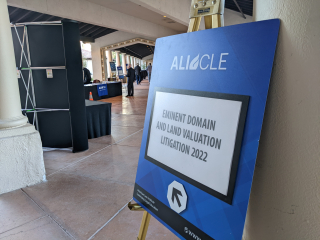
After a two-year absence in which we went remote, in the last week of last month (our usual spot on the calendar, between the playoffs and Super Bowl), we once again met in-person for the American Law Institute-CLE Eminent Domain and Land Valuation Litigation Conference.

Approximately 200 lawyers, judges, legal scholars, appraisers, law students, right-of-way agents, relocation experts, property owners, and other related professionals gathered in-person–yes, in-person–at the Scottsdale (Arizona) Resort at McCormick Ranch, to get reacquainted, learn stuff, and renew ties last made in-person in Nashville in 2020. In addition to the live attendance, we also welcomed about 50 remote colleagues, who joined the live webstream.

This was the 39th edition of the Conference, one of the most-established and successful conferences in the ALI-CLE stable of programs.

To those who joined us – thank you. This conference reminded us of why this program is so

Continue Reading 2022 ALI-CLE Eminent Domain And Land Valuation Litigation Conference, Scottsdale: You Should Have Been There!

All the topics you want to know about, presented by top-notch faculty from across the nation. Sessions include:

  • Property Rights as Civil Rights
  • Eminent Domain National Update
  • Just Relocation: Understanding the Law and Regulations to Ensure Fairness
  • Challenging Public Use: Lessons From a 67-Day Trial
  • COVID Takings
  • Federal Court and the Daubert Challenge: How to Prepare
  • Did the Supreme Court Signal a New Direction in Property Rights in Cedar Point Nursery?
  • How to Position Your Client for the Fallout When Projects Don’t Get Built
  • Rural Broadband and the Emerging Constitutional Challenges
  • Are Precondemnation Entry Statutes Still Valid After Cedar Point Nursery?
  • How Condemnor and Property Owners’ Counsel Prepare the Battlefield
  • How Will the Trillion Dollar Infrastructure Bill Impact Your Practice?
  • Ethics
  • …and more, including a full slate of networking and social events!

We’ve sold out the last few years, so don’t miss out. Room block now taking reservations. Continue Reading Join Us For The 39th Annual ALI-CLE Eminent Domain & Land Valuation Litigation Conference, Jan 26-29, 2022 (Scottsdale, AZ)