Court of Federal Claims | Federal Circuit

IMG_20180930_182039
Strong letter to follow!

A long-ish read (32 single-spaced pages) from the Federal Circuit in City of Fresno v. United States, No. 22-1994 (Dec. 17, 2024), but worth reading.

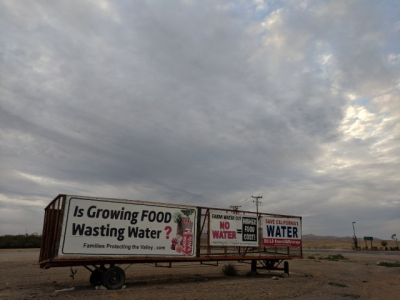
Not only will you get a crash course in how water is allocated in California’s vast central valley (as the billboards above, set up along the north-south I-5 corridor demonstrate, not everyone is happy about how that is accomplished), but you will also understand how the Federal Circuit approaches the predicate question in takings case: does the plaintiff own “private property?”

The court concluded no, the plaintiffs do not possess private property rights. Consequently, it affirmed the Court of Federal Claims dismissal of the takings claim.

The central valley, as the opinion explains, “is home to the largest federal water management project in the United States[.]” Slip op. Unsurprisingly named the Central Valley Project, is a series of dams, storage
Continue Reading CAFED: Feds Allocating California Water Isn’t A Taking Because Cal Says Only The Feds Have Water Rights

Check out the opinion of the Court of Federal Claims in Nix v. United States, No. 23-704C (Dec. 11, 2024). Fascinating stuff.

We post it here not because it breaks new ground, but due to the subject matter of the lawsuit: the alleged taking of a film that captures (in part) the assassination of President Kennedy in 1963.

No, this isn’t the famous Zapruder film, which was also the subject of a well-known takings claim. This case involved the “Nix film,” taken that fateful day “from an angle opposite the more famous Zapruder film. The Nix film thus captures Abraham Zapruder and the area around him, where some claim a gunman other than Lee Harvey Oswald was hiding.” Slip op. at 2. 

Nix licensed the film to UPI, which “unbeknownst to him … transferred the Nix film to the United States House of Representatives Select

Continue Reading CFC: Complaint Adequately Pleaded Physical Taking Of JFK Assassination Film

2025 San Diego

Get ready to join your colleagues and friends in San Diego for the 42d ALI-CLE Eminent Domain & Land Valuation Litigation Conference.

The 41st Conference was in New Orleans. Here’s a report of that event, and here are our reports from prior conferences in Austin and Scottsdale.

Here are some of the highlights of the upcoming Conference:

  • Property Rights at the Supreme Court: DeVillier and Sheetz and What’s Next
  • Slow Take: Possession, Rent, Relocation, and Offset
  • The Jury’s View: How Jurors See Your Case
  • From Penn Coal to Penn Central: How to Prove “Too Far”
  • Leveraging Expertise in Eminent Domain Litigation: Working with Land Planners, Engineers, and Other Predicate Experts
  • Kelo at Twenty: What Changed, What Didn’t, and What’s on the Horizon
  • Viva Las Vegas: How the Nevada Judiciary Upheld Property Rights in 180 Land’s Inverse Condemnation Taking
  • Ethics: Guiding the Trolley: Perspectives on Professional Ethics in


Continue Reading Registration For The 42d ALI-CLE Eminent Domain & Land Valuation Litigation Conference Is Underway (Don’t Miss Out!)

Be sure to read the entirety of Lawprof Ilya Somin’s recent post on Volokh,Federal Appellate Court Rules in Favor of Takings Lawsuit Against the CDC’s Covid-Era Eviction Moratorium.”

There, he analyzes the Federal Circuit’s recent 2-1 opinion in Darby Dev. Co., Inc. v. United States, No. 22-1929 (Aug. 7, 2024) (we wrote up the case here: “Deepening A Lower Court Split, Fed Cir (2-1) Reinstates CDC Co-19 Eviction Moratorium Temporary Takings Claim“).

Professor Somin does a better job that we did offering his thoughts on the “authorized” issue, concluding:

To me, the decisive factor should be that the Takings Clause nowhere says that compensation is only required for legal government actions or for those specifically authorized by statute. Rather, the Clause imposes a general rule that compensation must be paid whenever the government takes private property for “public use.” That, of course, can happen

Continue Reading Lawprof Somin: “Federal Appellate Court Rules in Favor of Takings Lawsuit Against the CDC’s Covid-Era Eviction Moratorium”

20151205_145921

This one is a must-read.

In Darby Dev. Co., Inc. v. United States, No. 22-1929 (Aug. 7, 2024), the U.S. Court of Appeals for the Federal Circuit held that the Court of Federal Claims should not have dismissed Darby’s complaint for failure to state a physical invasion takings claim.

The short takeaways:

  • Takings claims do not require the government action be legally authorized (here, the courts invalidated the government action, after which the plaintiff sued for a taking), only that the government action was “authorized” and thus can be “chargeable to the government.”
  • Prohibiting evictions is not merely a regulation of the landlord-tenant relationship. Yee v. City of Escondido is distinguishable, and does not categorically exempt all actions that implicate the landlord-tenant relationship from physical takings challenge.

We think the longer story is worth your time. Here it is.

As you may recall, the Center for Disease Control purported

Continue Reading Deepening A Lower Court Split, Fed Cir (2-1) Reinstates CDC Co-19 Eviction Moratorium Temporary Takings Claim

If you ever wanted a primer on the sometimes-confusing and seemingly arcane world of Rails-to-Trails takings cases, you would be hard-pressed to find a better example of the substantive law and the procedures in these cases than the Court of Federal Claims opinion in Nicholson v. United States , No. 23-843 (Mar. 13, 2024).

There’s nothing particularly outrageous about this case, but that’s one of the reasons why we appreciate the time that Judge Tapp put into the opinion (and the effort our colleagues Lindsay Brinton and Meghan Largent put into the case). 

Here’s how the opinion starts off:

“There is a pleasure in the pathless woods[.]” Yet for the Hyatt and Nicholson Plaintiffs (collectively referred to as “Plaintiffs”), that pleasure was replaced with the pain of usurped property rights. Tn its pursuit of public amenities, the United States transformed Plaintiffs’ land previously burdened by an unused railway into a

Continue Reading A CFC Primer On Rails-to-Trails Takings

ALI-CLE brochure cover page

When it comes to the longstanding ALI-CLE American Law Institute-CLE Eminent Domain and Land Valuation Litigation Conferences, we’re always ready to go. You know that. But this year’s version — the 41st — was buzzing like no other in recent memory.

Maybe it was the New Orleans venue with its atmo, food, and music for our after-class activities, or even the timing (the second-to-last week on the Mardi Gras parade season, and our conference hotel was right on the routes). It might have been the nice weather (oh, it rained buckets one evening, but there wasn’t an ice storm like we experienced in Austin in 2023). Or maybe it was the capacity crowd, and new topics and speakers on the agenda. Or maybe it was just the prospect of seeing our friends and colleagues again after a year.

Here’s a photo essay of some of the Conference highlights.

And

Continue Reading Pass A Good Time: Our Report From The 41st ALI-CLE Eminent Domain & Land Valuation Litigation Conference, Feb 1-3, 2024, New Orleans

Don’t miss out!

We promise: this is the last time we’re going to try to entice you to the upcoming ALI-CLE Eminent Domain & Land Valuation Litigation Conference in New Orleans. We are getting close to capacity, but there is still room. In recent years, we have standing room only in the Conference halls, and have sold out the hotel block. After all, this is a pretty niche area of law. So what gives?

When we were in Austin last year, we thought it might be nice to try and answer that question. We asked Conference participants why they come, year-after-year (and in Austin, despite massive travel disruptions). Yes, it is the various venues (Nashville, Austin, Scottsdale, Palm Springs, to name a few recent locations), and yes, it is the excellent and useful programming.

But as we suspected it is more than that.

Continue Reading No FOMO: There’s Still Room For You To Join Us In New Orleans Feb 1-3, 2024 For The 41st ALI-CLE Eminent Domain & Land Valuation Litigation Conference

“No need to ask, he’s a smooth operator…”

On Tuesday, January 16, 2024, the Supreme Court will hear arguments in a case we’ve  been following closely because it involves the fundamental limitation on the sovereign power to take private property. In our system, the sovereign indeed has the power to take private property against the will of the owner, but only if the taking is accompanied by just compensation.

Before we go on, a disclosure: we filed an amicus brief supporting Devillier’s arguments, so we’ve have an obvious bias. Special kudos to our law firm colleagues — and self-executing Just Compensation mavens — Deb La Fetra and Kady Valois for this brief.

Texas Flooded Devillier’s Property

Here are the facts in Devillier v. Texas. As part of a road project, the Texas Department of Transportation caused Devillier’s property to flood. The state flooding someone’s property is one of those

Continue Reading Devillier v. Texas Argument Preview: Do Courts Need Congress’ Permission To Enforce The Right To Just Compensation?

Here are the cases that Michael Berger and I discussed in today’s presentation to the ABA State and Local Government Law Section’s Land Use group. It was good seeing everyone, even virtually:


Continue Reading Cases And Links From Today’s ABA State & Local Govt Law Land Use Presentation