
Lately, we’ve been zeroing in on one of the lesser known parts of the Supreme Court’s takings canon, Yee v. City of Escondido, 503 U.S. 519 (1992), where the Court concluded that a city ordinance that limited the amount a property owner could charge a tenant for rent was not a physical invasion taking.
New Article: Common Sense and Common Law: Defining “Property” in Cedar Point v. Hassid

Thank you to the editors over at The Practical Real Estate Lawyer for publishing my missive on Cedar Point Nursery v. Hassid, the U.S. Supreme Court’s recent blockbuster regulatory takings decision (and for letting me post a copy of the article here so it is available even if you are not a PREL subscriber).
Important Developments In Canada (No, Not That!): Supreme Court Hears Argument In “Takings” Case
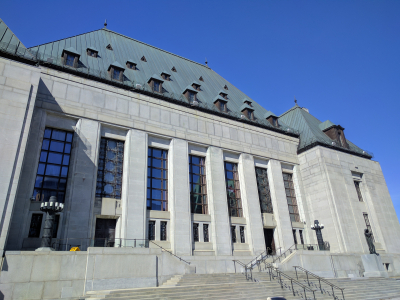
Sorry about the headline, but come on, man! We have to use clickbaity headlines every now and then to get your attention. Here’s the latest in a case we’ve been following.
Yesterday, the Supreme Court of Canada heard oral arguments in Annapolis Group Inc v. Halifax Regional Municipality, a case involving “de facto
IRWA’s Summary Of Major Eminent Domain Cases & Legislation (June-Dec 2021)

Check this out: the International Right of Way Association’s Real Estate Law Committee produces twice-a-year reports “which contain summaries of eminent domain decisions and legislation within the United States.” (This is the “international” right of way association, so that last qualifier is important.)
And what is really nice is that they make the report available
2022 ALI-CLE Eminent Domain And Land Valuation Litigation Conference, Scottsdale: You Should Have Been There!
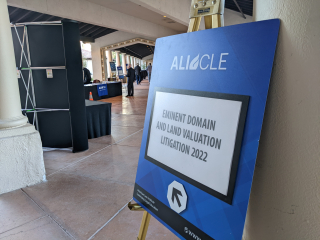
After a two-year absence in which we went remote, in the last week of last month (our usual spot on the calendar, between the playoffs and Super Bowl), we once again met in-person for the American Law Institute-CLE Eminent Domain and Land Valuation Litigation Conference.
Approximately 200 lawyers, judges, legal scholars, appraisers, law students
CA9: We Reject Legislative/Administrative Distinction In Exactions, But City Requirement That Owners Pay Tenant To Move Back Into Their Home Isn’t A Taking
Before we go further into the Ninth Circuit’s opinion in Ballinger v. City of Oakland, No. 19-16-550 (Feb. 2, 2022), this disclosure: this is a case in which our law firm represents the property owners. So take that into account as you read our take on the case.
The Ballingers own a home
The Circle Is Now Complete: A Sampling Of Final Paper Topics From William and Mary Law’s Eminent Domain & Property Rights, And Land Use Courses
If you ever get the opportunity to teach in a law school — either as a full-time legal scholar, or part-time as an expert adjunct practitioner — take it if you can. You might think you know a lot about a particular subject, but there’s nothing like spending time at the lectern in a law
A Tale Of Two Cities: A City’s Road Barriers Might Be A Taking, Even Though The Property Taken Is In A Neighboring City
A short trial court decision. But because it deals with an interesting question, we’re posting it.
Check it out: in this order, the U.S. District Court for the District of Minnesota denied the city’s motion to dismiss in a case alleging, inter alia, a Fifth Amendment taking.
The property owners’ complaint alleged that
Tex App: “Property” Includes Right To Rent It Out – City’s Short-Term Ban May Be A Taking
Here’s a must-read from the Texas Court of Appeals (Second District).
In City of Grapevine v. Muns, No. 02-19-00257 (Dec. 23, 2021),
Before 2018, the city’s 1982 zoning ordinance authorized “single-family detached dwellings” and didn’t say anything about short-term renting (short-term being defined as less than 30 days). The ordinance didn’t expressly authorize it
Latest Ep, Eminent Domain Podcast: The Legacy Of Robert Moses (Judge Andrew Edison)
Check this out, the latest episode of Clint Schumacher’s Eminent Domain Podcast, where his guest is Judge Andrew Edison (who may be familiar to many of you for his ALI-CLE presentation a couple of years ago about the eminent domain angle in the JFK assassination film).
Today, the topic is Robert Moses, NYC