Municipal & Local Govt law

Bergerpage

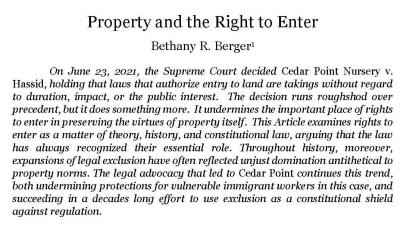
A new article by lawprof Bethany Berger, “Property and the Right to Enter,” criticizing the Supreme Court’s ruling in Cedar Point Nursery. The article builds on the amicus brief in the case, also authored by Prof Berger.

Here’s the Abstract:

On June 23, 2021, the Supreme Court decided Cedar Point Nursery v. Hassid, holding that laws that authorize entry to land are takings without regard to duration, impact, or the public interest. The decision runs roughshod over precedent, but it does something more. It undermines the important place of rights to enter in preserving the virtues of property itself. This Article examines rights to enter as a matter of theory, history, and constitutional law, arguing that the law has always recognized their essential role. Throughout history, moreover, expansions of legal exclusion have often reflected unjust domination antithetical to property norms. The legal advocacy that led to Cedar Point continues this trend, both undermining protections for vulnerable immigrant workers in this case, and succeeding in a decades long effort to use exclusion as a constitutional shield against regulation.

Definitely worth reading.
Continue Reading New Article (Bethany Berger): “Property and the Right to Enter”

FedCtsTakingsArticlepage1

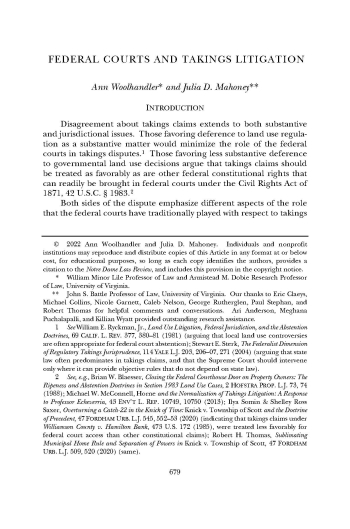
A new article on takings from U. Virginia Law School profs Ann Woolhandler and Julia Mahoney in the Notre Dame Law Review, “Federal Courts and Takings Litigation.” Get the pdf here.

Rather than try and summarize the piece, we’re just going to cut-and-paste the highlights from the article’s Introduction:

While Knick clearly expands

Not too long ago, we posted the Fifth Circuit’s panel opinion in a case where the court held that there’s nothing a federal court can do if a local government does not pay a state-court just compensation judgment. We filed an amicus brief in that case arguing “[t]he Takings Clause does not permit the Sewerage

Here’s an issue that we’ve been following for a while. What will a court do when a condemnor is ordered to pay (the property owner has a judgment in hand), but the condemnor says “no thanks”?

The latest incarnation is the U.S. Court of Appeals’ opinion in Ariyan, Inc. v. Sewerage & Water Board

Check out the U.S. Court of Appeals for the Eighth Circuit’s opinion in 301, 712, 2103 and 3141 LLC v. City of Minneapolis, No. 20-3493 (Mar. 14, 2022), in which the court held that a Minneapolis ordinance prohibiting property owners from rejecting a prospective tenant because of the applicant’s criminal, credit, or rental history

CEQAflowchartSee if you can navigate this maze.

Even if you are not in California, this thing called “CEQA” (the California Environmental Quality Act) is something you might have heard of. An environmental reporting statute on steroids, CEQA is, according to this new report from the Pacific Research Institute, the main reason why California is

Well, that was quick. Last month, as we reported here, the a Ninth Circuit panel held that the City of Oakland, California, could require property owners to pay thousands of dollars in what is branded “relocation fee” to their tenants as a precondition of the owner moving into their own property. This isn’t an

Lately, we’ve been zeroing in on one of the lesser known parts of the Supreme Court’s takings canon, Yee v. City of Escondido, 503 U.S. 519 (1992), where the Court concluded that a city ordinance that limited the amount a property owner could charge a tenant for rent was not a physical invasion taking.

CedarpointPRELcoverpage

Thank you to the editors over at The Practical Real Estate Lawyer for publishing my missive on Cedar Point Nursery v. Hassid, the U.S. Supreme Court’s recent blockbuster regulatory takings decision (and for letting me post a copy of the article here so it is available even if you are not a PREL subscriber).

IMG_20170323_142813

Sorry about the headline, but come on, man! We have to use clickbaity headlines every now and then to get your attention. Here’s the latest in a case we’ve been following.

Yesterday, the Supreme Court of Canada heard oral arguments in Annapolis Group Inc v. Halifax Regional Municipality, a case involving “de facto