Public Use | Kelo

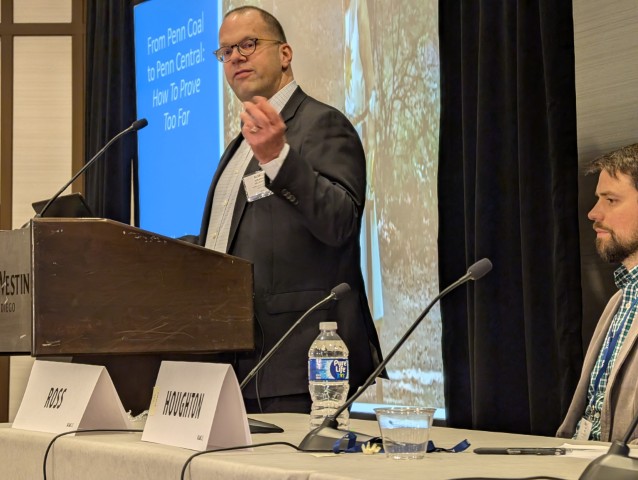
With our tongues firmly planted in cheeks, the Planning Chairs for the upcoming 42d edition of this popular and venerable Conference bring you this “breaking news” report from San Diego!

As you know, in addition to being the best nationally-focused conference on the subjects that we love and a venue that is nearly certain to

Sandefur

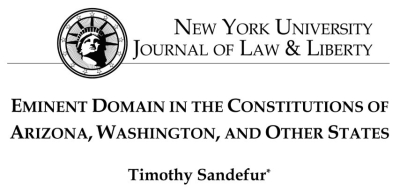
We’re starting off the new year with some eminent domain goodness. Tim Sandefur has published “Eminent Domain in the Constitutions of Arizona, Washington, and Other States,” 18 N.Y.U. J.L. & Liberty 167 (2024).

There’s a lot in the piece that will keep you reading, but what we found particularly insightful was how public use/purpose limitations “should operate in practice.” In our opinion, it’s fairly easy to say that the Fifth Amendment (and state constitutions) operate as a robust check on the sovereign power to take property for public use, but a lot more difficult to apply that broad notion to particular circumstances in a way that is both uniform and predictable. Right now, we seem to be operating on a know-it-when-I-see-it basis, but that doesn’t get us to a general rule. This piece goes a long way to getting us to a general rule.

Highly recommended.

Here’s the Abstract:

The nineteenth century was an extraordinarily prolific age of constitution-making. One of the greatest concerns of constitution-makers during this period—particularly in the western states—was the protection of private property against threats such as the use of eminent domain and the damage to property resulting from public works projects. This Article takes the eminent domain provisions of the Arizona and Washington constitutions as a point of departure to examine the innovative ways in which constitution-makers sought to limit government’s power to deprive people of their property. These constitutions—which until the admission of Alaska and Hawaii were the most up-to-date constitutions in America—contain four such innovations: (1) an explicit ban on takings for “private use,” reinforced by prohibitions on judicial deference regarding the definition of “public use”; (2) a compensation requirement for the “damaging” of property; (3) a requirement that payment precede a taking, and (4) a ban on deducting from just compensation awards the amount of purported “benefit” resulting from a taking. The Article traces the origins of these four protections, with reflections on how they should operate in practice.

Check it out

.
Continue Reading New Article: Timothy Sandefur, “Eminent Domain in the Constitutions of Arizona, Washington, and Other States,” 18 N.Y.U. J.L. & Liberty 167 (2024)

We usually don’t cover unpublished opinions, but the New Jersey Appellate Division’s reasoning in Hudson County Improvement Authority v. Mariana Properties, Inc., No. A-2686-22 (Oct. 29, 2024) stuck in our craw a bit. 

This is an eminent domain case in which the Authority is taking an easement and intends to construct one of

2025 San Diego

Get ready to join your colleagues and friends in San Diego for the 42d ALI-CLE Eminent Domain & Land Valuation Litigation Conference.

The 41st Conference was in New Orleans. Here’s a report of that event, and here are our reports from prior conferences in Austin and Scottsdale.

Here are some of the

Those of you who are students of eminent domain and the public use requirement know that in Berman v. Parker, 348 U.S. 26 (1954), the Court (in)famously held, “when the legislature has spoken, the public interest has been declared in terms well nigh conclusive.”

Not only was the Court in Berman signalling that it

Brinkmann

So close: if just one more Justice had agreed, the U.S. Supreme Court would have taken up a public use case we’ve been following, Brinkmann v. Town of Southhold. After all, this one had a lot of the usual markers: a divided court below, an allegation of a lower court split, beaucoup amicus support

Today we have a guest post by New York colleague Jennifer Polovetsky, who writes about the intersection of administrative law (Chevron deference) and public use in eminent domain.Thanks to Jennifer (and to the New York Law Journal) for allowing us to republish her intriguing piece.

_____________________________

Is Judicial Deference to Government Agency Decisions

Screenshot 2024-09-25 at 09-31-31 206PA21 and 410PA18-2 Town of Apex v Rubin - YouTube

Here’s the latest in a case we’ve been following (and in which we filed an amicus brief in favor of the property owner).

Yesterday, the North Carolina Supreme Court heard oral arguments in Town of Apex v. Rubin. Here’s a link to the recording (YouTube prevents us from embedding it, sorry).

This is a