
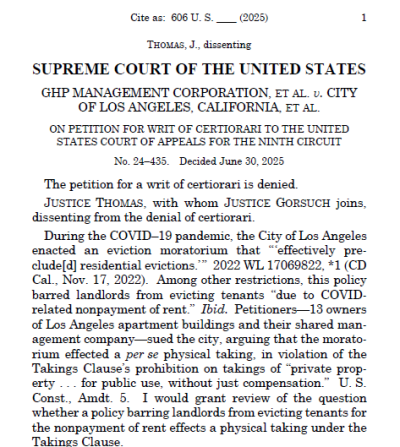
Yesterday, in this Order in a case we’ve been following, the U.S. Supreme Court declined to consider whether a municipal ordinance which allowed non-paying tenants to remain in the lessor’s property after the agreed-upon termination of a lease (nonpayment of rent) is a physical taking, or merely the regulation of the lessor/lessee relationship under
CA6: A Wrongful Keeping Is A Taking, If Plaintiff Proves He Owns The Kept Property
A short one from the U.S. Court of Appeals for the Sixth Circuit.
In Wenzel v. Federspiel, No. 24-1278 (June 20, 2025), the Sheriff was accused of keeping “fourteen firearms seized in a criminal investigation that ended years ago.” Slip op. at 1. Eventually, the claimed owners of those guns sued, inter alia
Fed Cir Denies En Banc, Tees Up SCOTUS: Can There Still Be A Taking If Government Acts Illegally? Is Prohibiting Eviction A Physical Taking?
Here’s the latest in a case we’ve been following.
In this Order, the U.S. Court of Appeals for the Federal Circuit denied en banc review of a 2-1 panel opinion which concluded that a complaint challenging the CDC’s Co-10 residential eviction moratorium properly pleaded a physical takings claim even though the Supreme Court
CFC: Allegation That Gov’t Ordered Destruction Of Bump Stocks Pleaded Physical Takings Claim
We’re back to bump stocks. Indeed, we have covered cases raising similar issues so we’re not going into too much detail on the U.S. Court of Federal Claims’ recent decision in The Modern Sportsman, LLC v. United States, No. 19-449 (May 8, 2025), and we’ll just assume you, like us, have been following along with this issue.
Suffice it to say that the federal government adopted regulations defining these devices as prohibited machine guns and gave those in possession 90 days to either turn them over to the government, or to destroy them. The plaintiffs destroyed their bump stocks and then sued the federal government for a taking.
The CFC dismissed the complaint under the government’s “police power” authority to prohibit contraband and noxious items. As we noted in this post, the line between uncompensated destruction and compensated takings was not as clear at the CFC saw it (the Armstrong rationale cannot be ignored, even where a taking may be for a very good public reason), and thus the Federal Circuit affirmed, but shifted the rationale from police power to a lack of a private property interest. After the Supreme Court denied cert, “that was that.” Slip op. at 2.
Meanwhile, other bump stock owners challenged the validity of the administrative rule declaring these things machine guns. And there, the owners found more success, with the Supreme Court eventually concluding that the agency lacked the authority to adopt the bump stock rule. The owners here “then asked this Court to revive this lawsuit, which the Court did … [t]he next day, plaintiffs amended their pleadings to add an illegal exaction claim in addition to their takings claim.” Slip op. at 3.
The government sought dismissal, arguing that the bump stock owners alleged a physical taking but the government hadn’t physically seized anything. It merely required the owners to destroy the bump stocks: as the CFC put it, the government “acknowledges that plaintiffs alleged that ‘the Rule required bump stock owners to destroy or surrender the devices to ATF.’ Reply 2. That does not pass muster for the government, however, because the government ‘did not seize any devices or otherwise physically invade plaintiffs’ property.’ Id. at 3.” Slip op. at 4. In short, we didn’t actually seize anything of yours, plaintiffs; we merely required you to destroy your property. Really.
The CFC wasn’t having any of that, and rejected this too-clever-by-half argument:
The Court cannot agree. Let us be clear that the government need not literally force private persons to turn over their property for a taking to occur; a legal requirement is sufficient. For example, in Horne, the Supreme Court held that an administrative order requiring raisin croppers to “give a percentage of their crop to the Government, free of charge” effected a compensable appropriation. 576 U.S. at 355. The government did not literally oust the farmers from possession of the raisins, yet a taking occurred because the order made a “formal demand” backed by fines and penalties. Id. at 362, 367–68. It is the same here. The Rule plainly states: “This final rule requires the destruction of existing bump-stock-type devices.” 83 Fed. Reg. at 66,549. It then instructs: “Individuals who have purchased bump-stock-type devices prior to the implementation of this rule must destroy the devices themselves prior to the effective date of the rule or abandon them at their local ATF office.” Id. Finally, it makes clear that “individuals are subject to criminal liability . . . for possessing bump-stock- type devices after the effective date of regulation.” Id. at 66,525. These statements undoubtedly constitute a formal demand to destroy or transfer possession of bump stocks, satisfying the standard under Horne.
Slip op. at 4-5.
If this argument strikes you as nonsense, welcome to our world, where arguments like this are put forth with a straight face on a regular basis.
And if that wasn’t enough, the government next argued that the regulations didn’t actually require the owners to destroy their bump stocks, “but ‘merely clarified’ the ‘longstanding statutory law’ banning machineguns.” Slip op. at 5. “Put plainly, the government essentially argues that the Rule is an informational document apprising the public of pre-existing legal obligations.” Id. The CFC held “[t]hat too is incorrect.” Id. That seems to be putting it mildly. What do you think would have happened to bump stock owners who didn’t comply with this “informational” rule and held on to their bump stocks?
Short story: the complaint alleged a physical taking.
Next, however, the CFC rejected the exaction claim, based on the remedy sought. As we know, the CFC is limited to awarding monetary damages in these kind of cases. The CFC held that an “exaction” generally “involves money that was ‘improperly paid, exacted, or taken from the claimant.'” Slip op. at 7 (quotations omitted). Here, the CFC held, no money changed hands and there’s no statute otherwise authorizing a claim for money damages:
In sum, plaintiffs cannot be said to have paid money, directly or “in effect,” for a very straightforward reason: They lost personal property, not money. Indeed, plaintiffs have not alleged that they spent any money for any purpose; or paid any money to any In sum, plaintiffs cannot be said to have paid money, directly or “in effect,” for a very straightforward reason: They lost personal property, not money. Indeed, plaintiffs have not alleged that they spent any money for any purpose; or paid any money to any
Slip op. at 8-9.
The CFC wrapped up by — get this — calling out the property owners’ lawyers for failing to expressly clarify that one of the cases they cited and relied on didn’t actually hold that an exaction could be a demand for “money or property,” only money. Slip op. at 9. The court acknowledged that the citation didn’t actually misquote the case, but that the lawyers should have been more candid that they were arguing for an extension of the law, and that the case limited exactions to money.
We’re fine with that (especially in the AI era), and requiring advocates to be candid.
But where’s the call-out of the government’s horse hockey arguments, noted above? Dead silence, of course. In our view, the borderline frivolous, time-and-expense wasting, divorced-from-reality arguments the government made are equally if not more deserving of censure.
Call us if that ever happens. We’ll wait.
The Modern Sportsman, LLC v. United States, No. 19-449 (Fed. Cl. May 8, 2025)
Continue Reading CFC: Allegation That Gov’t Ordered Destruction Of Bump Stocks Pleaded Physical Takings ClaimCAFED: Sleeping With The Fishes – Requiring Water To Stay In River Is A Regulatory, Not Physical, Taking
Here’s the U.S. Court of Appeals for the Federal Circuit’s opinion in United Water Conservation District v. United States, No. 23-1602 (Apr. 2, 2025), which gets a bit metaphysical.
The District is responsible for a dam and canal that diverts water from the Santa Clara River in southern California. Under the authority of the Endangered Species Act, the NOAA required the District to leave more water in the river for steelhead trout habitat. Either that, or seek an incidental take permit allowing the District to “take” (i.e., kill) steelhead.
The District asserted this is a physical taking of its water rights, but the government said no, this is a regulatory taking. Why is this important? Because a physical takings claim is ripe right now, without any need to exhaust any avenues for administrative relief from the NOAA, But if this is a regulatory takings claim, it isn’t ready for judicial review until the NOAA has provided a final decision in the form of a yes or no on an incidental take permit. Which it has not done because the District hasn’t applied for an incidental take permit. The Court of Federal Claims agreed with the government, and the District appealed.
The Federal Circuit saw the difference between physical and regulatory takings thusly:
Regulatory takings differ from physical takings in that, instead of asking “whether the government has physically taken property for itself or someone else—by whatever means,” the question is whether the government “has instead restricted a property owner’s ability to use his own property.” Id. (citing Tahoe-Sierra Pres. Council, Inc. v. Tahoe Reg’l Plan. Agency, 535 U.S. 302, 321–23 (2002)). “While there is no ‘set formula’ for evaluating regulatory takings claims, courts typically consider whether the restriction has risen to the level of a compensable taking under the multi-factor balancing test articulated in Penn Central, 438 U.S. at 124.” Casitas I, 543 F.3d at 1289; see Tahoe-Sierra, 535 U.S. at 322 n.17 (“When, however, the owner contends a taking has occurred because a law or regulation imposes restrictions so severe that they are tantamount to a condemnation or appropriation, the predicate of a taking is not self-evident, and the analysis is more complex.”).
Slip op. at 7.
The Federal Circuit concluded that the District has a property right in the use of water it diverts. But it rejected the District’s argument that NOAA’s order to not divert as much water as it had been diverting and instead leave it in the river is the same as the government seizing the water. Not so, held the court. This is merely a restriction on the District’s use.
But what about that earlier case in which the Federal Circuit held that the government requiring another water rights owner to put water into a fish ladder was a physical taking? See Casitas Municipal Water Dist. v. United States, 543 F.3d 1276 (Fed. Cir. (2008). Nope. The difference is that in Casitas, the water district already had diverted the water from the river into its own system and the government ordered it to redirect the already-appropriated water to the fish ladder. Whereas here, the water district was merely ordered to not divert it and leave it in the river for the fish.
The Federal Circuit also distinguished a a Supreme Court case which held that the government’s stopping the water flow to the plaintiff’s mill was a physical appropriation. By contrast, here, the government had not “completely cut off [the District’s] access to the water or cause it to return any volume of water it had previously diverted to its possession[.]” Slip op. at 10. “In fact, [the District] alleges that [NOAA], at most, required more water to stay in the Santa Clara River.” Id.
The District argued the court shouldn’t view this so hyper-technically: we had the right to X amount of water before, and due to the government’s restrictions has X-minus amount now. We think that makes a lot of sense.
But let’s put that aside for the moment and get to what we see as the more fundamental issue. Should there be a difference between a physical claim and a regulatory claim such that they should be subject to different ripeness requirements?
The idea that there’s a meaningful (or as the Federal Circuit says, “material”) difference between a physical takings theory and a regulatory takings theory is difficult for us to wrap our mind around. There’s but a single cause of action to describe the situation where an owner claims some action by the government has the same effect on property as would an exercise of eminent domain (aka inverse condemnation, regulatory taking, de facto taking). See Yee v. City of Escondido, 503 U.S. 519, 534-35 (1992) (“Petitioners’ arguments that the ordinance constitutes a taking in two different ways, by physical occupation and by regulation, are not separate claims. They are, rather, separate arguments in support of a single claim—that the ordinance effects an unconstitutional taking.”).
Reminds us of that perhaps-apocryphal story about LBJ getting into the “wrong” helicopter. They’re all de facto takings, son. After all, in eminent domain the taking of a nonpossessory easement is treated exactly the same way as a taking of the fee simple interest.
Nonetheless, the Federal Circuit thinks there’s a big difference. But what’s the difference between having a right to divert water, and a right to water already diverted? We can’t see a whole lot. But here’s the court’s thinking:
The Supreme Court precedent that United relies upon, however, does not acknowledge any distinction between physical and regulatory takings. That is presumably because it was not until 1978, decades after the decisions in International Paper, Gerlach, and Dugan, that the Court, in Penn Central, “clarified [ ] the test for how far was ‘too far’” for a regulation to be recognized as a taking. Horne v. Dep’t of Agric., 576 U.S. 350, 360 (2015). It may also be because the alleged takings in those cases did not arise from a regulation, as it clearly does here under the ESA. Moreover, Gerlach and Dugan involve riparian water rights, not appropriative water rights as here. The difference between the two is meaningful in the context of this case because riparian rights exist by virtue of land ownership and, therefore, their acquisition by the landowner does not depend on any physical acts of diversion and beneficial use of water as is required for appropriative water rights. See Colorado, 459 U.S. at 179, n.4 (“Appropriative rights do not depend on land ownership and are acquired and maintained by actual use. Riparian rights, in contrast, originate from land ownership and remain vested even if unexercised.”). Unlike the riparian-rights holders in Gerlach and Dugan, therefore, the appropriative-rights holder here needed to have physically diverted water for its property right to vest and thus become subject to a physical taking, as in Casitas. For at least those reasons, the Supreme Court precedent and related cases United cites are consistent with our decision here.
Slip op. at 12.
United Water Conservation Dist. v. United States, No. 23-1602 (Fed. Cir. Apr. 2, 2025)
Continue Reading CAFED: Sleeping With The Fishes – Requiring Water To Stay In River Is A Regulatory, Not Physical, TakingCA10 On Causby, Open Range, And Corner Crossings: Owners Have A Right To Exclude, But Not If Doing So Fully Encloses Public Lands
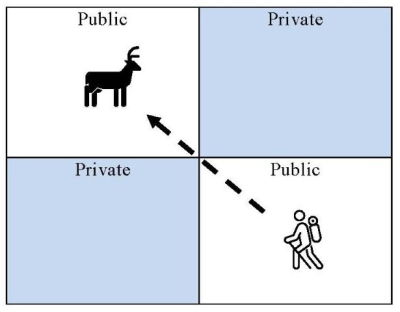 The opinion gets that diagrams are good.
Here’s the latest in a case we’ve been following.
A case that should end up in Property casebooks (it will almost certainly make an appearance in our William and Mary Eminent Domain and Property Rights course in the fall).
Dirt lawyers know the “ad coelum”
Eviction Moratorium As A Physical Taking All Teed Up
Here’s the latest in a case we’ve been following. This is GHP Management Corp. v. City of Los Angeles, No. 24-435, the cert petition which asks whether a local ordinance which allowed non-paying tenants to remain in the lessor’s property is a physical taking, or merely the regulation of the lessor/lessee relationship under
Join Us: “Property Rights and The Roberts Court: 2005-2025” (Feb. 27, 2025, UC Berkeley Law School)

Register now and plan on joining us on Thursday, February 27, 2025 at the U.C. Berkeley Law School for a one-day conference: “Property Rights and the Roberts Court: 2005-2025.”
Here’s the agenda. Here’s a description of the program:
For much of the past century, property rights were relegated to second-class status compared
CA8 Misses An Opportunity For Penn Central Clarity: No Taking When City Bans New Private Wells, Requires City Water
At first glance, it might seem like there’s a lot there in the U.S. Court of Appeals’ opinion in Becker v. City of Hillsboro, No. 23-3367 (Jan. 7, 2025).
After all, the city’s prohibition on new private wells and another requirement that newly built homes connect to the city’s water system seems a bit

Breaking News: Come Join Us For The 42d ALI-CLE Eminent Domain & Land Valuation Litigation Conference, San Diego, Jan 30-Feb 1
With our tongues firmly planted in cheeks, the Planning Chairs for the upcoming 42d edition of this popular and venerable Conference bring you this “breaking news” report from San Diego!
As you know, in addition to being the best nationally-focused conference on the subjects that we love and a venue that is nearly certain to have some of the warmest winter weather in the continental United States, and we went on-location from some of the local highlights: the beaches, Torrey Pines, the Zoo, Balboa Park, the Gaslamp Quarter, and Coronado to name but a few.
More about the Conference here, including registration information.
Here are some of the highlights:
- Property Rights at the Supreme Court: DeVillier and Sheetz and What’s Next
- Slow Take: Possession, Rent, Relocation, and Offset
- The Jury’s View: How Jurors See Your Case
- From Penn Coal to Penn Central: How to Prove “Too Far”
- Leveraging Expertise in Eminent Domain Litigation: Working with Land Planners, Engineers, and Other Predicate Experts
- Kelo at Twenty: What Changed, What Didn’t, and What’s on the Horizon
- Viva Las Vegas: How the Nevada Judiciary Upheld Property Rights in 180 Land’s Inverse Condemnation Taking
- Ethics: Guiding the Trolley: Perspectives on Professional Ethics in Eminent Domain for Lawyers, Appraisers, and Right of Way Agents
- “I Think I Shall Never See” Just Compensation For a Tree: Strategies to Securing Recovery for Trees, Crops, and Fixtures
And more. Check out the complete agenda here. Registration information here.
We especially welcome first-time participants, or those returning after an absence. Connect (or reconnect) with your colleagues from across the nation.
The 41st Conference was in New Orleans. Here’s a report of that event, and here are our reports from prior conferences in Austin and Scottsdale.
Don’t miss out on San Diego: we have had record attendance in recent years, so hold your space now. #EminentDomain2025
Continue Reading Breaking News: Come Join Us For The 42d ALI-CLE Eminent Domain & Land Valuation Litigation Conference, San Diego, Jan 30-Feb 1