Here’s the latest in a case we’ve been following.

In Englewood Hospital & Medical Center v. State, No A-16-24 (July 16, 2025), the New Jersey Supreme Court rejected physical and regulatory takings claims made by hospitals which are required to treat nonpaying patients even though the Medicare reimbursements available will not cover the hospitals’ costs. 

Here’s the bottom line:  

Under the facts as presented in this case, we hold that charity care is not an unconstitutional “per se” physical taking of private property without just compensation. It does not grant an affirmative right of access to occupy hospitals; it does not give away or physically set aside hospital property for the government or a third party; and it does not deprive hospitals of all economically beneficial use of their property. We also hold that charity care is not an unconstitutional “regulatory” taking of private property without just compensation.

Continue Reading NJ: Forcing Hospitals To Lose Money To Treat Nonpaying Patients Isn’t A Taking

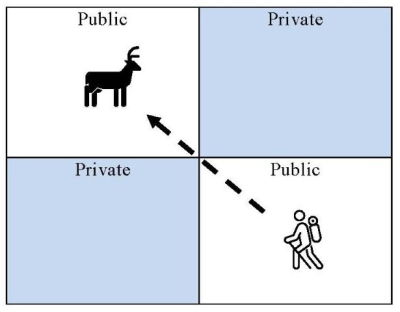
CornercrossingYour Mission: go from Public to Public, without invading Private 

Here’s the latest in a case we’ve been following from its inception.

This is the “corner crossing” case, which as we noted here, is sure to be a mainstay in future Property Law casebooks, because the checkerboard pattern of public and private land ownership has resulted in a fascinating case. We’re not going to wait for the pocket part, and the case will almost certainly make an appearance in our William and Mary Eminent Domain and Property Rights course in the fall.

Hunters want to access the public lands. This can only be accomplished by crossing at the corners where the parcels connect as shown in the above illustration. Problem is that this cannot be done without trespassing on the private parcels. Even where the hunters go through “Twister“-like contortions to avoid touching the land or violating private airspace. Check this out:

Ladders
Now that is dedication.

After the Tenth Circuit held that the The private property owner has now filed a cert petition.

Before we go further, here’s the Question Presented:

Between 1850 and 1870, Congress ceded millions of acres of public land in the West to railroads in a distinct checkerboard pattern of alternating public and private plats of land. The result of Congress’s peculiar land-grant scheme is that many parcels of public land in the checkerboard are landlocked and accessible only by “corner crossing”—the act of moving diagonally from the corner of one public parcel to another, trespassing through the adjoining private property in the process.

Nearly fifty years ago, this Court unanimously rejected the government’s argument that Congress “implicitly reserved an easement to pass over the [privately-owned] sections in order to reach the [public] sections that were held by the Government” in the checkerboard. Leo Sheep Co. v. United States, 440 U.S. 668, 678 (1979). In Leo Sheep, that meant the government could not create public access to a Wyoming reservoir by clearing a dirt road that crossed two checkerboard corners—at least not without exercising the government’s power of eminent domain and paying just compensation.

In 2021, four hunters corner crossed through Iron Bar’s property to hunt on public land; Iron Bar sued for trespass. In the decision below, the Tenth Circuit recognized that, under Wyoming law, the hunters had trespassed on Iron Bar’s property. The court nonetheless held that an 1885 federal statute governing fences—the Unlawful Inclosures Act—implicitly preempted Wyoming law and “functionally” created a “limited easement” across privately-held checkerboard land.

The question presented is:

Whether the Unlawful Inclosures Act implicitly preempts private landowners’ state-law property right to exclude in an area covering millions of acres of land throughout the West.

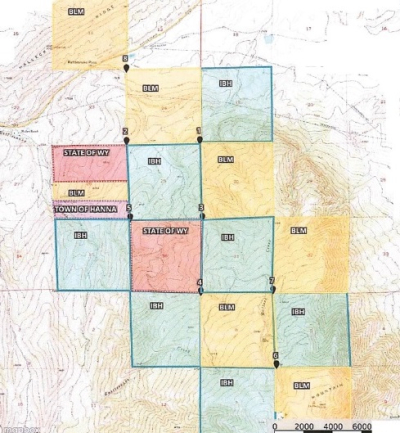
Here are the actual parcels, and some of the corner crossings at issue (again, from the District Court).

Signs1

The Tenth Circuit started by noting that under Wyoming state law, corner crossings are likely actionable civil trespasses. But the court went on, concluding that the federal anti-fencing statute “preempts” state property law and prohibits the private owners from excluding the hunters. In short, the federal statute and interpreting caselaw “have overridden the state’s civil trespass regime[.]” Id.

In short, here is the Tenth Circuit’s rationale: The owners here have a right to exclude corner-crossers. But the statute says that the public has a right to access public lands, which means any private owner that is getting in the way of that — even where that owner does nothing affirmative to impede public access — is creating a nuisance.

Now the issue has been offered up for Supreme Court review. Stay tuned to see what the Court does with this fascinating case. 

Petition for Writ of Certiorari, Iron Bar Holdings, LLC v. Cape, No. ___ (U.S. July 16, 2025) 

Continue Reading New Cert Petition In “Corner Crossing” Case: Can A Federal Anti-Fencing Statute “Preempt” A State-Recognized Right to Exclude?

JLEPcover

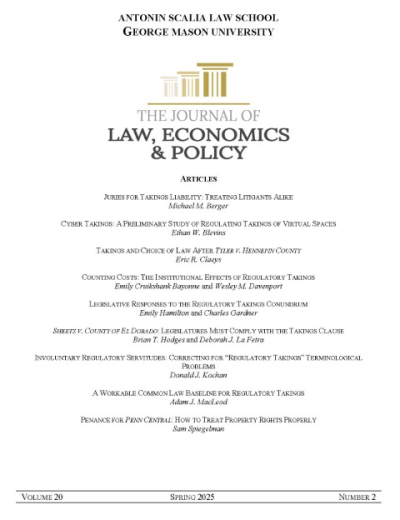
Last year, we attended a conference devoted to the future of regulatory takings, hosted by the Antonin Scalia School of Law (George Mason U), and Pacific Legal Foundation.

The publisher, the Journal of Law, Economics, and Policy has released the articles and essays from that conference, and made them available here

Here’s the list of articles:

  • Michael M. Berger, Juries for Takings Liability: Treating Litigants Alike
  • Ethan W. Blevins, Cyber Takings: A Preliminary Study of Regulating Takings of Virtual Spaces
  • Eric R. Claeys, Takings and Choice of Law After Tyler v. Hennepin County
  • Emily Cruikshank Bayonne and Wesley M. Davenport, Counting Costs: the Institutional Effects of Regulatory Takings
  • Emily Hamilton and Charles Gardner, Legislative Responses to the Regulatory Takings Conundrum
  • Brian T. Hodges and Deborah J. La Fetra, Sheetz v. County of El Dorado: Legislatures Must Comply With the Takings Clause
  • Donald J. Kochan, Involuntary Regulatory Servitudes:


Continue Reading New Property Rights Symposium Published – “Too Far: Imagining the Future of Regulatory Takings”

Here’s the latest in a case we’ve been following.

In Idaho Power Co. v. Bean, No. 23CV12213 (July 9, 2025), the Oregon Court of Appeals reversed a trial court ruling which held that Oregon’s precondemnation entry statute, which requires “reasonable compensation” for physical damage or substantial interference with the owner’s possession or use, sets the bar too high and the U.S. and Oregon Constitutions require “just compensation” for any appropriation of a right to physically invade, not just for physical damage or substantial interferences.

The court of appeals held that “temporary precondemnation entries–at least insofar as they do not cause any ‘substantial interference with the property’s possession or use’ or ‘any physical damage’–are consistent with ‘longstanding background restrictions on property rights’ and ‘traditional common law privileges to access private property.'” Slip op. at 699. In short, the court concluded that the U.S. and Oregon constitutions permit exactly

Continue Reading Oregon App: Not All Precondemnation Entries Are Takings – It’s Gotta Be “Substantial”

Righttoretrievecover

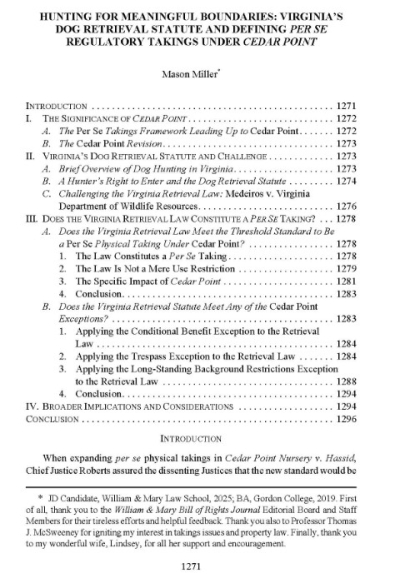
Be sure to read this recently-published piece in the William and Mary Bill of Rights Journal, Mason Miller, “Hunting for Meaningful Boundaries: Virginia’s Dog Retrieval Statute and Defining Per Se Regulatory Takings Under Cedar Point,” 33 Wm. & Mary Bill of Rights J. 1271 (2025). 

The article focuses on Virginia’s so-called “right to retrieve” law, Va. Code § 18.2-136 (“Fox hunters and coon hunters, when the chase begins on other lands, may follow their dogs on prohibited lands, and hunters of all other game, when the chase begins on other lands, may go upon prohibited lands to retrieve their dogs, falcons, hawks, or owls but may not carry firearms or bows and arrows on their persons or hunt any game while thereon.“).

Disclosure: our firm represented property owners in an earlier case challenging this statute, which is discussed in the piece. 

Here’s the Introduction

Continue Reading New Article: “Hunting for Meaningful Boundaries: Virginia’s Dog Retrieval Statute and Defining Per Se Regulatory Takings Under Cedar Point“

Screenshot 2025-06-30 201407

Yesterday, in this Order in a case we’ve been following, the U.S. Supreme Court declined to consider whether a municipal ordinance which allowed non-paying tenants to remain in the lessor’s property after the agreed-upon termination of a lease (nonpayment of rent) is a physical taking, or merely the regulation of the lessor/lessee relationship under the Yee theory.

You remember that theory? It goes like this: once an owner voluntarily rents property to a tenant, the government then allowing that tenant to remain rent-free when, under the rental agreement, the right to occupancy would otherwise be terminated (for failure to timely pay rent, for example) isn’t the government facilitating an unauthorized physical occupation (see, e.g., Kaiser Aetna), but rather is merely a regulation of the existing lessor/lessee relationship. The Ninth Circuit in this case, and other courts around the country have viewed Yee as compelling

Continue Reading The Other Shoe Drops: SCOTUS Declines Review Despite Acknowledged Split – Is Barring Owners From Evicting Nonpaying Tenants A Physical Taking?

A short one from the U.S. Court of Appeals for the Sixth Circuit.

In Wenzel v. Federspiel, No. 24-1278 (June 20, 2025), the Sheriff was accused of keeping “fourteen firearms seized in a criminal investigation that ended years ago.” Slip op. at 1. Eventually, the claimed owners of those guns sued, inter alia, for a taking. You got no proof that these guns belong to you, replied the Sheriff. 

The plaintiffs “do not have any documents proving their ownership,” slip op. at 2, so in support of their motion for summary judgment, they submitted declarations that they owned the guns. We’re not sure whether the Sheriff responded with any evidence of his own. But in the end, the district court granted the Sheriff summary judgment because the plaintiffs “had not established constitutional violations.” Slip op. at 3. 

After first concluding that the Sheriff in his personal capacity was

Continue Reading CA6: A Wrongful Keeping Is A Taking, If Plaintiff Proves He Owns The Kept Property

Here’s the latest in a case we’ve been following

In this Order, the U.S. Court of Appeals for the Federal Circuit denied en banc review of a 2-1 panel opinion which concluded that a complaint challenging the CDC’s Co-10 residential eviction moratorium properly pleaded a physical takings claim even though the Supreme Court eventually invalidated the moratorium as beyond the CDC’s authority.

In that opinion, the Court also noted that preventing a property owner from “evicting tenants who breach their leases intrudes on one of the most fundamental elements of property ownership–the right to exclude.” The Darby panel concluded similarly, holding that prohibiting evictions is not merely regulating the lessor-lessee relationship, but could result in a physical occupation taking. This issue is the same one we’ve been on hold waiting to see if the Supreme Court is willing to take up in GHP Management Corp. v.

Continue Reading Fed Cir Denies En Banc, Tees Up SCOTUS: Can There Still Be A Taking If Government Acts Illegally? Is Prohibiting Eviction A Physical Taking?

We’re back to bump stocks. Indeed, we have covered cases raising similar issues so we’re not going into too much detail on the U.S. Court of Federal Claims’ recent decision in The Modern Sportsman, LLC v. United States, No. 19-449 (May 8, 2025), and we’ll just assume you, like us, have been following along with this issue.

Suffice it to say that the federal government adopted regulations defining these devices as prohibited machine guns and gave those in possession 90 days to either turn them over to the government, or to destroy them. The plaintiffs destroyed their bump stocks and then sued the federal government for a taking.

The CFC dismissed the complaint under the government’s “police power” authority to prohibit contraband and noxious items. As we noted in this post, the line between uncompensated destruction and compensated takings was not as clear at the CFC saw it (the Armstrong rationale cannot be ignored, even where a taking may be for a very good public reason), and thus the Federal Circuit affirmed, but shifted the rationale from police power to a lack of a private property interest. After the Supreme Court denied cert, “that was that.” Slip op. at 2.

Meanwhile, other bump stock owners challenged the validity of the administrative rule declaring these things machine guns. And there, the owners found more success, with the Supreme Court eventually concluding that the agency lacked the authority to adopt the bump stock rule. The owners here “then asked this Court to revive this lawsuit, which the Court did … [t]he next day, plaintiffs amended their pleadings to add an illegal exaction claim in addition to their takings claim.” Slip op. at 3. 

The government sought dismissal, arguing that the bump stock owners alleged a physical taking but the government hadn’t physically seized anything. It merely required the owners to destroy the bump stocks: as the CFC put it, the government “acknowledges that plaintiffs alleged that ‘the Rule required bump stock owners to destroy or surrender the devices to ATF.’ Reply 2. That does not pass muster for the government, however, because the government ‘did not seize any devices or otherwise physically invade plaintiffs’ property.’ Id. at 3.” Slip op. at 4. In short, we didn’t actually seize anything of yours, plaintiffs; we merely required you to destroy your property. Really. 

The CFC wasn’t having any of that, and rejected this too-clever-by-half argument:

The Court cannot agree. Let us be clear that the government need not literally force private persons to turn over their property for a taking to occur; a legal requirement is sufficient. For example, in Horne, the Supreme Court held that an administrative order requiring raisin croppers to “give a percentage of their crop to the Government, free of charge” effected a compensable appropriation. 576 U.S. at 355. The government did not literally oust the farmers from possession of the raisins, yet a taking occurred because the order made a “formal demand” backed by fines and penalties. Id. at 362, 367–68. It is the same here. The Rule plainly states: “This final rule requires the destruction of existing bump-stock-type devices.” 83 Fed. Reg. at 66,549. It then instructs: “Individuals who have purchased bump-stock-type devices prior to the implementation of this rule must destroy the devices themselves prior to the effective date of the rule or abandon them at their local ATF office.” Id. Finally, it makes clear that “individuals are subject to criminal liability . . . for possessing bump-stock- type devices after the effective date of regulation.” Id. at 66,525. These statements undoubtedly constitute a formal demand to destroy or transfer possession of bump stocks, satisfying the standard under Horne.

Slip op. at 4-5.

If this argument strikes you as nonsense, welcome to our world, where arguments like this are put forth with a straight face on a regular basis. 

And if that wasn’t enough, the government next argued that the regulations didn’t actually require the owners to destroy their bump stocks, “but ‘merely clarified’ the ‘longstanding statutory law’ banning machineguns.” Slip op. at 5. “Put plainly, the government essentially argues that the Rule is an informational document apprising the public of pre-existing legal obligations.” Id. The CFC held “[t]hat too is incorrect.” Id. That seems to be putting it mildly. What do you think would have happened to bump stock owners who didn’t comply with this “informational” rule and held on to their bump stocks?

Short story: the complaint alleged a physical taking.

Next, however, the CFC rejected the exaction claim, based on the remedy sought. As we know, the CFC is limited to awarding monetary damages in these kind of cases. The CFC held that an “exaction” generally “involves money that was ‘improperly paid, exacted, or taken from the claimant.’” Slip op. at 7 (quotations omitted). Here, the CFC held, no money changed hands and there’s no statute otherwise authorizing a claim for money damages:

In sum, plaintiffs cannot be said to have paid money, directly or “in effect,” for a very straightforward reason: They lost personal property, not money. Indeed, plaintiffs have not alleged that they spent any money for any purpose; or paid any money to any In sum, plaintiffs cannot be said to have paid money, directly or “in effect,” for a very straightforward reason: They lost personal property, not money. Indeed, plaintiffs have not alleged that they spent any money for any purpose; or paid any money to any

Slip op. at 8-9.

The CFC wrapped up by — get this — calling out the property owners’ lawyers for failing to expressly clarify that one of the cases they cited and relied on didn’t actually hold that an exaction could be a demand for “money or property,” only money. Slip op. at 9. The court acknowledged that the citation didn’t actually misquote the case, but that the lawyers should have been more candid that they were arguing for an extension of the law, and that the case limited exactions to money.

We’re fine with that (especially in the AI era), and requiring advocates to be candid. 

But where’s the call-out of the government’s horse hockey arguments, noted above? Dead silence, of course. In our view, the borderline frivolous, time-and-expense wasting, divorced-from-reality arguments the government made are equally if not more deserving of censure. 

Call us if that ever happens. We’ll wait.

The Modern Sportsman, LLC v. United States, No. 19-449 (Fed. Cl. May 8, 2025)

Continue Reading CFC: Allegation That Gov’t Ordered Destruction Of Bump Stocks Pleaded Physical Takings Claim

Here’s the U.S. Court of Appeals for the Federal Circuit’s opinion in United Water Conservation District v. United States, No. 23-1602 (Apr. 2, 2025), which gets a bit metaphysical.

The District is responsible for a dam and canal that diverts water from the Santa Clara River in southern California. Under the authority of the Endangered Species Act, the NOAA required the District to leave more water in the river for steelhead trout habitat. Either that, or seek an incidental take permit allowing the District to “take” (i.e., kill) steelhead.

The District asserted this is a physical taking of its water rights, but the government said no, this is a regulatory taking. Why is this important? Because a physical takings claim is ripe right now, without any need to exhaust any avenues for administrative relief from the NOAA, But if this is a regulatory takings claim, it isn’t ready for judicial review until the NOAA has provided a final decision in the form of a yes or no on an incidental take permit. Which it has not done because the District hasn’t applied for an incidental take permit. The Court of Federal Claims agreed with the government, and the District appealed. 

The Federal Circuit saw the difference between physical and regulatory takings thusly:

Regulatory takings differ from physical takings in that, instead of asking “whether the government has physically taken property for itself or someone else—by whatever means,” the question is whether the government “has instead restricted a property owner’s ability to use his own property.” Id. (citing Tahoe-Sierra Pres. Council, Inc. v. Tahoe Reg’l Plan. Agency, 535 U.S. 302, 321–23 (2002)). “While there is no ‘set formula’ for evaluating regulatory takings claims, courts typically consider whether the restriction has risen to the level of a compensable taking under the multi-factor balancing test articulated in Penn Central, 438 U.S. at 124.” Casitas I, 543 F.3d at 1289; see Tahoe-Sierra, 535 U.S. at 322 n.17 (“When, however, the owner contends a taking has occurred because a law or regulation imposes restrictions so severe that they are tantamount to a condemnation or appropriation, the predicate of a taking is not self-evident, and the analysis is more complex.”).

Slip op. at 7.

The Federal Circuit concluded that the District has a property right in the use of water it diverts. But it rejected the District’s argument that NOAA’s order to not divert as much water as it had been diverting and instead leave it in the river is the same as the government seizing the water. Not so, held the court. This is merely a restriction on the District’s use.

But what about that earlier case in which the Federal Circuit held that the government requiring another water rights owner to put water into a fish ladder was a physical taking?  See Casitas Municipal Water Dist. v. United States, 543 F.3d 1276 (Fed. Cir. (2008). Nope. The difference is that in Casitas, the water district already had diverted the water from the river into its own system and the government ordered it to redirect the already-appropriated water to the fish ladder. Whereas here, the water district was merely ordered to not divert it and leave it in the river for the fish.

The Federal Circuit also distinguished a a Supreme Court case which held that the government’s stopping the water flow to the plaintiff’s mill was a physical appropriation. By contrast, here, the government had not “completely cut off [the District’s] access to the water or cause it to return any volume of water it had previously diverted to its possession[.]” Slip op. at 10. “In fact, [the District] alleges that [NOAA], at most, required more water to stay in the Santa Clara River.” Id.

The District argued the court shouldn’t view this so hyper-technically: we had the right to X amount of water before, and due to the government’s restrictions has X-minus amount now. We think that makes a lot of sense. 

But let’s put that aside for the moment and get to what we see as the more fundamental issue. Should there be a difference between a physical claim and a regulatory claim such that they should be subject to different ripeness requirements?

The idea that there’s a meaningful (or as the Federal Circuit says, “material”) difference between a physical takings theory and a regulatory takings theory is difficult for us to wrap our mind around. There’s but a single cause of action to describe the situation where an owner claims some action by the government has the same effect on property as would an exercise of eminent domain (aka inverse condemnation, regulatory taking, de facto taking). See Yee v. City of Escondido, 503 U.S. 519, 534-35 (1992) (“Petitioners’ arguments that the ordinance constitutes a taking in two different ways, by physical occupation and by regulation, are not separate claims. They are, rather, separate arguments in support of a single claim—that the ordinance effects an unconstitutional taking.”).

Reminds us of that perhaps-apocryphal story about LBJ getting into the “wrong” helicopter. They’re all de facto takings, son. After all, in eminent domain the taking of a nonpossessory easement is treated exactly the same way as a taking of the fee simple interest.

Nonetheless, the Federal Circuit thinks there’s a big difference. But what’s the difference between having a right to divert water, and a right to water already diverted? We can’t see a whole lot. But here’s the court’s thinking:

The Supreme Court precedent that United relies upon, however, does not acknowledge any distinction between physical and regulatory takings. That is presumably because it was not until 1978, decades after the decisions in International Paper, Gerlach, and Dugan, that the Court, in Penn Central, “clarified [ ] the test for how far was ‘too far’” for a regulation to be recognized as a taking. Horne v. Dep’t of Agric., 576 U.S. 350, 360 (2015). It may also be because the alleged takings in those cases did not arise from a regulation, as it clearly does here under the ESA. Moreover, Gerlach and Dugan involve riparian water rights, not appropriative water rights as here. The difference between the two is meaningful in the context of this case because riparian rights exist by virtue of land ownership and, therefore, their acquisition by the landowner does not depend on any physical acts of diversion and beneficial use of water as is required for appropriative water rights. See Colorado, 459 U.S. at 179, n.4 (“Appropriative rights do not depend on land ownership and are acquired and maintained by actual use. Riparian rights, in contrast, originate from land ownership and remain vested even if unexercised.”). Unlike the riparian-rights holders in Gerlach and Dugan, therefore, the appropriative-rights holder here needed to have physically diverted water for its property right to vest and thus become subject to a physical taking, as in Casitas. For at least those reasons, the Supreme Court precedent and related cases United cites are consistent with our decision here.

Slip op. at 12.

United Water Conservation Dist. v. United States, No. 23-1602 (Fed. Cir. Apr. 2, 2025)

Continue Reading CAFED: Sleeping With The Fishes – Requiring Water To Stay In River Is A Regulatory, Not Physical, Taking