Municipal & Local Govt law

Here’s the latest in a case we’ve been following. This is GHP Management Corp. v. City of Los Angeles, No. 24-435, the cert petition which asks whether a local ordinance which allowed non-paying tenants to remain in the lessor’s property is a physical taking, or merely the regulation of the lessor/lessee relationship under

You should already know Short Circuit is the Institute for Justice’s frequently-updated podcast on important and interesting decisions from the federal courts of appeals (the “Circuit” part of the title, we assume).

If you are not already a regular listener you are missing out, because it is a fantastic and easy way to keep up

2025RMLUI_750x550_FNL

Registration is open and underway for this year’s edition of the Rocky Mountain Land Use Institute in Denver, March 5-7, 2025. Location: University of Denver Sturm College of Law.

This conference is more what we’ll call “land usey” than ALI-CLE’s Eminent Domain & Land Valuation Litigation Conference (as the respective titles suggest), but there’s a

Check this out, a recent Fourth Branch pod featuring lawprof Donald Kochan and our law firm colleague Jeremy Talcott, “Explainer Episode 85 – Rebuilding California: Lessons from the Pacific Palisades Fire.”

Here’s the description:

The 2025 Pacific Palisades Fire has underscored the challenges of building in California’s complex regulatory landscape. In response

PXL_20230509_183011703

This Sunday, February 16, 2025, will be the day, 192 years ago, when — a mere 5 days after oral arguments — the U.S. Supreme Court issued its (in)famous opinion in Barron ex rel. Tiernan v. Mayor and City Council of Baltimore, 32 U.S. 243 (1833).

Generations of law students study this decision in

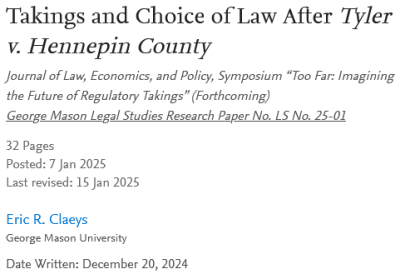
Screenshot 2025-01-23 at 15-10-58 Takings and Choice of Law After i Tyler v. Hennepin County _i by Eric R. Claeys SSRN

Check out this article, forthcoming in the George Mason Journal of Law, Economics, and Policy from lawprof Eric Claeys, “Takings and Choice of Law After Tyler v. Hennepin County.”

This is one of the pieces coming out of the recent symposium “Imaging the Future of Regulatory Takings” at George Mason Law School.

Here’s the Abstract:

This Essay contributes to a symposium on the future of regulatory takings. It focuses on choice of law in eminent domain disputes. When claimants bring eminent domain claims in federal courts, the courts must determine whether the claimants have constitutional “private property” in the entitlements allegedly taken. Should that determination be made with federal law, with the law of the state allegedly taking property, or law from some other source?

The 2023 Supreme Court decision Tyler v. Hennepin County addressed that issue. Under Tyler, it is a federal question whether an eminent domain claimant has constitutional private property. To answer the question, federal courts usually consult the law of the state where the alleged taking took place. But that presumption applies only if state law seems to secure and not to circumvent the federal right. And if that reservation is not satisfied, federal courts may consult a wider pattern of legal sources—Anglo-American history, the general law of the several United States, federal court precedents, and a broader cross-section of law from the state allegedly taking property. That approach resembles the approach taken generally for federal constitutional rights—especially in Indiana ex rel. Anderson v. Brand (1938)—but varies from the general approach in the sources it makes relevant to settle what counts as private property under the Fifth Amendment. This Essay interprets Tyler, and it offers a normative justification for Tyler’s approach to choice of law in eminent domain. 

Don’t miss this one.Continue Reading New Article (Eric Claeys): “Takings and Choice of Law After Tyler v. Hennepin County”

20180720_150853_HDR
The only courthouse we know where the Supreme Court
is
below the Court of Appeals (SJC on the second floor,
appellate court on the third)

A brief one from the Supreme Judicial Court of Massachusetts.

In Attorney General v. Town of Milton, No. SJC-13580 (Jan. 8, 2025), the court rejected a challenge to

The facts in D.A. Realestate Inv., LLC v. City of Norfolk, No. 23-1863 (Jan. 16, 2025), a recent decision from the U.S. Court of Appeals for the Fourth Circuit, are fairly sympathetic. And the opinion starts off with a tantalizing quote:

In 1761, Massachusetts lawyer James Otis exclaimed “one of the most essential branches

Two — count ’em two! — cert petitions from our shop, filed today. Both call for “clarifying or overruling” Penn Central.

Oh, have I got your attention now?