Floods and Flooding

Floodsfiresarticle

Here’s what we’re reading today (inter alia): Walter W. Heiser, Floods, Fires, and Inverse Condemnation, 29 N.Y.U. Envtl. L. J. 1 (2021).

From the Introduction:

This Article examines the proper application of the doctrine of inverse condemnation in two important areas: flood damage to private property caused by a public improvement (e.g., a
20160126_164144

Here’s one we’ve been waiting to drop. In San Jacinto River Authority v. Medina, Nos. 19-0400, 19-0402 (Apr. 16, 2021), the Texas Supreme Court held that “statutory takings” under the Texas Government Code include both physical invasion takings as well as regulatory takings.

This case stems from flooding allegedly caused in part by the

Goofus-gallant

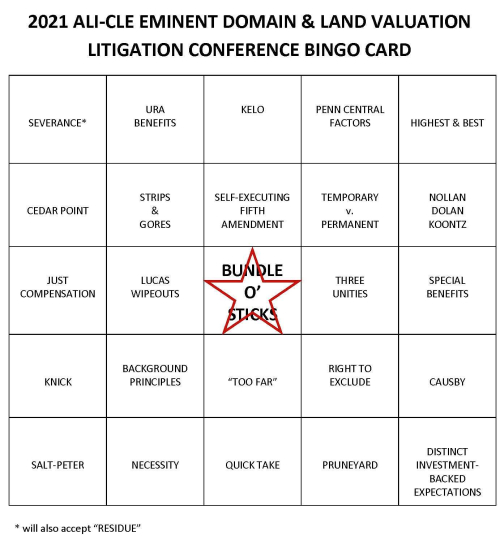
Yes, it starts tomorrow, Thursday, January 28, 2021, but we’re “remote” this year, so it is not too late to register to join us for the 38th Annual ALI-CLE Eminent Domain & Land Valuation Litigation Conference. This is the “big one” where the nation’s best practitioners, scholars, jurists, and other industry professionals gather to talk

ALI-CLE 2021 Bingo card

If you “get” this, you should be registered for the 38th Annual Eminent Domain & Land Valuation Litigation Conference, to be held remotely on Thursday and Friday, January 28-29, 2021.

The list is growing rapidly, and you need to join us!

This is the “big one” where the nation’s best practitioners, scholars, jurists,

1o 11 ALI-CLE

Are you a law student interested in takings, eminent domain, land use, environmental, and other dirt-lawyering related topics? If so, good news: thanks to the generosity of ALI-CLE, you can register gratis (free!) for the upcoming 38th Annual Eminent Domain & Land Valuation Litigation Conference, to be held remotely on Thursday and Friday,

One does not walk to ALI-CLE 2021

1o 11 ALI-CLE

No mr bond 2021

Often, the dispositive question in many takings cases tuns on whether the plaintiff owns “property,” and if so, what rights does that recognize. If you define the property in such a way that ipse dixit excludes the “stick” the owner claims was taken, then the answer is always going to be no property, no taking.

We listened live last week, but the court has now made the recording available in Johnson v. City of Suffolk.

This is what we call the “oyster takings” case in which Nansemond River oystermen claim that their property was taken when the City of Suffolk and the Sanitation District dumped sewage into the

Property owners sued the State of Ohio Department of Transportation’s Director (in his official capacity) in federal court after ODOT’s highway project resulted in flooding of their land. They raised two claims: the first, a taking under the Fifth (and Fourteenth) Amendments, and the second a claim under 42 U.S.C. § 1983. The relief sought:

It’s been a long week, and it’s Friday with a filing coming up. So we’re not going to spend a lot of time digesting the Federal Circuit’s opinion in Alford v. United States, No 19-1678 (June 19, 2020). Plus, it is a short one (11 pages) that makes one major point.

Short story: after