Due process

Screenshot 2021-08-08 at 23-55-14 The Dawn of a Judicial Takings Doctrine em Stop the Beach Renourishment  Inc v Florida De[...]

Here’s what we’re reading today, a recently-published law review article by Brendan Mackesey, The Dawn of a Judicial Takings Doctrine: Stop the Beach Renourishment, Inc. v. Florida Department of Environmental Protection, 75 U. Miami L. Rev. 798 (2021). 

Here’s the Abstract:

In Stop the Beach Renourishment v. Florida Department of Environmental Protection, 130

There’s not a whole lot in the U.S. Supreme Court’s order granting an injunction on appeal that suspends application of a part of New York State’s eviction moratorium until such time as a cert petition is filed. The claims in that case are due process claims regarding the deprivation of a hearing, not takings. 

But

According to that trustworthy source Wikipedia, in drama, the term deus ex machina (“God from the machine”) “is a plot device whereby a seemingly unsolvable problem in a story is suddenly and abruptly resolved by an unexpected and unlikely occurrence. Its function is generally to resolve an otherwise irresolvable plot situation, to surprise the

All the topics you want to know about, presented by top-notch faculty from across the nation. Sessions include:

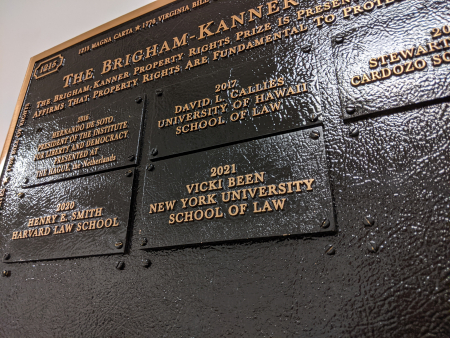
  • Property Rights as Civil Rights
  • Eminent Domain National Update
  • Just Relocation: Understanding the Law and Regulations to Ensure Fairness
  • Challenging Public Use: Lessons From a 67-Day Trial
  • COVID Takings
  • Federal Court and the Daubert Challenge: How to


Talk amongst yourselves.

We’ve had our say, so in this post — the sixth and final post in a series of deeper dives about June’s U.S. Supreme Court opinion in Cedar Point Nursery v. Hassid , No. 20-107 (June 23, 2021) — we’re linking to what others are saying about the case.

Here are all

In this post — the fifth and penultimate post in a series of deeper dives that we’re posting about June’s U.S. Supreme Court opinion in Cedar Point Nursery v. Hassid, No. 20-107 (June 23, 2021) — we’ll be trying to take some educated guesses about what the decision means for the future.

Here are

Our thanks to our friends and colleagues at the ABA Section of Real Property, Probate & Trust Section’s Land Use and Environmental Group for inviting us to a discussion of the latest and greatest decisions of interest.

We only had an hour together, so naturally could not cover everything of interest (indeed, we reserved a

For your Monday reading, Amnon Lehavi, Temporary Eminent Domain, 69 Buff. L. Rev. 683 (2021). From the Abstract:

Times of emergency call for drastic measures. These steps may include the physical takeover of privately-owned assets by the government for a certain period of time and for various purposes, aimed at addressing the state of emergency. When will such acts amount to a taking, and what compensation should be paid to the property owner? How do temporary physical appropriations during times of emergency diverge, if at all, from temporary takeovers in more ordinary times?

The doctrinal and theoretical analysis of potential temporary takings has been done mostly in the context of non-physical government intervention with private property, such as when a local government imposes a temporary moratorium on land development until a certain condition is met. This Article focuses, however, on less investigated scenarios of temporary physical takeovers or other forms of government invasions. It seeks to identify the differences between a temporary invasion and a permanent occupation of property considered a per se taking under the Loretto rule. In so doing, this Article argues that while the alleged distinction between prevention of public harm and promotion of public benefit often proves untenable in evaluating whether a permanent government measure constitutes a taking, it might make more sense in exploring temporary acts.

Temporary eminent domain—referring here to various types of acts amounting to time-limited physical takings, even if not initially recognized as such by the government—may diverge from permanent eminent domain in yet another key element: identifying the basis for just compensation. Under long established (although often criticized) rules, compensation for a permanent taking is based on identifying the “fair market value” of the rights taken, while ignoring the effects that the public use for which the underlying asset is taken might have on the property’s long-term value.

The allegedly parallel metric used in the case of temporary takings,one of “fair rental value,” may often prove inadequate, both practically and normatively. This Article argues that because of unique aspects of temporary physical takings, legal rules on compensation should often seek to identify lost profits or actual damage. Moreover, in some cases, in which there is a direct relation between the pre-appropriation use of the asset and its post-appropriation use by the government, just compensation might also be based on a certain portion of the value of the public use. This is especially so when the time-sensitive value of the asset during such public use is particularly high. On this point, the Article offers an analogy to rules pertaining to compulsory licenses for patents.

Check it out.
Continue Reading New L. Rev. Article: “Temporary Eminent Domain”

Here’s the latest in a case we’ve been following.

In Jim Olive Photography v. Univ. of Houston, No. 19-0605 (June 18, 2021), the Texas Supreme Court affirmed the court of appeals, concluding that a public university’s unauthorized use of a photograph on its website was merely copyright infringement, and not a taking. 

In Protect and Preserve Kahoma Ahupuaa Ass’n v. Maui Planning Comm’n, No. SCWC-15-0000478 (June 16, 2021), the Hawaii Supreme Court reaffirmed the idea that all members of the public have a right under the Hawaii Constitution to a “clean and healthful environment,” and that this is a “property” right entitled to due process protection