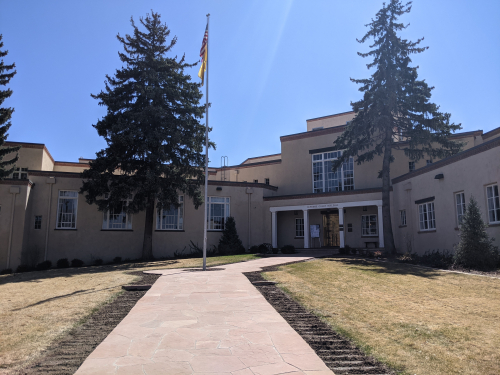
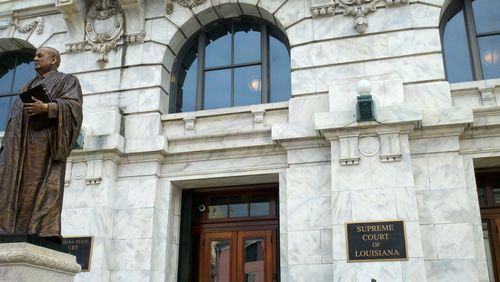
In what amounts to an advisory opinion, in State of New Mexico v. Wilson, No. S-1-SC-3850 (June 7, 2021), the New Mexico Supreme Court (courthouse pictured above) concluded that the State’s public health orders that impose “restrictions on business operations regarding occupancy limits and closures cannot support a claim
Due process
New Law Review Article (Ours) – “Evaluating Emergency Takings: Flattening the Economic Curve,” 29 Wm. & Mary Bill of Rights J. 1145 (2021)

Wondering about so-called “covid takings” such as business lockdowns, seizures, commandeerings, eviction moratoria, and whether these might be takings?
If so, check out our latest article, Evaluating Emergency Takings: Flattening the Economic Curve, just published in the latest issue of the William and Mary Bill of Rights Journal.
Here’s the Intro to the article:
Desperate times may breed desperate measures, but when do desperate measures undertaken as a response to an emergency trigger the Fifth Amendment’s requirement that the government provide just compensation when it takes private property for public use? The answer to that question has commonly been posed as a choice between the “police power”—a sovereign government’s power to regulate property’s use in order to further the public health, safety, and welfare —and the eminent domain power, the authority to seize private property for public use with the corresponding requirement to pay compensation. But that should not be the question. After all, emergencies do not increase government power, nor do they necessarily alter constitutional rights, and an invocation of police power by itself does not solve the compensation question, but is merely the predicate issue: all government actions must be for the public health, safety, or welfare, in the same way that an exercise of eminent domain power must be for a public use.
This Article provides a roadmap for analyzing these questions, hoping that it will result in a more consistent approach for resolving claims for compensation that arise out of claims of emergencies. This Article analyzes the potential takings claims stemming from emergency measures, mostly under current takings doctrine. Which types of claims are likely to succeed or fail? In “normal” times, it is very difficult to win a regulatory takings claim for compensation. In the midst of emergencies—real or perceived—the courts are even more reluctant to provide a remedy, even when they should, and emergencies are a good time to make bad law, especially in takings law. Can a better case be made analytically for compensation?
Part I summarizes the economic “flattening the curve” principle that motivates takings claims for compensation. Part II sets out the prevailing three-factor Penn Central standard for how courts evaluate claims that a health, safety, or welfare measure “goes too far” and requires compensation as a taking, examining the character of the government action, the impact of the action on the owner, and the extent of the owner’s property rights. Deep criticism of the Penn Central standard is beyond the scope of this Article, and here, I accept it as the default takings test. But I argue that the government’s motivation and reason for its actions—generally reviewed under the “rational basis” standard—should not be a major question in takings claims. Rather, as this Article argues in Part III, the government’s emergency justifications should be considered as part of a necessity defense, not subject to the low bar of rational basis, but a more fact and evidence driven standard of “actual necessity.” Part IV attempts to apply these standards and examines the various ways that emergency actions can take property for public use: commandeerings, occupations of property, and restrictions on use. I do not conclude that the approach will result in more (or less) successful claims for compensation, merely a more straightforward method of evaluating emergency takings claims than the current disjointed analytical methods.
In sum, this article argues there is no blanket immunity from the requirement to provide just compensation when property is taken simply because the government claims to be acting in response to an emergency, even though its actions and reasons may satisfy the rational basis test. Instead, claims that the taking is not compensable because of the exigency of an emergency should only win the day if the government successfully shows that the measure was actually needed to avoid imminent danger posed by the property owner’s use and that the restriction on use was narrowly tailored to further that end.
One final word: the editors at the Bill of Rights Journal have been fantastic to work with to get this piece publication ready. Offering helpful comments, gently suggesting that certain parts are not working (but never insisting, and giving the author a lot of discretion), and getting the citations squared away: I could not have asked for more helpful editing. Congratulations on the publication of your latest issue.
Louisiana SCT: No Statutory Attorneys’ Fees For Pipeline Taking – But LA Constitution’s Just Comp Clause Requires Owners Recover “The Full Extent” Of Their Loss (Which Includes Fees)
A private pipeline did what pipelines often do: it started negotiating with property owners for the property needed, but at the same time pressed forward. It reached agreement with some owners, others not. It filed “expropriation” lawsuits (for it is in Louisiana that our scene lies). It started to build, even before judgments of expropriation.…
Fla App Doubles Down On That Weird Property Isn’t “Property” Thing
We’re hoping that someone can explain the Florida District Court of Appeal’s recent opinion in Bondar v. Town of Jupiter Inlet Colony, No. 4D19-2118 (May 5, 2021) in a way that makes sense other than the old apocryphal tale of “I don’t know why we do things this way, except that we’ve always done…
Must Read: “Necessity Exceptions to Takings” (Shelley Ross Saxer)
Takings! Armstrong! Emergencies! Mahon! Jacobson!
Add lawprof Shelley Ross Saxer’s latest article (forthcoming in the University of Hawaii Law Review), “Necessity Exceptions to Takings” to your reading list.
Rather than summarize it for you, we’ll just post the abstract:
The doctrine of necessity has strong roots in…
Hoist the Yellow Flag and Spam® Up: The Separation of Powers Limitation on Hawaii’s Emergency Authority, 43 U. Haw. L. Rev. 71 (2020)
Not our usual takings fare, but our readers are pretty forgiving about our occasional sidebars. And this one is otherwise relevant if you are wondering how governors and other executive state and municipal officials have the power to do things in events deemed to be emergencies.
So here’s the final, as-published version of the law…
CA8: You Can’t Fool Us, Property Owner, We Know That Nollan/Dollan/Koontz Claim Isn’t A Due Process Or Unconstitutional Conditions Claim, But Really A Takings Claim
Dig this: property owners assert that the County’s right of way dedication ordinance is an unlawful exaction. You know the drill – logical nexus, rough proportionality, etc. Nollan, Dolan, Koontz. Here’s the short story: the owners sought subdivision plat approval without the dedication for public roads required by the ordinance. No deal. The County’s process…
New Cert Petition: Judge Barrett’s (Sole) CA7 Takings Opinion Is Wrong
You remember that Seventh Circuit case challenging (as, inter alia, a no-public-use taking) the location of the Obama Center in Chicago’s Jackson Park under the public trust (from the home of the American public trust doctrine, Chicago)? We wrote about it in “Friends Without Benefits: CA7 Rejects Takings Claim For Obama Center …
West Virginia: Thirty-Year-Old Quick-Take Wasn’t That Quick
Check out the unusual facts in the West Virginia Supreme Court of Appeals’ opinion in Scherich v. Wheeling Creed Watershed Protection and Flood Prevention Comm’n, No. 19-1065 (Mar. 15, 2021).
This started back in 1990, when the Commission instituted a condemnation action to take two parcels belonging to the Scheriches for a dam, as…
Complaint Alleged That Chicago Pol Zoned The Chicago Way – But Still No Taking Because Family Owners Only Lost $1 Million
Read the allegations in the complaint that the Illinois Appellate Court recounted in Strauss v. City of Chicago, No. 1-19-1977 (Mar. 5, 2021), and they will make your hair curl in horror.
In short: a family rented the ground floor of its mixed residential-commercial building in Chicago to Double Door Liquors (a live music…