
Here’s the latest takings cert petition, in a case involving a California county’s refusal to rezone property back to its former zoning to allow residential development. The only uses permitted on the property presently are “scientific research facilities uses” and hiking trails. Or, at the petition puts it, “only public, park-like uses.” Pet. at
New Cert Petition: Does A Taking For Public Use Become A Problem If The Govt Later Abandons That Use?
Here’s the latest in a case we’ve been following, which has now results in a cert petition from Michael Berger. This one involves some very intriguing questions about what limits the Constitution places on the government acquiring property for a public use (in this case, an “airport purpose”) but then later deciding it
By The Thinnest Of Margins, SCOTUS Declines Public Use Pretext “Spite Taking” Case
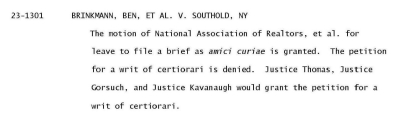
So close: if just one more Justice had agreed, the U.S. Supreme Court would have taken up a public use case we’ve been following, Brinkmann v. Town of Southhold. After all, this one had a lot of the usual markers: a divided court below, an allegation of a lower court split, beaucoup amicus support
Ohio: Settlement Means You’re Done
Here’s the latest in our series of cases which in effect say “when you settle, you’re done.”
In State ex rel. Gideon v. Page, No. 2024-0573 (Oct. 10, 2024), the Ohio Supreme Court made short work of an argument that the trial judge in an eminent domain case lacked jurisdiction to enforce a settlement
New Just Comp Cert Petition: Is $0 Just Compensation Constitutional?
Here’s a recently-filed cert petition which raises two questions about the constitutional calculation of just compensation.
Here are the Questions Presented:
A county unquestionably used real property that denied access to private property and allowed the private property owner to restore the denied access at the owner’s own expense, without county reimburse- ment. Although at
Comity Of Errors: CA11 Chooses Nondisruption Of State’s Administrative Process Over Constitutional Right To Compensation
In Turner v. Jordan, No. 22-13159 (Sep. 17, 2024), the U.S. Court of Appeals for the Eleventh Circuit held that even though the federal courts have jurisdiction over Turner’s takings claim, the court nonetheless has the discretion to choose to wash its hands of the case in order to protect a state’s administrative procedures.
New Cert Petition: When State Law Bars Owner From Challenging A Taking, Can Federal Court Abstain?
Here’s the latest takings cert petition. This one seeks review of the Seventh Circuit’s affirming the district court’s sua sponte abstaining from considering a property owner’s challenge to a Wisconsin municipality’s exercise of eminent domain.
The court concluded that federal courts could — but shouldn’t — consider the owner’s public use challenge
New Cert Petition: Can An Owner Whose Property Has Been Taken Sue A State Directly Under The Fifth Amendment?
Check this out, a recently-filed cert petition asking whether, in order to sue for compensation for a taking, the government must first affirmatively provide a cause of action (an issue recently left unanswered by the U.S. Supreme Court). That’s an issue we’ve been following closely (our outfit recently filed this cert petition also).
This
New Cert Petition: After Permit Denial, To Ripen A Takings Claim Do You Have To Keep On Trying?
Check this out, the latest takings cert petition from the Pacific Legal Foundation shop.
Since this is one of ours (our colleague Chris Kieser is in the lead), we’re not going into too much detail, but will say that this involves ripeness in a regulatory takings claims, a topic we’ve been focused on a
New Cert Petition: Does The Obligation To Provide Just Compensation Waive Sovereign Immunity?
Because the latest takings cert petition is one of ours (our colleagues Dave Breemer and Deb La Fetra are counsel for the petitioner), we won’t be commenting all that much on it.
Except to say that this is the latest in a series of cases where the obligation to provide just compensation for takings butts