
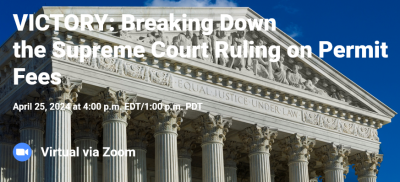
Be sure to join our Pacific Legal Foundation colleagues Brian Hodges and Larry Salzman, and Paul Beard (arguing counsel) and Chance Weldon (Texas Public Policy Foundation) tomorrow, Thursday, April 25, 2024, at 4pm ET for a free webinar on Sheetz v. El Dorado County, the Supreme Court’s recent decision holding that all permit conditions
Sheetz pt. II: The Concurrences – Does Nollan/Dolan Operate Differently When Exaction Affects A Class?

Note: this is the second of our posts on the recent Supreme Court opinions in Sheetz v. County of El Dorado, the case in which the unanimous Court held that exactions imposed by legislation are not exempt from the essential nexus (Nollan) and rough proportionality (Dolan) standards. Here’s our first post
Sheetz pt. I – “Radical Agreement” At SCOTUS: “Your Money Or Your Rights” Isn’t OK Just Because A Legislature Does It

Guess where we stopped for coffee this morning?
(A reminder: this case has nothing to do
with the convenience store.)
Note: this is the first of two posts on the recent Supreme Court opinions in Sheetz v. County of El Dorado, the case in which the unanimous Court held that exactions imposed by
Sheetz Round-Up
Here’s what folks are saying about yesterday’s unanimous U.S. Supreme Court decision in Sheetz v. County of El Dorado, where the Court held that impact fees and exactions imposed by legislative action are not categorically immune from the close nexus and rough proportionality requirements already applicable to ad hoc/administratively-imposed exactions under Nollan, Dolan, and
Unanimous SCOTUS Delivers A YIMBY Blow: “The Takings Clause does not distinguish between legislative and administrative permit conditions.”
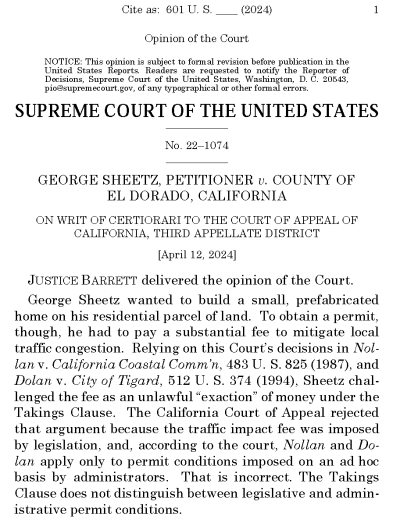
This just in: the U.S. Supreme Court has issued a unanimous opinion in Sheetz v. County of El Dorado, a case we’ve been following (not only because it is one of ours).
The Court, as predicted, held that an exaction (in this case a traffic impact fee) isn’t immune from the Nollan/Dolan nexus
Thursday Round Up: Pretextual Takings, Squatting, Unconstitutional Conditions
Here’s what we’re reading today:
- Michael Berger, “Is a taking based on pretext constitutional?,” Daily Journal (a take on the Second Circuit’s recent decision holding that a property owner could not assert a pretext claim where the allegedly pretextual use did not confer a private benefit.
- Christian Britschgi, “Are ‘Squatters’ Rights’ Out
We’ve Been Pronouncing “Nollan” Wrong All These Years?
The Chief Justice calling the case for oral arguments.
Who knew?
(And in case you are wondering, yes — we’re joking.)
New Article: “Fines, Forfeitures, and Federalism” (Jessica Asbridge)

When it comes to property rights, we’re most often focused on takings, compensation, and due process. But as you all know, the concept of property rights encompasses a whole lot more.
Our colleague, lawprof Jessica Asbridge, has posted on SSRN an article that is forthcoming in the Virginia Law Review, “Fines, Forfeitures, and Federalism,” in which she delves into the question of how the Excessive Fines Clause applies to state and local forfeitures and fines. To resolve the federalism concerns she identifies, the article argues that courts “should look to the exactions doctrine under the Takings Clause.”
Count us as intrigued.
Here’s the Abstract:
Fines are ubiquitous in modern society, and they are imposed for both serious crimes and minor civil wrongs. The U.S. Supreme Court recently recognized that the Constitution’s Excessive Fines Clause applies to the states, but that decision raises previously unexplored questions as to how to enforce the Clause’s protections in the states. A key question is what role, if any, federalism should play in crafting doctrinal rules that apply the Clause’s protections to state and local fines and related property forfeitures. This Article is the first to accord in-depth treatment to that important question.
The extent to which federalism principles should apply does not have an immediate and obvious answer. On the one hand, federalism plays a significant role in the Court’s jurisprudence on the Cruel and Unusual Punishment Clause. The Court therefore generally takes a highly deferential approach in reviewing sentences of imprisonment. Lower courts have applied that same deferential review in the context of the Excessive Fines Clause. On the other hand, fines and forfeitures are unlike other forms of punishment—such as prison—because they are often used as a revenue source for state and local governments, creating a conflict of interest for state and local decision-making bodies.
To address this conundrum, this Article makes the novel argument that the Court should look to the exactions doctrine under the Takings Clause, which often implicates similar concerns of government self-interest and overreaching. Exactions and excessive fines are conceptually similar, but scholars thus far have overlooked the close relationship between them. The exactions doctrine gives minimal weight to federalism concerns, and it applies a heightened-scrutiny standard that is well suited to the excessive fines context. Indeed, differences between federal practice and state and local practices as to fines suggest that discretionary state and local fines should be subject to closer constitutional scrutiny than federal fines. As a recent example illustrates, such heightened scrutiny would ensure that the Excessive Fines Clause is not merely a parchment barrier, while still accounting for variations between states and localities in terms of their communities’ values and needs.
Check it out. Download your copy on SSRN here.
Continue Reading New Article: “Fines, Forfeitures, and Federalism” (Jessica Asbridge)
Too Soon For CA5 To Figure Out Whether City Demolishing Property For Code Violations Is A Taking
In Rhone v. City of Texas City, No. 22-40551 (Feb. 14, 2024), the U.S. Court of Appeals for the Fifth Circuit held that a municipality’s conclusion that Rhone’s apartment building had not been properly maintained, and a subsequent municipal court demolition order, might be a taking … or it might not be.
We won’t
Pass A Good Time: Our Report From The 41st ALI-CLE Eminent Domain & Land Valuation Litigation Conference, Feb 1-3, 2024, New Orleans

When it comes to the longstanding ALI-CLE American Law Institute-CLE Eminent Domain and Land Valuation Litigation Conferences, we’re always ready to go. You know that. But this year’s version — the 41st — was buzzing like no other in recent memory.
Maybe it was the New Orleans venue with its atmo, food, and music for